
dstl

TERMINAL

TERMINAL

LIBRARY

LIBRARY

//

Why Science Can't Be Reduced to a Process — and What That Means for AI

Why Science Can't Be Reduced to a Process — and What That Means for AI

Why Science Can't Be Reduced to a Process — and What That Means for AI

Dwarkesh Patel

Dwarkesh Patel

2:02:58

2:02:58

38K Views

38K Views

THESIS

The verification loops that would confirm correct scientific theories are so long and hostile that AI cannot close them through gradient descent alone.

The verification loops that would confirm correct scientific theories are so long and hostile that AI cannot close them through gradient descent alone.

The verification loops that would confirm correct scientific theories are so long and hostile that AI cannot close them through gradient descent alone.

ASSET CLASS

ASSET CLASS

SECULAR

SECULAR

CONVICTION

CONVICTION

HIGH

HIGH

TIME HORIZON

TIME HORIZON

10 to 30 years

10 to 30 years

01

01

//

PREMISE

PREMISE

Scientific progress systematically outruns experimental verification, and the heuristics that bridge the gap are non-formalizable

Scientific progress systematically outruns experimental verification, and the heuristics that bridge the gap are non-formalizable

The history of science reveals a persistent structural gap between when the correct theory is adopted by the scientific community and when it is experimentally validated. Heliocentrism was accepted centuries before stellar parallax was measured in 1838. Special relativity was preferred over Lorentz's ether interpretation decades before muon decay experiments in 1940 could distinguish them. Prout's hypothesis about whole-number atomic weights faced 85 years of actively hostile verification data before isotopes were discovered. In each case, the community navigated between competing theories using aesthetic judgments, parsimony biases, and integrative reasoning that cannot be reduced to a verification loop. Furthermore, at any given experimental juncture, an infinite number of theories remain compatible with the data, and there is no ex ante heuristic that reliably distinguishes which anomalies signal a fundamental paradigm shift versus a mundane measurement artifact — as illustrated by Uranus (correctly predicting Neptune) versus Mercury (incorrectly predicting Vulcan, when the real answer was general relativity) versus the Pioneer spacecraft anomaly (ultimately explained by asymmetric thermal radiation).

The history of science reveals a persistent structural gap between when the correct theory is adopted by the scientific community and when it is experimentally validated. Heliocentrism was accepted centuries before stellar parallax was measured in 1838. Special relativity was preferred over Lorentz's ether interpretation decades before muon decay experiments in 1940 could distinguish them. Prout's hypothesis about whole-number atomic weights faced 85 years of actively hostile verification data before isotopes were discovered. In each case, the community navigated between competing theories using aesthetic judgments, parsimony biases, and integrative reasoning that cannot be reduced to a verification loop. Furthermore, at any given experimental juncture, an infinite number of theories remain compatible with the data, and there is no ex ante heuristic that reliably distinguishes which anomalies signal a fundamental paradigm shift versus a mundane measurement artifact — as illustrated by Uranus (correctly predicting Neptune) versus Mercury (incorrectly predicting Vulcan, when the real answer was general relativity) versus the Pioneer spacecraft anomaly (ultimately explained by asymmetric thermal radiation).

02

02

//

MECHANISM

MECHANISM

AI science is bottlenecked not on computation but on the non-algorithmic judgment required to navigate theory selection under radical underdetermination

AI science is bottlenecked not on computation but on the non-algorithmic judgment required to navigate theory selection under radical underdetermination

The prevailing thesis that AI will disproportionately accelerate science rests on the analogy to coding, where tight verification loops (unit tests, compilation) enable rapid iteration. But scientific discovery has a fundamentally different structure. The bottleneck keeps moving: once AI removes one constraint (e.g., protein structure prediction via AlphaFold, which is principally a data acquisition story built on billions of dollars of experimental X-ray diffraction and cryo-EM work), the binding constraint shifts to having interesting ideas, recognizing which anomalies matter, and knowing when to abandon versus defend a research program. These are precisely the capabilities that resist formalization. Nielsen argues that wherever previous heuristics and processes are sufficient, smart humans already apply them — so by definition, the remaining bottlenecks are where existing methods fail. Moreover, the tech tree of science is vastly wider than appreciated, path-dependent, and contingent on historically specific conditions (deep time geology enabling Darwin, personal computers and ion traps coincidentally maturing around 1980 enabling quantum computing). Different civilizations might explore entirely different branches, meaning there is no single convergent 'science' to automate toward.

The prevailing thesis that AI will disproportionately accelerate science rests on the analogy to coding, where tight verification loops (unit tests, compilation) enable rapid iteration. But scientific discovery has a fundamentally different structure. The bottleneck keeps moving: once AI removes one constraint (e.g., protein structure prediction via AlphaFold, which is principally a data acquisition story built on billions of dollars of experimental X-ray diffraction and cryo-EM work), the binding constraint shifts to having interesting ideas, recognizing which anomalies matter, and knowing when to abandon versus defend a research program. These are precisely the capabilities that resist formalization. Nielsen argues that wherever previous heuristics and processes are sufficient, smart humans already apply them — so by definition, the remaining bottlenecks are where existing methods fail. Moreover, the tech tree of science is vastly wider than appreciated, path-dependent, and contingent on historically specific conditions (deep time geology enabling Darwin, personal computers and ion traps coincidentally maturing around 1980 enabling quantum computing). Different civilizations might explore entirely different branches, meaning there is no single convergent 'science' to automate toward.

03

03

//

OUTCOME

OUTCOME

AI will accelerate well-defined domains with existing data but will not produce the paradigm shifts that constitute transformative scientific progress

AI will accelerate well-defined domains with existing data but will not produce the paradigm shifts that constitute transformative scientific progress

The expected outcome is a bifurcated landscape. In domains where massive experimental datasets already exist and the problem is essentially sophisticated curve-fitting — protein folding, materials property prediction, drug candidate screening — AI will continue to deliver impressive results analogous to AlphaFold. But for the class of scientific advances that matter most — the ones that restructure our understanding of reality, like special relativity, quantum mechanics, or evolution — AI systems relying on gradient descent and verification loops will systematically fail. These breakthroughs require the ability to abandon productive research programs, to recognize that an anomaly invalidates not just a parameter but an entire framework, and to synthesize across disparate domains in ways that are definitionally not captured by existing loss functions. The bottleneck on transformative science will persist until either AI systems develop genuine capacity for non-algorithmic judgment, or until some external change (analogous to the institutional innovations that enabled the Scientific Revolution) restructures the conditions under which discovery happens. The practical implication is that expectations of AI-driven scientific acceleration should be sharply downgraded for fundamental science while remaining high for applied, data-rich domains.

The expected outcome is a bifurcated landscape. In domains where massive experimental datasets already exist and the problem is essentially sophisticated curve-fitting — protein folding, materials property prediction, drug candidate screening — AI will continue to deliver impressive results analogous to AlphaFold. But for the class of scientific advances that matter most — the ones that restructure our understanding of reality, like special relativity, quantum mechanics, or evolution — AI systems relying on gradient descent and verification loops will systematically fail. These breakthroughs require the ability to abandon productive research programs, to recognize that an anomaly invalidates not just a parameter but an entire framework, and to synthesize across disparate domains in ways that are definitionally not captured by existing loss functions. The bottleneck on transformative science will persist until either AI systems develop genuine capacity for non-algorithmic judgment, or until some external change (analogous to the institutional innovations that enabled the Scientific Revolution) restructures the conditions under which discovery happens. The practical implication is that expectations of AI-driven scientific acceleration should be sharply downgraded for fundamental science while remaining high for applied, data-rich domains.

//

NECESSARY CONDITION

Regulatory frameworks must remain permissive to innovation (avoiding the 'European' model) and open source development must remain unencumbered by downstream liability.

If you're attempting to reduce science to a process, you're attempting to reduce it to something where there is just a method which you can apply, and you turn the crank and out pops insight. You can do a certain amount of that, but you're going to get bottlenecked at the places where your existing method doesn't apply. Definitionally, there's no crank you can turn.

If you're attempting to reduce science to a process, you're attempting to reduce it to something where there is just a method which you can apply, and you turn the crank and out pops insight. You can do a certain amount of that, but you're going to get bottlenecked at the places where your existing method doesn't apply. Definitionally, there's no crank you can turn.

20:45

RISK

Steel Man Counter-Thesis

The strongest counter-thesis is not merely that AI will be slow at science, but that AI-optimized science will be actively worse than human science at the most consequential junctures. Human scientific progress has depended on what are, from an optimization standpoint, pathological features: individuals irrationally clinging to minority theories for decades (Prout's supporters, Michelson's ether believers), communities tolerating massive redundancy and disagreement, and young scientists making career choices based on aesthetic taste rather than expected-value calculations. These features look like bugs from an efficiency perspective but are actually the immune system that allows science to survive hostile verification loops and eventually undergo paradigm shifts. An AI system optimizing for experimental confirmation would have abandoned the correct atomic theory during the 85-year isotope confusion. An AI system optimizing for parsimony would have adopted Ptolemy over Copernicus, since Copernicus was initially less accurate and less parsimonious. An AI system trained on historical scientific taste would have replicated Poincaré's sophisticated-but-wrong dynamical interpretation rather than Einstein's radical kinematic insight, because Poincaré's approach was more consistent with accumulated expertise. The empirical record from Bloom et al. showing consistent diminishing returns to research effort — requiring exponentially more researchers for linear progress — is actually evidence that the easy-to-automate components of science (computation, data processing, literature review) are not where the binding constraint lies. The binding constraint is the generation of genuinely novel ontological categories, which by definition cannot be optimized for because they are not yet in the hypothesis space. AI acceleration of science would therefore produce a world with faster curve-fitting, faster incremental progress within existing paradigms, and dramatically slower paradigm shifts — because the diversity of thought that enables shifts would be replaced by convergent optimization. The net effect could be a civilization that is more productive at normal science but structurally incapable of revolutionary science, locked into local optima with unprecedented efficiency.

//

RISK 01

RISK 01

The Irreducibility of Scientific Paradigm Shifts to Any Encodable Process

The Irreducibility of Scientific Paradigm Shifts to Any Encodable Process

THESIS

The core thesis emerging from Module A is that scientific progress involves heuristics (parsimony, aesthetics, explanatory reach) that might be encodable into AI systems, even if tight verification loops cannot be closed. The strongest failure mode is Nielsen's own repeated insistence that progress is definitionally bottlenecked at the exact points where prior heuristics fail. Einstein's leap to special relativity was not an application of known heuristics — it was the invention of a new ontological category (kinematics replacing dynamics for length contraction). Poincaré had superior heuristics and superior mathematical skill and still failed. If the decisive moments in science are precisely those where no existing process, taste, or bias applies, then encoding historical scientific taste into AI systems would reproduce exactly the kind of thinking that gets stuck — sophisticated Lorentzian or Poincaréan reasoning that is almost right but categorically wrong. The bottleneck is not compute, data, or even intelligence in a general sense, but the capacity to abandon one's own best framework, which is anti-correlated with mastery of that framework.

The core thesis emerging from Module A is that scientific progress involves heuristics (parsimony, aesthetics, explanatory reach) that might be encodable into AI systems, even if tight verification loops cannot be closed. The strongest failure mode is Nielsen's own repeated insistence that progress is definitionally bottlenecked at the exact points where prior heuristics fail. Einstein's leap to special relativity was not an application of known heuristics — it was the invention of a new ontological category (kinematics replacing dynamics for length contraction). Poincaré had superior heuristics and superior mathematical skill and still failed. If the decisive moments in science are precisely those where no existing process, taste, or bias applies, then encoding historical scientific taste into AI systems would reproduce exactly the kind of thinking that gets stuck — sophisticated Lorentzian or Poincaréan reasoning that is almost right but categorically wrong. The bottleneck is not compute, data, or even intelligence in a general sense, but the capacity to abandon one's own best framework, which is anti-correlated with mastery of that framework.

DEFENSE

Nielsen explicitly addresses this by stating that the bottleneck always moves to where existing methods do not apply, and that definitionally there is no crank to turn at those junctures. He argues you need many independent research programs with different initial biases running simultaneously, not a single optimized process. However, his defense is incomplete — he acknowledges the problem but offers no mechanism by which AI systems would generate the requisite diversity of ontological commitments rather than converging on a single loss-minimized consensus. The defense identifies the need but does not solve it.

Nielsen explicitly addresses this by stating that the bottleneck always moves to where existing methods do not apply, and that definitionally there is no crank to turn at those junctures. He argues you need many independent research programs with different initial biases running simultaneously, not a single optimized process. However, his defense is incomplete — he acknowledges the problem but offers no mechanism by which AI systems would generate the requisite diversity of ontological commitments rather than converging on a single loss-minimized consensus. The defense identifies the need but does not solve it.

//

RISK 02

RISK 02

Hostile Verification Loops Actively Reward Incorrect Theories for Extended Periods

Hostile Verification Loops Actively Reward Incorrect Theories for Extended Periods

THESIS

The Prout hypothesis example (1815-1900) demonstrates that empirical evidence can be systematically hostile to the correct theory for 85 years. Chlorine's atomic weight of 35.46 actively moved measurements away from the correct whole-number hypothesis because isotopes could not be chemically distinguished. The Michelson-Morley case similarly shows experimental results that were compatible with multiple ether theories for decades. If AI systems are trained to close verification loops — running experiments and updating beliefs based on outcomes — they would have systematically abandoned the correct theory in both cases. Any RL-based scientific agent optimizing for experimental confirmation would be actively misled. This is not merely a case of insufficient data; the data itself points in the wrong direction given available conceptual frameworks. The failure mode is that tighter, faster verification loops could accelerate convergence to the wrong answer rather than the right one.

The Prout hypothesis example (1815-1900) demonstrates that empirical evidence can be systematically hostile to the correct theory for 85 years. Chlorine's atomic weight of 35.46 actively moved measurements away from the correct whole-number hypothesis because isotopes could not be chemically distinguished. The Michelson-Morley case similarly shows experimental results that were compatible with multiple ether theories for decades. If AI systems are trained to close verification loops — running experiments and updating beliefs based on outcomes — they would have systematically abandoned the correct theory in both cases. Any RL-based scientific agent optimizing for experimental confirmation would be actively misled. This is not merely a case of insufficient data; the data itself points in the wrong direction given available conceptual frameworks. The failure mode is that tighter, faster verification loops could accelerate convergence to the wrong answer rather than the right one.

DEFENSE

Nielsen raises the Prout and Michelson-Morley examples as illustrations of why falsification is naive, but neither he nor the interviewer addresses the implication for AI-driven science specifically: that an AI system optimizing for experimental fit would have been confidently wrong for decades in these cases. The discussion identifies that human scientific communities survived these hostile loops by maintaining minority research programs through social and institutional mechanisms (stubborn individuals, academic freedom, diverse funding), but there is no discussion of how AI research agents — which would presumably be optimized for efficiency and convergence — would replicate this crucial inefficiency. The very thing that makes AI attractive for science (speed, convergence, optimization) is precisely what would destroy the diversity needed to survive hostile verification periods.

Nielsen raises the Prout and Michelson-Morley examples as illustrations of why falsification is naive, but neither he nor the interviewer addresses the implication for AI-driven science specifically: that an AI system optimizing for experimental fit would have been confidently wrong for decades in these cases. The discussion identifies that human scientific communities survived these hostile loops by maintaining minority research programs through social and institutional mechanisms (stubborn individuals, academic freedom, diverse funding), but there is no discussion of how AI research agents — which would presumably be optimized for efficiency and convergence — would replicate this crucial inefficiency. The very thing that makes AI attractive for science (speed, convergence, optimization) is precisely what would destroy the diversity needed to survive hostile verification periods.

//

RISK 03

RISK 03

The AlphaFold Illusion — Confusing Curve-Fitting at Scale with Scientific Discovery

The AlphaFold Illusion — Confusing Curve-Fitting at Scale with Scientific Discovery

THESIS

Nielsen explicitly states that AlphaFold is principally a story of data acquisition — billions of dollars spent on X-ray diffraction, NMR, and cryo-EM to obtain 180,000 protein structures — with AI as a relatively small component that fitted a model at the end. If the signature example of AI accelerating science is actually an example of massive human experimental infrastructure with a machine learning capstone, then extrapolating from AlphaFold to AI-driven scientific revolution is a category error. AlphaFold does not generate novel explanatory principles; it interpolates within a dense experimental dataset. The risk is that the entire narrative of AI-for-science is built on a misattribution where the real bottleneck (experimental data acquisition at scale) is ignored while the relatively easy part (model fitting) is celebrated. Future scientific frontiers may not have anything resembling the Protein Data Bank — they may require entirely new experimental paradigms that no amount of compute can substitute for.

Nielsen explicitly states that AlphaFold is principally a story of data acquisition — billions of dollars spent on X-ray diffraction, NMR, and cryo-EM to obtain 180,000 protein structures — with AI as a relatively small component that fitted a model at the end. If the signature example of AI accelerating science is actually an example of massive human experimental infrastructure with a machine learning capstone, then extrapolating from AlphaFold to AI-driven scientific revolution is a category error. AlphaFold does not generate novel explanatory principles; it interpolates within a dense experimental dataset. The risk is that the entire narrative of AI-for-science is built on a misattribution where the real bottleneck (experimental data acquisition at scale) is ignored while the relatively easy part (model fitting) is celebrated. Future scientific frontiers may not have anything resembling the Protein Data Bank — they may require entirely new experimental paradigms that no amount of compute can substitute for.

DEFENSE

Nielsen himself provides this critique directly, noting that the AI component is impressive but is only a small fraction of the total investment story. The interviewer also pushes on AlphaFold's lack of explanatory reach compared to general relativity. Nielsen offers three possible framings — AlphaFold as not-an-explanation, as containing extractable explanations via interpretability, or as a new type of epistemic object — but does not resolve which is correct. The defense is honest about the limitation but does not counter the implication that AI-for-science may be systematically overhyped relative to the experimental infrastructure that actually enables it.

Nielsen himself provides this critique directly, noting that the AI component is impressive but is only a small fraction of the total investment story. The interviewer also pushes on AlphaFold's lack of explanatory reach compared to general relativity. Nielsen offers three possible framings — AlphaFold as not-an-explanation, as containing extractable explanations via interpretability, or as a new type of epistemic object — but does not resolve which is correct. The defense is honest about the limitation but does not counter the implication that AI-for-science may be systematically overhyped relative to the experimental infrastructure that actually enables it.

//

ASYMMETRIC SKEW

The downside is severe and structural: if AI-driven science converges too efficiently, it eliminates the intellectual diversity that enables paradigm shifts, potentially locking civilization into sophisticated but fundamentally wrong frameworks for extended periods — analogous to a hyper-optimized Ptolemaic astronomy that never transitions to Copernicus. The upside — that AI accelerates science broadly — appears most credible only in well-understood domains with dense experimental data (the AlphaFold case), which may represent a narrow and diminishing fraction of the scientific frontier. The asymmetry skews negative at the frontier: the more consequential the scientific question, the less likely AI optimization helps and the more likely it actively hinders progress by destroying the requisite diversity of approaches. The ratio is approximately bounded: substantial near-term upside in incremental/applied domains, but potentially catastrophic long-term downside in fundamental science where the most transformative discoveries historically required precisely the kind of irrational persistence and ontological creativity that optimization would eliminate.

ALPHA

NOISE

The Consensus

The market consensus in AI and science circles is that AI will dramatically accelerate scientific discovery by closing verification loops — that tight feedback cycles (like unit tests in coding or experimental validation in science) are the key bottleneck, and that AI's ability to rapidly iterate within these loops will produce compounding breakthroughs. The prevailing narrative holds that science is fundamentally a process that can be systematized and automated, that diminishing returns in research productivity are intrinsic and can be overcome primarily by throwing more compute and more AI agents at the problem, and that we are converging toward a unified understanding of the universe where the remaining work is largely incremental.

The market's causal logic runs: (1) Science progresses through hypothesis generation and experimental falsification. (2) AI can accelerate both — generating hypotheses faster and running experiments or simulations to test them. (3) Tight verification loops (like those in coding) are the template for how AI will accelerate science. (4) Diminishing returns in research are a resource allocation problem solvable by scaling compute and AI researchers. (5) AlphaFold-style successes demonstrate AI can already do frontier science. (6) The path to transformative scientific AI is largely an engineering problem of scaling and improving these verification loops.

SIGNAL

The Variant

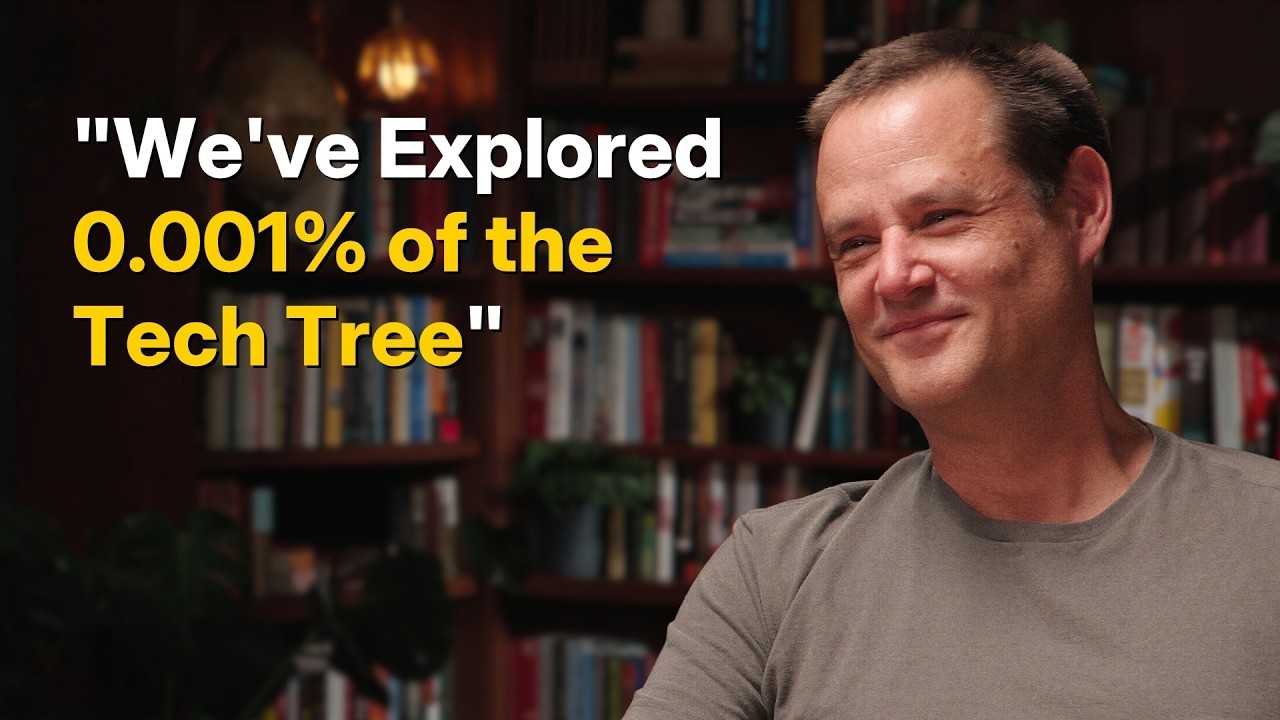
Nielsen believes the market dramatically underestimates the complexity of scientific progress. His core claim is that science cannot be reduced to a process or a crank you turn — the bottlenecks that matter most are precisely the ones where existing methods and heuristics break down, and by definition there is no systematic procedure for overcoming them. He argues that the tech tree of possible knowledge is vastly larger than assumed, that most of it will never be explored by any civilization, that different civilizations would develop fundamentally different science and technology stacks, and that the appearance of diminishing returns may be an artifact of static institutional conditions rather than an intrinsic feature of knowledge. He sees AI as helpful for certain bottleneck types (like protein structure prediction, which was fundamentally a data fitting problem atop billions of dollars of experimental data acquisition) but not as a universal solvent for the deepest forms of scientific progress, which require paradigm shifts that cannot be induced by gradient descent or verification loops.

Nielsen's causal logic diverges at nearly every node: (1) Falsification is far messier than commonly understood — the history of science (Michelson-Morley, Prout's hypothesis, the Pioneer anomaly, Mercury vs. Uranus) shows that experiments routinely produce results compatible with infinitely many theories, and the verification loop can be actively hostile to the correct theory for decades or even a century. (2) The key transitions in science (special relativity, evolution, quantum mechanics) were not produced by closing verification loops but by conceptual paradigm shifts that required abandoning deeply held priors — something gradient descent is structurally unsuited for, since it optimizes within a loss landscape rather than restructuring the landscape itself. (3) AlphaFold's success is fundamentally misattributed — it is primarily a story of billions of dollars of experimental data acquisition (the Protein Data Bank), with the AI model being a small fraction of the total investment, more akin to sophisticated curve fitting than genuine scientific discovery. (4) Diminishing returns may not be intrinsic but rather a consequence of static institutional and cognitive constraints — when those constraints change (new fields opening up, new instruments, new institutional forms), progress can suddenly accelerate again, suggesting the bottleneck is not compute but the generation of genuinely new conceptual frameworks. (5) The tech tree is so vast and path-dependent that different starting conditions lead to fundamentally different science, meaning there is no convergent 'science' that AI will inevitably crank through. (6) The bottleneck in science keeps moving to wherever existing methods fail — definitionally, there is no crank for the hardest problems, and the hardest problems are the ones that matter most.

SOURCE OF THE EDGE

Nielsen's claimed edge rests on deep historical knowledge of how scientific revolutions actually occurred (drawn from primary sources like Pais's Einstein biography, Lakatos's methodology, and his own experience as a pioneer in quantum computing) combined with firsthand experience as both a practitioner who identified and built a new field and as someone who has studied the epistemology of science professionally. This is a genuine structural informational advantage in one specific sense: most people opining about AI and science have never actually navigated the messy reality of scientific paradigm shifts, read the primary historical sources, or had to make the judgment call of which nascent field to invest their career in. Nielsen did all three. His account of Michelson-Morley, Poincaré's near-miss on special relativity, Prout's hypothesis, and the Pioneer anomaly are not narratives constructed to support a thesis — they are well-documented historical cases that genuinely complicate the naive verification-loop model. However, his edge has clear limits: his argument is fundamentally a negative claim (science cannot be reduced to a process, AI will not straightforwardly accelerate the deepest discoveries) rather than a positive prediction with a measurable timeline. Negative claims about what AI cannot do have a poor track record. His framework also lacks a mechanism for predicting when or how the next paradigm shift will occur, which limits its actionable value. The edge is real as a corrective to overconfident narratives about AI-driven scientific acceleration, but it does not itself constitute a tradeable thesis — it is more like a calibration adjustment on existing theses.

//

CONVICTION DETECTED

• Definitionally, there's no crank you can turn • AlphaFold really isn't about AI • The idea that we've discovered all the deep ideas in programming just seems obviously ludicrous • Most parts of the tech tree are never going to be explored • We're still at the point where we're just understanding these basic fundamental theories, and we haven't yet explored them • This looks to me like we're down at the bottom of the tech tree. We've barely gotten started there • We're basically slightly jumped-up chimpanzees • Where we always get bottlenecked is where the previous processes and heuristics don't apply. That's almost definitionally what causes the bottlenecks • A massive fraction of the success there is the Protein Data Bank • If you're attempting to reduce science to a process, you're attempting to reduce it to something where there is just a method which you can apply, and you turn the crank and out pops insight

//

HEDGE DETECTED

• I don't entirely know the answer • I don't know. All I have here is speculation and instinct • Obviously we can't prove this, but it certainly seems quite plausible • I'm not sure anybody understands very well the dynamics of that • This is just speculation, but it's certainly amusing • Does it turn out that it's very narrow? Maybe. Does it turn out that it's very broad? That's also a really radical expansion that seems distinctly possible • I'm overgeneralizing a bit, but I think it's right • Some historians of science would certainly disagree • I don't know to what extent that's been done with AlphaFold • I don't think there's any public confirmation of this • It's all speculation, obviously • Maybe there's something special about human beings, but maybe it's also a more general thing Nielsen displays an unusually well-calibrated ratio of conviction to hedging. He is maximally assertive on historical claims and structural arguments where he has direct expertise (the nature of scientific bottlenecks, the AlphaFold attribution, the impossibility of reducing science to process), and explicitly uncertain on forward-looking speculations (alien civilizations, quantum AGI, the far future of the tech tree). This pattern is characteristic of genuine epistemic confidence rather than performed certainty — he knows where his knowledge ends and flags it clearly. This calibration should increase the weight placed on his high-conviction claims, as they are not the product of someone who simply asserts everything with equal force. His hedging on speculative matters actually reinforces rather than undermines his credibility on the core thesis.