
dstl

TERMINAL

TERMINAL

LIBRARY

LIBRARY

//

VCX and the Democratization of Venture Capital: Building the Bridge Between Public and Private Markets

VCX and the Democratization of Venture Capital: Building the Bridge Between Public and Private Markets

VCX and the Democratization of Venture Capital: Building the Bridge Between Public and Private Markets

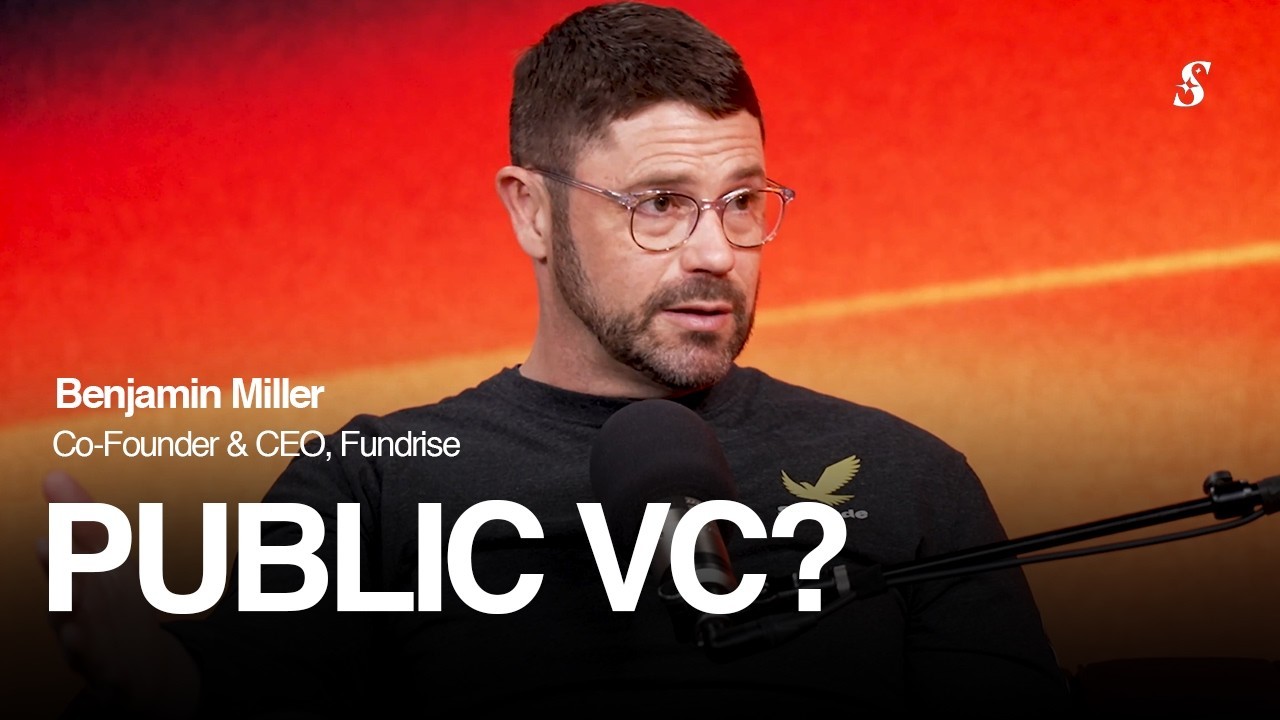
Sourcery with Molly O'Shea

Sourcery with Molly O'Shea

1:06:12

1:06:12

135 Views

135 Views

THESIS

Fundrise's VCX fund listed at $700M and traded to $6.5B in three days, signaling that publicly traded venture capital may become a standard asset class for retail investors.

Fundrise's VCX fund listed at $700M and traded to $6.5B in three days, signaling that publicly traded venture capital may become a standard asset class for retail investors.

Fundrise's VCX fund listed at $700M and traded to $6.5B in three days, signaling that publicly traded venture capital may become a standard asset class for retail investors.

ASSET CLASS

ASSET CLASS

SECULAR

SECULAR

CONVICTION

CONVICTION

HIGH

HIGH

TIME HORIZON

TIME HORIZON

5 to 10 years

5 to 10 years

01

01

//

PREMISE

PREMISE

The high-growth phase of technology companies has migrated entirely to private markets, locking out retail investors from the most valuable period of wealth creation

The high-growth phase of technology companies has migrated entirely to private markets, locking out retail investors from the most valuable period of wealth creation

Companies now take 10 to 15 years before going public, if they ever do, because the private markets offer sufficient capital without the burden, volatility, and complexity of public listing. The weighted average revenue growth rate of public tech companies (QQQ) was 25% last year, while VCX's private portfolio grew at 193%. This means the highest-growth, highest-return phase of company building — the phase that historically created generational wealth for public market investors — now occurs entirely behind closed doors, accessible only to institutional LPs paying 2-and-20 fee structures. The traditional venture lifecycle of fund, grow, IPO, and exit has structurally broken down. Simultaneously, AI is accelerating the concentration of value creation in a small number of private companies (OpenAI's $110 billion round represented roughly a third of all private tech funding in 2025), making the access gap not just a financial inequality but a potential societal crisis around ownership of the means of AI production.

Companies now take 10 to 15 years before going public, if they ever do, because the private markets offer sufficient capital without the burden, volatility, and complexity of public listing. The weighted average revenue growth rate of public tech companies (QQQ) was 25% last year, while VCX's private portfolio grew at 193%. This means the highest-growth, highest-return phase of company building — the phase that historically created generational wealth for public market investors — now occurs entirely behind closed doors, accessible only to institutional LPs paying 2-and-20 fee structures. The traditional venture lifecycle of fund, grow, IPO, and exit has structurally broken down. Simultaneously, AI is accelerating the concentration of value creation in a small number of private companies (OpenAI's $110 billion round represented roughly a third of all private tech funding in 2025), making the access gap not just a financial inequality but a potential societal crisis around ownership of the means of AI production.

02

02

//

MECHANISM

MECHANISM

A publicly traded closed-end venture fund structure creates a low-cost liquid wrapper around illiquid private assets, enabling retail capital to flow into private tech without exposing portfolio companies to public market volatility

A publicly traded closed-end venture fund structure creates a low-cost liquid wrapper around illiquid private assets, enabling retail capital to flow into private tech without exposing portfolio companies to public market volatility

The mechanism works through a specific structural innovation: Fundrise raises capital from its two-million-customer retail base into a non-traded closed-end fund, deploys into top-tier private companies (Anthropic, Databricks, OpenAI, SpaceX, Ramp), marks holdings at last private round valuations, and then lists the fund itself on public markets. Unlike an ETF, which creates and redeems shares in underlying assets, the closed-end structure means public trading occurs at the fund level — investors buy and sell the fund, not the underlying private companies. This insulates portfolio companies from public market volatility while giving them access to a new democratized capital source. The fund charges no carried interest, which is dramatically cheaper than the traditional 2-and-20 venture structure, creating a structural cost advantage that Miller argues justifies the premium over NAV. When trading at a premium, the fund can raise additional capital and deploy into private rounds; when trading at a discount, the portfolio companies are unaffected. The initial allocation was obtained opportunistically during the 2022-2023 venture downturn when distressed funds were selling their best assets, and Fundrise's two-million-customer network provides tangible distribution value to portfolio companies (e.g., being Ramp's most successful partnership ever), creating a virtuous cycle of access and credibility as the fund scales from $5 million checks toward $50-100 million checks.

The mechanism works through a specific structural innovation: Fundrise raises capital from its two-million-customer retail base into a non-traded closed-end fund, deploys into top-tier private companies (Anthropic, Databricks, OpenAI, SpaceX, Ramp), marks holdings at last private round valuations, and then lists the fund itself on public markets. Unlike an ETF, which creates and redeems shares in underlying assets, the closed-end structure means public trading occurs at the fund level — investors buy and sell the fund, not the underlying private companies. This insulates portfolio companies from public market volatility while giving them access to a new democratized capital source. The fund charges no carried interest, which is dramatically cheaper than the traditional 2-and-20 venture structure, creating a structural cost advantage that Miller argues justifies the premium over NAV. When trading at a premium, the fund can raise additional capital and deploy into private rounds; when trading at a discount, the portfolio companies are unaffected. The initial allocation was obtained opportunistically during the 2022-2023 venture downturn when distressed funds were selling their best assets, and Fundrise's two-million-customer network provides tangible distribution value to portfolio companies (e.g., being Ramp's most successful partnership ever), creating a virtuous cycle of access and credibility as the fund scales from $5 million checks toward $50-100 million checks.

03

03

//

OUTCOME

OUTCOME

Public venture capital becomes a normalized asset class with every American holding approximately 5% of their portfolio in PVC within a decade, creating a multi-hundred-billion-dollar category

Public venture capital becomes a normalized asset class with every American holding approximately 5% of their portfolio in PVC within a decade, creating a multi-hundred-billion-dollar category

Miller projects that publicly traded venture capital funds will become as standard as ETFs, with millions of retail investors routinely allocating to private tech companies through liquid public wrappers. The immediate validation is VCX trading at 9.5x its IPO NAV within three days, demonstrating overwhelming retail demand for private market exposure. The broader outcome is a structural bridge between the trillions in public markets (which are 99% secondary trading) and the trillions in private markets (which are primarily funding real company-building). As competitors like Robinhood and Destiny normalize the category, portfolio companies begin endorsing the model — Miller notes a defense tech company shifting from very skeptical to very open-minded over 24 months. The ultimate vision is that major AI labs allocate a portion of their funding rounds specifically for democratized retail ownership, turning 'universal basic ownership' into the societal solution for AI-driven economic disruption rather than universal basic income. This creates a permanent new capital channel where public market retail investors fund private company growth, and private companies gain a broad ownership base without the operational burden of a traditional IPO.

Miller projects that publicly traded venture capital funds will become as standard as ETFs, with millions of retail investors routinely allocating to private tech companies through liquid public wrappers. The immediate validation is VCX trading at 9.5x its IPO NAV within three days, demonstrating overwhelming retail demand for private market exposure. The broader outcome is a structural bridge between the trillions in public markets (which are 99% secondary trading) and the trillions in private markets (which are primarily funding real company-building). As competitors like Robinhood and Destiny normalize the category, portfolio companies begin endorsing the model — Miller notes a defense tech company shifting from very skeptical to very open-minded over 24 months. The ultimate vision is that major AI labs allocate a portion of their funding rounds specifically for democratized retail ownership, turning 'universal basic ownership' into the societal solution for AI-driven economic disruption rather than universal basic income. This creates a permanent new capital channel where public market retail investors fund private company growth, and private companies gain a broad ownership base without the operational burden of a traditional IPO.

//

NECESSARY CONDITION

Regulatory frameworks must remain permissive to innovation (avoiding the 'European' model) and open source development must remain unencumbered by downstream liability.

10 years from now, every single person in America will have 5% of their portfolio in public venture capital. It'll be totally normal. It'll be like an ETF. It'll be just this thing that's standard.

10 years from now, every single person in America will have 5% of their portfolio in public venture capital. It'll be totally normal. It'll be like an ETF. It'll be just this thing that's standard.

16:45

RISK

Steel Man Counter-Thesis

VCX is not a democratization of venture capital — it is the financialization of AI hype into a retail-facing closed-end fund trading at a historically anomalous premium that is structurally unsustainable and likely to harm the very investors it claims to serve. The counter-thesis rests on three independent pillars: (1) Historical precedent is unambiguous: closed-end funds trading at extreme premiums revert to discounts. The speaker acknowledges this himself. There is no creation/redemption mechanism to enforce NAV discipline, and the 100,000-investor base — many investing small amounts based on brand recognition of Anthropic and OpenAI — constitutes exactly the kind of momentum-driven retail flow that historically buys tops and sells bottoms. The 9x premium embeds years of optimistic assumptions about AI lab valuations that may never materialize. (2) The portfolio's outperformance is almost entirely attributable to a one-time factor: distressed entry during the 2022-2023 venture downturn into what became the most hyped technology cycle in decades. This is not replicable. Future capital deployed at current peak valuations — the speaker explicitly wants to write $50-200M checks — will generate structurally lower returns, diluting fund-level performance. The 193% growth rate is a rearview-mirror statistic from an unrepeatable vintage. (3) The 'democratization' framing creates a moral hazard: by positioning the fund as a social good (universal basic ownership, solving AI inequality), the speaker inoculates the vehicle against standard financial scrutiny. But the economic reality is that retail investors are paying a 9x premium for illiquid venture exposure marked at last-round valuations, with no structural downside protection, in a sector (AI) that has historically produced winner-take-all outcomes where most companies fail. The comparison to ETFs is misleading — ETFs have arbitrage mechanisms that enforce fair pricing; closed-end funds do not. The closest historical analogue is not the democratization of index investing but rather the late-1990s closed-end tech funds that traded at massive premiums before reverting to deep discounts, leaving retail investors with permanent capital impairment. The speaker's own admission that 'all you have to do is do a bad job and the whole thing goes down in flames' is the most honest assessment in the entire conversation.

//

RISK 01

RISK 01

Structural Fragility of Closed-End Premium: Reflexivity Trap and NAV Disconnection

Structural Fragility of Closed-End Premium: Reflexivity Trap and NAV Disconnection

THESIS

VCX trades at approximately 9.3x its NAV ($6.5B market cap vs ~$700M NAV) just three days after listing. This premium is entirely sentiment-driven and reflexive — it exists because retail investors are chasing access to marquee AI names (Anthropic, OpenAI, Databricks) in a moment of peak AI enthusiasm. The problem is that this premium creates a dangerous disconnect: new investors buying at $6.5B are paying roughly 9x the marked value of the underlying portfolio. If sentiment shifts — due to an AI winter, a macro shock, or simply the novelty wearing off — the premium compresses or inverts to a discount, which is the historical norm for 99% of closed-end funds as the speaker himself acknowledges. Unlike an ETF with a creation/redemption mechanism that arbitrages away NAV deviations, a closed-end fund has no such floor. The very retail investor base (100,000 unsophisticated investors, many investing $10-$10,000) that makes this vehicle novel also makes it maximally vulnerable to panic selling in a downturn. The speaker's own analogy of cyclicality confirms this is not a question of if but when. Investors who buy at a 9x premium and experience a reversion to NAV or below would suffer catastrophic losses — far worse than the underlying portfolio performance would warrant.

VCX trades at approximately 9.3x its NAV ($6.5B market cap vs ~$700M NAV) just three days after listing. This premium is entirely sentiment-driven and reflexive — it exists because retail investors are chasing access to marquee AI names (Anthropic, OpenAI, Databricks) in a moment of peak AI enthusiasm. The problem is that this premium creates a dangerous disconnect: new investors buying at $6.5B are paying roughly 9x the marked value of the underlying portfolio. If sentiment shifts — due to an AI winter, a macro shock, or simply the novelty wearing off — the premium compresses or inverts to a discount, which is the historical norm for 99% of closed-end funds as the speaker himself acknowledges. Unlike an ETF with a creation/redemption mechanism that arbitrages away NAV deviations, a closed-end fund has no such floor. The very retail investor base (100,000 unsophisticated investors, many investing $10-$10,000) that makes this vehicle novel also makes it maximally vulnerable to panic selling in a downturn. The speaker's own analogy of cyclicality confirms this is not a question of if but when. Investors who buy at a 9x premium and experience a reversion to NAV or below would suffer catastrophic losses — far worse than the underlying portfolio performance would warrant.

DEFENSE

The speaker explicitly acknowledges that closed-end funds are cyclical, that premiums will likely compress, and that historical precedent shows 99% of closed-end funds trade at discounts. He frames the premium period as an opportunity to raise and deploy capital, and the discount period as 'not the company's problem' since the fund acts as an insulator for portfolio companies. However, this defense completely sidesteps the harm to the retail investors who are the core constituency — investors buying at a 9x premium during euphoria have no structural protection against massive losses when the cycle turns. The defense protects portfolio companies, not the democratized investors the thesis claims to serve.

The speaker explicitly acknowledges that closed-end funds are cyclical, that premiums will likely compress, and that historical precedent shows 99% of closed-end funds trade at discounts. He frames the premium period as an opportunity to raise and deploy capital, and the discount period as 'not the company's problem' since the fund acts as an insulator for portfolio companies. However, this defense completely sidesteps the harm to the retail investors who are the core constituency — investors buying at a 9x premium during euphoria have no structural protection against massive losses when the cycle turns. The defense protects portfolio companies, not the democratized investors the thesis claims to serve.

//

RISK 02

RISK 02

Concentration Risk and Vintage Dependency in an AI-Monoculture Portfolio

Concentration Risk and Vintage Dependency in an AI-Monoculture Portfolio

THESIS

The portfolio is overwhelmingly concentrated in a single technological thesis (AI/ML infrastructure) and a single vintage (2022-2023 distressed entry). Anthropic alone is 20% of the fund, and the top three holdings (Anthropic, Databricks, OpenAI) constitute approximately 47% of total NAV. The 193% weighted average growth rate cited is largely a function of AI-specific valuation re-ratings from the 2022-2023 trough, not diversified organic growth. This creates multiple correlated failure modes: (1) If AI lab economics prove unsustainable — e.g., if inference costs don't decline fast enough, if open-source models commoditize frontier capabilities, or if enterprise AI adoption disappoints — all three top holdings reprice simultaneously. (2) The portfolio has no meaningful hedge against AI-skeptic scenarios. (3) The 193% growth rate is backward-looking and reflects a one-time regime change from distressed-to-euphoric sentiment, not a repeatable return profile. New capital deployed at current elevated private valuations will almost certainly generate far lower returns than the initial distressed vintage, creating a structural dilution problem for existing investors as the fund scales.

The portfolio is overwhelmingly concentrated in a single technological thesis (AI/ML infrastructure) and a single vintage (2022-2023 distressed entry). Anthropic alone is 20% of the fund, and the top three holdings (Anthropic, Databricks, OpenAI) constitute approximately 47% of total NAV. The 193% weighted average growth rate cited is largely a function of AI-specific valuation re-ratings from the 2022-2023 trough, not diversified organic growth. This creates multiple correlated failure modes: (1) If AI lab economics prove unsustainable — e.g., if inference costs don't decline fast enough, if open-source models commoditize frontier capabilities, or if enterprise AI adoption disappoints — all three top holdings reprice simultaneously. (2) The portfolio has no meaningful hedge against AI-skeptic scenarios. (3) The 193% growth rate is backward-looking and reflects a one-time regime change from distressed-to-euphoric sentiment, not a repeatable return profile. New capital deployed at current elevated private valuations will almost certainly generate far lower returns than the initial distressed vintage, creating a structural dilution problem for existing investors as the fund scales.

DEFENSE

The speaker never addresses concentration risk or the possibility that AI-specific valuations could correct across the entire portfolio simultaneously. He acknowledges the portfolio 'maybe they're riskier' but frames the 193% growth as a structural feature of private markets versus public markets, rather than as a vintage-specific and sector-specific anomaly. The due diligence framework described — 'we use the product at Fundrise' — is explicitly narrow (he admits he couldn't evaluate Replit or Deel because Fundrise doesn't use them), which means the portfolio is selected through an extremely constrained lens that naturally clusters around AI/SaaS tools. There is no discussion of portfolio construction discipline, position sizing limits, or what happens when new deployments at current valuations (writing $50-200M checks at peak) compress fund-level returns.

The speaker never addresses concentration risk or the possibility that AI-specific valuations could correct across the entire portfolio simultaneously. He acknowledges the portfolio 'maybe they're riskier' but frames the 193% growth as a structural feature of private markets versus public markets, rather than as a vintage-specific and sector-specific anomaly. The due diligence framework described — 'we use the product at Fundrise' — is explicitly narrow (he admits he couldn't evaluate Replit or Deel because Fundrise doesn't use them), which means the portfolio is selected through an extremely constrained lens that naturally clusters around AI/SaaS tools. There is no discussion of portfolio construction discipline, position sizing limits, or what happens when new deployments at current valuations (writing $50-200M checks at peak) compress fund-level returns.

//

RISK 03

RISK 03

Misalignment Between Democratization Narrative and Retail Investor Outcomes

Misalignment Between Democratization Narrative and Retail Investor Outcomes

THESIS

The entire thesis rests on a populist narrative — 'universal basic ownership,' democratizing access, serving the 'little guy' — but the fund's actual structure may systematically disadvantage the retail investors it claims to serve. First, the 100,000 retail investors lack the sophistication to evaluate whether paying a 9x NAV premium is rational; many are making investment decisions based on brand recognition of portfolio companies (Anthropic, SpaceX, OpenAI) rather than fundamental analysis. Second, the speaker's planned expansion — VCX 2, writing $50-200M checks, scaling to millions of investors — is a classic asset-gathering model where management fees scale with AUM regardless of investor returns. Third, the 'no carried interest' pitch obscures the fact that investors are paying a massive implicit cost through the premium-to-NAV. Fourth, when the speaker describes the cycle turning and the fund trading at a discount as 'not the company's problem,' he reveals that the structure protects Fundrise and portfolio companies while leaving retail investors as the residual risk-bearers. This is structurally identical to the pre-2008 dynamic the speaker claims motivated him to build Fundrise in the first place — financial intermediaries extracting value while retail bears the losses.

The entire thesis rests on a populist narrative — 'universal basic ownership,' democratizing access, serving the 'little guy' — but the fund's actual structure may systematically disadvantage the retail investors it claims to serve. First, the 100,000 retail investors lack the sophistication to evaluate whether paying a 9x NAV premium is rational; many are making investment decisions based on brand recognition of portfolio companies (Anthropic, SpaceX, OpenAI) rather than fundamental analysis. Second, the speaker's planned expansion — VCX 2, writing $50-200M checks, scaling to millions of investors — is a classic asset-gathering model where management fees scale with AUM regardless of investor returns. Third, the 'no carried interest' pitch obscures the fact that investors are paying a massive implicit cost through the premium-to-NAV. Fourth, when the speaker describes the cycle turning and the fund trading at a discount as 'not the company's problem,' he reveals that the structure protects Fundrise and portfolio companies while leaving retail investors as the residual risk-bearers. This is structurally identical to the pre-2008 dynamic the speaker claims motivated him to build Fundrise in the first place — financial intermediaries extracting value while retail bears the losses.

DEFENSE

This is the deepest blind spot in the thesis. The speaker's founding story — being told 'why would you bother with a little guy' — positions him as a champion of retail investors. But nowhere in the conversation does he grapple with the possibility that retail investors buying at a massive premium are being harmed by the very access he's providing. He celebrates early investors making 9x returns without acknowledging that those gains come from later investors paying inflated prices. He describes death threats and blood-signed subscription agreements as evidence of the challenges of democratization, but doesn't connect this to a fiduciary question about whether unsophisticated investors should be buying a closed-end venture fund at 9x NAV. The narrative of democratization becomes self-justifying: any criticism of the structure is deflected as elitism or skepticism about the 'little guy.'

This is the deepest blind spot in the thesis. The speaker's founding story — being told 'why would you bother with a little guy' — positions him as a champion of retail investors. But nowhere in the conversation does he grapple with the possibility that retail investors buying at a massive premium are being harmed by the very access he's providing. He celebrates early investors making 9x returns without acknowledging that those gains come from later investors paying inflated prices. He describes death threats and blood-signed subscription agreements as evidence of the challenges of democratization, but doesn't connect this to a fiduciary question about whether unsophisticated investors should be buying a closed-end venture fund at 9x NAV. The narrative of democratization becomes self-justifying: any criticism of the structure is deflected as elitism or skepticism about the 'little guy.'

//

ASYMMETRIC SKEW

The downside-upside asymmetry is heavily skewed against new investors entering at current levels. Upside: If the premium holds and the underlying portfolio continues to appreciate at rates remotely close to historical performance, investors could see further gains — but the premium already prices in extraordinary expectations. Downside: A reversion from 9x NAV premium to par (1x NAV) represents an ~89% loss even if the underlying portfolio holds its value. A reversion to a typical closed-end fund discount of 10-15% below NAV represents a ~90%+ loss. Even a modest premium compression to 2-3x NAV — which would still be historically unusual — represents a 67-78% loss. The asymmetry is approximately 3:1 to 5:1 skewed to the downside for investors entering at the current premium, because the premium itself has consumed most of the available upside while the full NAV-reversion downside remains intact.

ALPHA

NOISE

The Consensus

The market consensus holds that private venture capital is a specialized, access-gated asset class best managed by elite firms (A16Z, Sequoia, General Catalyst) who possess unique sourcing and selection abilities. The prevailing view is that closed-end funds trade at discounts, that the IPO window remains viable for high-growth companies, that SaaS companies retain durable premium valuations, and that the current AI boom may be overheated or bubble-like. Consensus also assumes that venture capital's traditional cycle — fund, grow, IPO, exit — will eventually normalize, and that Middle Eastern LP capital will continue flowing into venture regardless of geopolitical disruption.

The market's logic chain: (1) Top-tier VC firms have proprietary deal flow, pattern recognition, and network effects that justify their 2-and-20 fee structures; (2) closed-end funds historically trade at discounts because of illiquidity and information asymmetry; (3) the IPO cycle will normalize once macro conditions stabilize; (4) SaaS recurring revenue models deserve premium multiples due to predictability; (5) AI investment enthusiasm may be a bubble similar to prior tech cycles; (6) retail investors lack the sophistication for venture-stage investing; (7) Middle Eastern sovereign wealth will increase allocation to venture as a hedge against domestic disruption.

SIGNAL

The Variant

Miller believes the entire venture capital industry structure is being permanently reorganized. His core variant view is that the traditional VC-to-IPO pipeline is broken and will not return to its prior form — companies will stay private for 10-15 years and the high-growth phase that used to occur in public markets is now captured entirely in private markets. He argues that publicly traded venture capital funds (PVCs) will become a standard allocation (5% of every American portfolio) within a decade, that closed-end venture funds can and will trade at sustained premiums (contra 99% of historical precedent), that venture investing requires no special genius (the builder captures 99-100% of the value), and that democratized ownership of AI companies is not merely a financial product innovation but an existential societal necessity to prevent concentrated AI ownership from destabilizing democracy. He also believes a near-term economic shock from the Iran conflict will reduce Middle Eastern LP capital flows (contra Mark Suster's view), trigger a reckoning for zombie unicorns, and that 20-30% of white-collar jobs will be displaced or suppressed within five years.

Miller's causal logic diverges at several critical nodes: (1) Venture 'genius' is a narrative construction — the builder creates 99-100% of value, so access and cost matter far more than investor brand, which means a low-fee, democratized structure can outcompete elite funds on net returns; (2) Closed-end venture funds trade at premiums (not discounts) when they offer cheaper access to otherwise inaccessible high-growth assets — the premium reflects genuine arbitrage against 2-and-20 private market pricing plus illiquidity discount elimination; (3) The IPO window is functionally closed not because of cyclical timing but because being public is structurally inferior for high-growth tech companies — public market volatility, short-term sentiment swings, and regulatory burden make private markets permanently preferable, meaning the old pipeline is broken by design not by cycle; (4) SaaS was mispriced as 'bond-like high-growth low-risk' and the overnight repricing to 'high-risk low-growth' demonstrates exactly why companies avoid public markets; (5) His cross-asset experience (real estate, credit, public, private) gives him pattern recognition that pure venture specialists lack — specifically the forced-selling dynamics of distressed cycles where best assets are dumped first; (6) The 2022-2023 vintage was a generational buying opportunity precisely because consensus was maximally negative, venture funds were panic-selling, and Fundrise could be a 'good long-term partner' rather than a vulture, earning them allocation that wouldn't be available in normal markets; (7) Middle Eastern LPs will pull back during the Iran conflict to address domestic priorities, triggering a capital vacuum that could force the zombie unicorn reckoning that has been extend-and-pretended since 2022.

SOURCE OF THE EDGE

Miller claims multiple sources of edge, and they deserve differentiated assessment. His strongest and most credible edge is operational and structural: Fundrise has 2 million customers who serve as both a distribution network and a product diligence engine. The fact that Fundrise uses Ramp, Intercom, and Anthropic internally before investing — and that this usage-based diligence led to what he claims was Ramp's most successful partnership ever — is a genuine structural advantage that traditional venture funds cannot replicate. This is real proprietary signal: a 2-million-person consumer base that can be enriched with demographic data and activated for portfolio company growth is not something a listener can go replicate. His second claimed edge — buying distressed venture assets in 2022-2023 when sentiment was maximally negative — is credible but somewhat retrospective and narrative-laden. Many investors claim contrarian timing in hindsight. However, the specific mechanism he describes (LP dropouts creating allocation gaps, forced selling from distressed funds) is well-documented and his cross-asset pattern recognition from real estate cycles adds plausibility. His weakest claimed edge is the thesis that closed-end venture funds will permanently trade at premiums. Trading at 9.5x NAV three days after listing is not validation of a structural premium — it is likely a combination of retail euphoria, scarcity premium, and momentum trading. The historical base rate (99% of closed-end funds trade at discounts) exists for deep structural reasons, and three days of trading data tells you almost nothing about long-term equilibrium pricing. Miller himself acknowledges cyclicality will bring discount periods. The 'democratized ownership as existential AI solution' framing is primarily narrative construction — it is a compelling philosophical pitch for why the product should exist, but it is not an investment edge. Overall assessment: Miller has one genuinely strong structural edge (the customer network as both distribution and diligence), one credible but common edge (contrarian timing in distressed markets), and is over-claiming on the premium-persistence thesis where the evidence is far too thin to support the conviction level displayed.

//

CONVICTION DETECTED

• 99% is the business builder, maybe 100% • it must be a good idea (when the board/consensus says it's bad) • when we get conviction, it's like it's magic • I think democratized ownership is the solution to how we deal with AI • universal basic income I think that's a horrible idea but universal basic ownership I feel like that is magic • 10 years from now, every single person in America will have 5% of their portfolio in public venture capital. It'll be totally normal. • I just think that like this is the solution • I thought it would trade at a premium • every single expert told me that I was wrong and so far it's been it mostly they've been admitting that they were not right • the old playbook is falling apart... it may not ever go back to normal • just better in the private markets • this is going to be the most successful drug in history • we need to democratize ownership • I think democratic ownership is critical to successful AI implementation • if you want something done, you get like the maniacs who know how to do things • Whatever is the most painful thing that's the answer

//

HEDGE DETECTED

• there's a lot of luck to it and a lot of timing • we were just lucky when we launched VCX • So we were lucky and we had conviction • I'm not going to be surprised that at some point the cycle turns negative • it's anyone's guess, but it probably affects everything • I don't know (regarding VCX 2) • I'm not inside Destiny • I don't want to say which company • I can't say which company it was • it's contingent on politics • it's hard for me to imagine that like the political system will rally together to solve a crisis now, but maybe they'll rise to the occasion • I think more than 20% but less than 50 • nothing's inevitable • All you have to do is do a bad job and the whole thing goes down in flames • these crossover ideas they could fail because it's a bubble and you invest poorly The ratio reveals a speaker who hedges on timing, macro outcomes, and external variables he cannot control, but displays near-absolute conviction on his structural thesis (democratized ownership, the broken IPO pipeline, PVC as inevitable category). This is a credible pattern: it suggests genuine conviction on the core thesis rather than performed certainty, because a speaker performing certainty would not repeatedly acknowledge luck, cyclicality risk, and execution risk. However, the hedging on macro timing combined with absolute conviction on structural inevitability creates a potential blind spot — he may be right about the direction but catastrophically early or wrong about the vehicle's resilience through the very shocks he predicts are coming. Weight the structural thesis moderately — the conviction is genuine but the three-day track record cannot support the level of certainty expressed about premium persistence and category creation.