
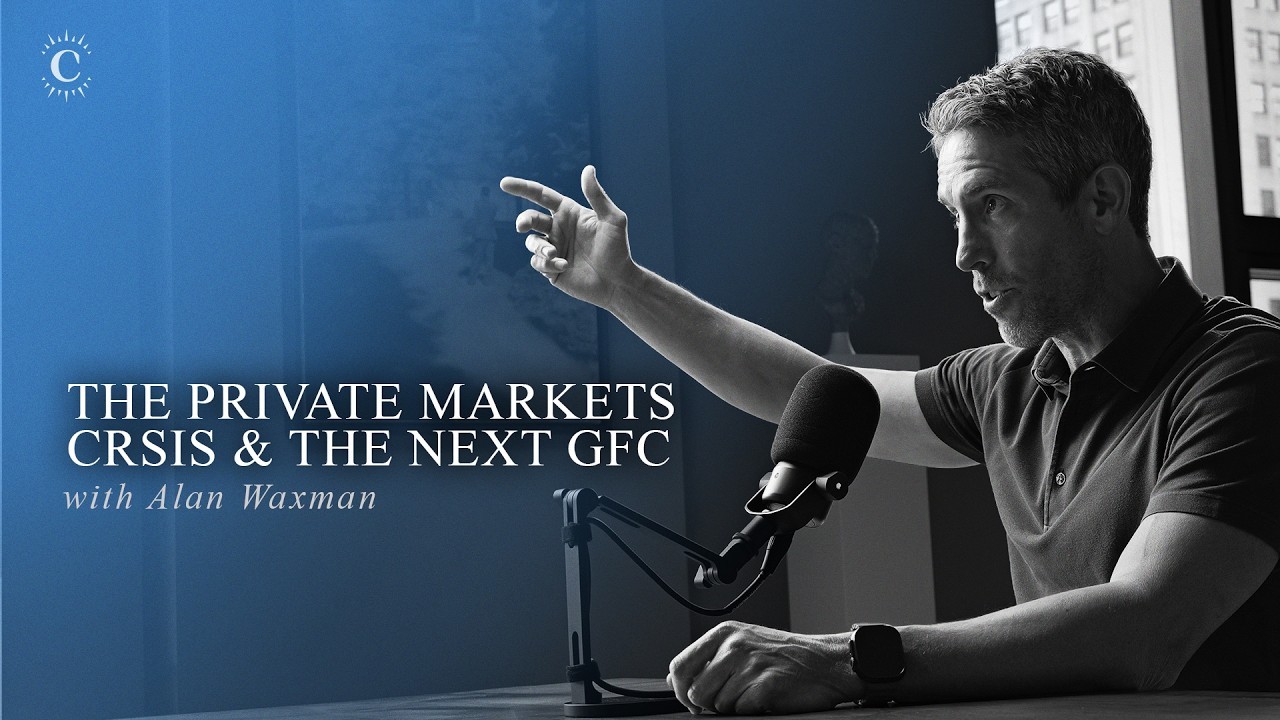
THESIS
//
//
//
//
NECESSARY CONDITION
Regulatory frameworks must remain permissive to innovation (avoiding the 'European' model) and open source development must remain unencumbered by downstream liability.
28:45
RISK
Steel Man Counter-Thesis
Waxman's thesis is that System 3 — the post-GFC architecture of constrained commercial banks plus matched-liability private capital — represents the optimal financial system, temporarily disrupted by factory model behavioral excesses that will self-correct through market discipline and recalibration. The strongest counter-thesis is that the factory model is not a behavioral aberration but a structural inevitability produced by System 3's own design. When Basel III and Dodd-Frank constrained bank balance sheets, they created a permanent capital vacuum that could only be filled by private capital at scale. But private capital at scale requires industrial fundraising — the very factory model Waxman critiques — because the institutional LP base is finite and increasingly concentrated, fee compression pressures margins, and public market multiples reward AUM growth over return quality. The FRE multiple expansion from 10-15x to 25-30x is not a distortion; it is the market correctly pricing the recurring revenue durability of scaled asset gathering, which is structurally more predictable than performance-dependent carry. This means the factory model is the rational economic response to the incentive structure System 3 created. Furthermore, the wealth channel's growth from 2% to 10%+ allocation to alternatives is not optional — it is demographically and structurally necessary because defined benefit pensions are shrinking, defined contribution plans need return enhancement, and the wealth channel represents the only capital pool large enough to sustain private capital's role as the risk-taking pillar. The asset-liability mismatch Waxman identifies is therefore not a correctable mistake but an inherent feature of democratizing access to illiquid investments — the same tension that existed with commercial bank deposits funding illiquid loans in System 1. History suggests this tension is never resolved through voluntary behavioral change; it is resolved either through explicit government backstops (FDIC for banks) or through crisis-driven regulation. The 'Goldilocks' System 3 may therefore be unstable by construction: it requires private capital to simultaneously fill the risk-capital gap at industrial scale AND maintain artisanal investment discipline with perfectly matched liabilities — objectives that are fundamentally contradictory. The most likely equilibrium is not Waxman's recalibrated System 3 but rather a System 4 featuring explicit regulation of private capital's liability structures, potential government backstops for systemically important private credit vehicles, and a compression of the return premium that originally justified private capital's existence — effectively recreating the bank-like constraints that System 3 was designed to escape.
//
THESIS
DEFENSE
//
THESIS
DEFENSE
//
THESIS
DEFENSE
//
ASYMMETRIC SKEW
The upside case is an orderly, market-driven recalibration where the factory model retreats, underwriting standards restore, and System 3 achieves its Goldilocks potential — a slow, grinding normalization that rewards patient, well-structured firms. The downside case is that recalibration is interrupted by macroeconomic deterioration, triggering the 2-3x redemption multiplier Waxman himself identifies, compounded by credit losses on poorly underwritten 2021-2023 vintage assets, forcing fire sales and creating contagion across the $14-15 trillion private capital ecosystem. The skew is unfavorable because the upside (gradual normalization) is the base case only if the macro cooperates — a condition entirely outside anyone's control — while the downside is path-dependent and self-reinforcing once triggered. Additionally, even in the benign scenario, the structural incentives driving the factory model (FRE multiples, finite institutional capital, wealth channel growth imperatives) remain unresolved, suggesting the same dynamics will re-emerge in the next cycle. The asymmetry is approximately 1:3 unfavorable on a risk-adjusted basis: the upside is already partially priced into the assumption of a healthy economy, while the downside carries multiplicative tail risk from reflexive redemption-liquidation spirals in a $2 trillion private credit market with embedded underwriting deterioration.
ALPHA
NOISE
The Consensus
The market broadly believes that the growth of private credit and alternative asset managers represents a secular, durable shift in financial markets — a permanent migration of activity from regulated banks to private capital. Consensus holds that the largest alternative asset managers (publicly traded firms commanding 25-30x+ FRE multiples) are well-positioned platforms whose scale is a competitive advantage. The democratization of alternatives through wealth channel products like perpetual private BDCs is viewed as the next major growth frontier, expected to take individual allocations from ~2% to 10%+ over the coming decade. The prevailing narrative treats recent redemption pressures and stock price declines at some firms as temporary, manageable growing pains rather than structural warnings.
The market's logic chain is: Basel III and Dodd-Frank constrained banks → private capital filled the gap → this is a structural and permanent reallocation → larger platforms with diversified fundraising channels (institutional + wealth) will compound AUM and fee-related earnings → FRE multiples of 25-30x+ are justified by the durability and predictability of management fee streams → the wealth channel is the next major growth vector and early movers will be rewarded. On private credit specifically, consensus treats the current redemption pressures as a liquidity management challenge that competent operators can handle within existing 5% quarterly redemption gates.
SIGNAL
The Variant
Waxman believes the market is diagnosing symptoms while missing the root cause. The root cause is what he calls the 'factory model' — the industrialization of both liability gathering (fundraising) and asset deployment — which has fundamentally divorced the business model of many firms from the investment equation (return per unit of risk). He argues that the asset-liability mismatch now embedded in wealth channel vehicles (illiquid assets with quarterly liquidity features) is structurally unsound, not merely cyclically stressed. His key variant perception is temporal: this is happening during a relatively healthy economy, meaning the current stress is a mild preview of what would be 2-3x worse in a recession. He sees the current moment as a 'gift' — a recalibration opportunity — but believes the industry must fundamentally restructure how it approaches the wealth channel (wider investment apertures, governed inflows, honest liquidity terms) or risk recreating the same commercial bank/retail depositor conflicts that caused crises in 1929 and 2008. He is also notably variant on the breadth of AI disruption risk: while consensus focuses on software sector exposure in private credit portfolios, he believes AI-driven creative destruction will hit every industry, making narrow investment strategies even more dangerous than the market appreciates.
Waxman's causal logic is fundamentally different. He traces a three-system historical arc (Glass-Steagall stability 1933-1999 → deregulation-fueled leverage 1999-2008 → post-GFC reconfiguration 2010-present) to argue that the current system's strength depends on maintaining a strict separation between two pillars: conservative, government-backstopped commercial banks and matched-asset-liability private capital. His causal chain for the current problem is: FRE multiples rose dramatically (10-15x → 25-30x+) → this created an incentive to maximize AUM growth above all else → firms industrialized fundraising, gravitating toward the wealth channel because it is the easiest and cheapest capital to raise → to deploy rapidly growing capital, firms lowered underwriting standards and accepted narrower mandates → narrow mandates in 'semi-liquid' vehicles with quarterly redemption features created structural asset-liability mismatches → this effectively placed retail/individual capital adjacent to principal risk-taking activity, which is the exact configuration that preceded every major financial crisis in American history (1929, 2008). The critical insight is that the liability side drives the asset side, not the reverse — excessive fundraising forces behavioral degradation in underwriting, not the other way around. He further argues that 'semi-liquid' is a fiction: there is only liquid and illiquid, and any structure that pretends otherwise will fail in a stressed environment because wealth channel capital is inherently procyclical.
SOURCE OF THE EDGE
Waxman's claimed edge rests on three pillars, and each deserves separate scrutiny. First, he has genuine operating experience at the center of this system across multiple cycles — he started in direct lending in 2001, built Sixth Street from scratch, and operated through the GFC as both a Goldman Sachs veteran and a principal. This is a real structural advantage; he has seen the full arc from System 1 through System 3 as a practitioner, not an observer. Second, he claims a revealed-preference edge: Sixth Street has zero perpetual private BDC assets despite having the track record and brand to raise billions in that format. This is the strongest form of credibility — he is not theorizing about what one should do; he actually did it at material personal and firm-level economic cost. That decision forfeited significant near-term fee revenue, which makes the thesis harder to dismiss as self-serving narrative construction. Third, his historical framework (Systems 1-2-3, the factory model taxonomy) is a proprietary analytical lens, not commonly articulated in this form by other market participants. However, there is a clear narrative incentive to note: Waxman is positioning Sixth Street as the disciplined, artisanal alternative to factory-model competitors. His critique of the industry is simultaneously an advertisement for his firm's approach. This does not invalidate the analysis — the factual claims about asset-liability mismatches, underwriting degradation, and FRE-multiple-driven incentives are independently verifiable — but a listener should recognize that the framing is strategically self-serving even if analytically sound. On balance, the edge is credible. The combination of multi-decade operating experience, a costly revealed preference (zero BDC exposure), and a historically grounded analytical framework that explains observable market phenomena gives this thesis more weight than a typical talking-head narrative. The self-serving element is real but does not undermine the core logic.
//
CONVICTION DETECTED
• There's no semi-liquid. Okay? There's no such thing as semi-liquid. • Like anyone that's an investor that's been through a bunch of cycles, there's liquid and then there's illiquid • You know it when you see it. • Those are just things that you shouldn't do for a 10% return. • How many dollars of perpetual private BDC's we have — zero. Exactly zero. • The root cause of this is the change of behavior patterns of the factory model. That's like the root cause. • If you're not adaptive in this environment and you're not a learner... you have the risk of getting lost • The idea that you're going to have a narrow investment strategy when the world's changing so much — crazy • This is not just software, this is every industry • That cup never gets full
//
HEDGE DETECTED
• I'm not an economic historian • I think there was definitely some attribution to it. I don't think that was clearly not the only reason. • I don't think this is a systemic issue yet • It could turn out that way, but that's actually not what I think is going to happen • There's definitely risk out there to be worried about • Maybe it's both. Maybe you can do that. Maybe some firms can do that. • There are a number of people that are public that I would say have not adopted a factory model • Just because you're large and just because you're public, it doesn't mean that you've adopted the factory model The ratio of conviction to hedging reveals a speaker with genuinely high internal confidence who hedges selectively and deliberately — almost exclusively on questions of systemic risk magnitude and attribution of blame to specific firms. On his core thesis (the factory model is the root cause, asset-liability mismatches are dangerous, semi-liquid is a fiction, narrow strategies are reckless in a dynamic world), he uses absolute language with zero qualification. His hedges cluster around predictions about outcomes and around avoiding blanket indictments of all large or public firms — which reads as strategic precision rather than uncertainty. This is the pattern of a speaker who is genuinely certain about causal mechanics but appropriately uncertain about timing and severity of consequences. High weight should be placed on the structural diagnosis; moderate weight on the specific outcome predictions.