
THESIS
//
//
//
//
NECESSARY CONDITION
Regulatory frameworks must remain permissive to innovation (avoiding the 'European' model) and open source development must remain unencumbered by downstream liability.
13:45
RISK
Steel Man Counter-Thesis
The optimistic thesis that AI will dramatically accelerate scientific progress rests on a category error: it conflates problem-solving with scientific understanding. The Kepler example actually illustrates this perfectly. Kepler's third law sat for a century before Newton provided the theoretical framework that gave it meaning. Without Newton's synthesis, the empirical regularity would have remained an isolated curiosity rather than a foundation for physics. If AI can generate thousands of Kepler-like empirical regularities but cannot produce Newton-like theoretical unifications, we may accumulate vast databases of verified facts while making no progress on understanding. The human scientific enterprise is not bottlenecked on finding patterns but on constructing the conceptual frameworks that make patterns meaningful and extensible. Furthermore, the very success of AI at scale-solving creates a second-order problem: it destroys the training ground for developing human theoretical insight. As Tao notes, if you do not write the code yourself, you cannot maintain it. If mathematicians outsource problem-solving to AI, they may lose the intuition-building that historically enabled theoretical breakthroughs. We could simultaneously solve more problems and understand less, creating a civilization that is competent but not wise, with vast technical capabilities built on foundations no one comprehends.
//
THESIS
DEFENSE
//
THESIS
DEFENSE
//
THESIS
DEFENSE
//
ASYMMETRIC SKEW
Downside: Scientific progress stalls despite apparent productivity gains, as verification systems collapse, serendipity disappears, and AI proves unable to generate genuine theoretical advances. Upside: AI-human collaboration creates unprecedented breadth-depth complementarity, solving orders of magnitude more problems while humans retain the theoretical integration role. The asymmetry favors the downside because the failure modes are structural and self-reinforcing, while the upside requires solving coordination problems we do not yet have frameworks for. A decade of apparent productivity gains could mask underlying degradation of scientific capacity that only becomes apparent when we need novel theoretical frameworks to address genuinely new challenges.
ALPHA
NOISE
The Consensus
The market believes that AI will fundamentally transform mathematical research by automating the core intellectual work of mathematicians, potentially rendering human mathematicians obsolete at the frontier within a relatively short timeframe. The consensus view treats AI progress in mathematics as a capability expansion problem where models will steadily climb from solving easier problems to harder ones until they surpass human abilities entirely.
The market's logic assumes that mathematical ability is essentially a single dimension that AI will climb monotonically. Success on benchmark problems and competitions translates to success on frontier research. As models get larger and training improves, they will naturally progress from solving Erdős problems to Millennium Prize problems. The constraint is raw capability.
SIGNAL
The Variant
Tao believes AI and human mathematicians are fundamentally complementary rather than substitutive. He argues AI excels at breadth (trying thousands of approaches in parallel) while humans excel at depth (building cumulative understanding, identifying partial progress, constructing narratives). He does not see AI replacing mathematicians soon because the core bottleneck has shifted from idea generation to verification, validation, and assessing which ideas constitute real progress - tasks that cannot be easily reinforcement learned. He expects hybrid human-AI collaboration to dominate mathematics for a lot longer than the consensus implies.
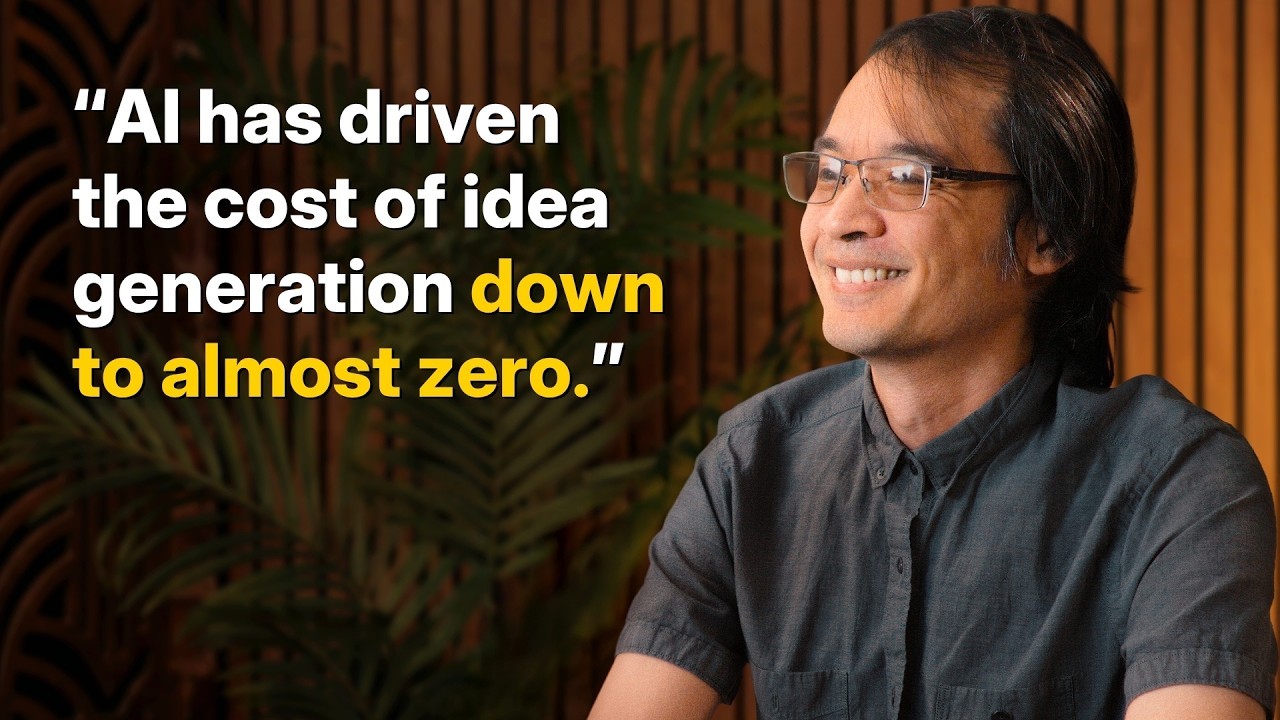
Tao's logic centers on a fundamentally different constraint. AI tools have driven idea generation costs to near zero, but this creates a new bottleneck in verification and evaluation that current systems cannot address. He observes that AI success on Erdős problems came from a one-time sweep of low-hanging fruit with roughly 1-2% per-problem success rates. The tools succeed or fail atomically without building partial progress or transferring learning across problems. The missing capability is not raw intelligence but adaptive, cumulative problem-solving - the ability to reach a handhold, stay there, pull others up, and jump from there. This is qualitatively different from what current architectures provide.
SOURCE OF THE EDGE
Tao's edge derives from direct operational experience testing frontier AI systems against mathematical problems, combined with his position as one of the few people who can evaluate both the AI outputs and the mathematical difficulty simultaneously. He has personally observed the 1-2% success rate across systematic sweeps that contrasts with the cherry-picked wins publicized on social media. He has tested these tools on tasks he himself can do and found performance roughly at parity with his own error rate. This is a genuine structural informational advantage - most commentary on AI for math comes from people who cannot personally evaluate whether a mathematical solution constitutes real progress or whether a claimed insight is novel. His skepticism about imminent replacement is grounded in having actually used these tools extensively rather than extrapolating from benchmark scores or announcements.
//
CONVICTION DETECTED
• I think AI has driven the cost of idea generation down to almost zero • We are absolutely convinced it's true (regarding twin prime conjecture) • I do believe a lot in serendipity • I definitely think of myself as a fox • It will require some additional breakthroughs beyond what we already have • We don't have all the ingredients to really have a truly satisfactory replacement for all intellectual tasks
//
HEDGE DETECTED
• We don't know (regarding whether important proofs could be gobbledygook) • It's going to be stochastic • I think the world is very, very unpredictable at this point in time • Anything is possible at this point • Maybe there are ways to benchmark these and simulate this, but it's all very new science • In many ways, I would prefer the much more boring, quiet era where things are much the same The ratio reveals calibrated uncertainty rather than performed confidence or defensive hedging. Tao expresses strong conviction on matters where he has direct operational evidence (the 1-2% success rate, the complementary nature of AI and human abilities, the shift in bottlenecks) while hedging extensively on timeline predictions and future architectural breakthroughs. This pattern is consistent with genuine epistemic humility about unknowable future developments combined with high confidence about what current systems can and cannot do. His thesis about the complementary relationship deserves substantial weight; his non-predictions about when replacement might occur should be treated as honest admissions of uncertainty rather than signals of low conviction in his core framework.