
THESIS
//
//
//
//
NECESSARY CONDITION
Regulatory frameworks must remain permissive to innovation (avoiding the 'European' model) and open source development must remain unencumbered by downstream liability.
24:35
RISK
Steel Man Counter-Thesis
The strongest counter-thesis is that Google is making an enormous, largely irreversible capital commitment ($175-185B in 2026 alone) predicated on three assumptions that may simultaneously fail: (1) that frontier model advantages remain durable enough to justify vertical integration economics, (2) that Search monetization survives the transition to agentic interfaces, and (3) that Google's organizational culture can ship fast enough to capture the value its R&D creates. On assumption (1), Pichai's own statements undermine the case—Gemma 4 on a USB stick is near-frontier, Chinese models are 'very good,' and the supply constraints he describes apply industry-wide, creating a natural ceiling on how far any single player can pull ahead. The commoditization of model weights is arguably the fastest commoditization cycle in computing history, meaning the returns on training infrastructure may compress faster than any prior hardware investment cycle. On assumption (2), Google's $200B+ annual advertising business depends on users encountering ads in the context of information-seeking queries. The shift to agentic task completion—which Pichai himself describes as the future—removes the user from the ad-impression loop entirely. There is no historical precedent for a company successfully transitioning a $200B+ high-margin advertising business to a fundamentally different monetization surface while simultaneously spending $180B/year on infrastructure. The YouTube and Facebook analogies Pichai invokes are precisely wrong: those companies' monetization mechanics (video ads, feed ads) survived their respective platform transitions. Search ads may not survive the transition to agents. On assumption (3), the pattern of Google developing capabilities internally but shipping them late is not a one-time aberration—it is an emergent property of operating a system that serves billions of users with extremely high reliability and safety requirements. Pichai's own timeline reveals this: the internal AI coding tool reached the Search team 'just last week,' consumer persistence features are described as a frontier Google is 'looking at,' and the full-organization AI transformation is projected for 2027. In a landscape where Pichai says the models will be 'dramatically different in a year's time,' a company that operates on 12-18 month diffusion cycles is structurally disadvantaged against faster-moving competitors and startups that Pichai himself concedes will have AI-native advantages. The base case for this counter-thesis is not that Google fails—it is that Google spends $500B+ over 2025-2027 and emerges with a less differentiated model position than expected, a Search business whose CPMs are structurally declining as agentic interfaces reduce ad surface area, and an organizational transformation that, while eventually successful, arrives late enough that meaningful market share in new AI-native categories accrues to faster movers. In this scenario, Google's stock may be worth less in 2028 than today despite the company having executed competently—because the capital intensity required to stay at the frontier exceeds the incremental economic value the frontier generates in a rapidly commoditizing model environment.
//
THESIS
DEFENSE
//
THESIS
DEFENSE
//
THESIS
DEFENSE
//
ASYMMETRIC SKEW
The downside skew is significant and under-appreciated because the three risks compound. If models commoditize (which Pichai's own Gemma 4 commentary suggests is accelerating), then the $180B/year CapEx generates diminishing returns. If Search monetization degrades through the agentic transition (which Pichai describes as inevitable but never addresses economically), the cash engine funding the CapEx weakens simultaneously. And if organizational shipping latency persists (which the structural factors suggest it will), Google captures less of the upside from its own R&D. Upside is that Google's vertical integration, distribution, and data advantages prove durable, the agentic transition expands monetizable surface area rather than shrinking it, and Google's scale becomes an advantage rather than a liability. The asymmetry skews negative because the downside scenario requires only that current trends continue (model commoditization, interface evolution, organizational inertia), while the upside scenario requires Google to simultaneously solve an unprecedented monetization transition, win a multi-front model competition, and transform a 180,000-person organization—all while spending at historically unprecedented levels on infrastructure whose economic lifespan is uncertain.
ALPHA
NOISE
The Consensus
The market consensus as of roughly a year ago (spring/summer 2025) was that Google Search is structurally impaired—that the core business model is under existential attack from AI-native competitors like ChatGPT, that Google missed the productization of its own Transformer research, and that the company lacks the cultural urgency ('AGI-pilled' mentality) to compete at the frontier of AI. The broader market view was that Google's dominance was zero-sum threatened, that new entrants could disintermediate Search, and that Google's massive CapEx spending (~$175-185B in 2026) may not generate sufficient returns given the gap between infrastructure investment and revenue generation from AI. Consensus also held that compute constraints (memory, power, wafer capacity) would limit all players roughly equally, creating a ceiling on differentiation.
The market's logic chain was: (1) Transformers were invented at Google but productized by OpenAI → Google has a research-to-product gap; (2) ChatGPT captured consumer mindshare → Search is being disintermediated; (3) Google's culture is too cautious and consensus-driven to move fast in AI → structural disadvantage vs. leaner, more 'AGI-pilled' competitors; (4) CapEx is massively outpacing demonstrable AI revenue → potential for value destruction; (5) Compute constraints (memory, power, wafer starts) limit everyone proportionally → no one can pull far ahead, so incumbency offers no real moat.
SIGNAL
The Variant
Pichai's view is that the narrative of Google 'missing' the AI moment is fundamentally misunderstood. He argues Google conceived the ChatGPT-equivalent product (LaMDA) internally, had the vertical integration stack (TPUs at v7, research teams, platforms, data) already in place, and was constrained not by vision but by quality bar and safety considerations. His core macro variant is that this is an emphatically non-zero-sum, expansionary moment—the value frontier is growing so fast that multiple winners will emerge simultaneously, analogous to how YouTube thrived alongside TikTok and Instagram. He believes Google's full-stack vertical integration (research → TPUs → models → products → distribution across Search, YouTube, Cloud, Waymo) creates a uniquely leveraged position where one common AI technology accelerates all businesses simultaneously. He also believes the intelligence overhang is real—models are already far more capable than current deployment, and the diffusion constraints (security, permissions, change management, role redefinition) are temporary fixed costs that, once absorbed, will produce a step-function jump in capability. He projects 2027 as a major inflection point for non-engineering AI-native workflows.
Pichai's causal logic diverges at multiple nodes. First, on the research-to-product narrative: Transformers were not undirected research—they were built to solve specific product problems (translation, speech recognition inference at scale), and were immediately deployed into Search via BERT and MUM, producing 'some of the biggest jumps in search quality.' The productization gap was narrow (LaMDA existed internally; Google shipped ~9 months after ChatGPT) and attributable to a higher quality bar and the lack of RLHF alignment rather than a strategic blindness. Second, on zero-sum dynamics: Pichai explicitly rejects the displacement framework, citing Amazon thriving post-Google, YouTube growing alongside TikTok—his causal model is that technology expansions grow the total addressable pie faster than competitors can take share. Third, on compute constraints enforcing oligopoly: while acknowledging memory and wafer starts as genuine near-term bottlenecks, he introduces a nuance that model weights compress to USB-stick-sized flat files, fundamentally different from hardware-gated industries, which 'challenges those frameworks.' He also argues that constraint forces compaction and efficiency innovation (30X efficiency improvements happening simultaneously). Fourth, on the AGI culture gap: he flatly rejects this by pointing out that Demis Hassabis, Jeff Dean, Ilya Sutskever, and Dario Amodei all once worked at Google—the foundational AI talent incubated there—and that scaling CapEx from $30B to ~$180B is incompatible with not believing in the curve. Fifth, on CapEx returns: he argues the market for AI applications (using coding as an example) is 'dramatically bigger than anybody thinks' because the prior market was demand-constrained for talent, and adding AI supply can 10X the market rather than merely substituting tokens for salaries.
SOURCE OF THE EDGE
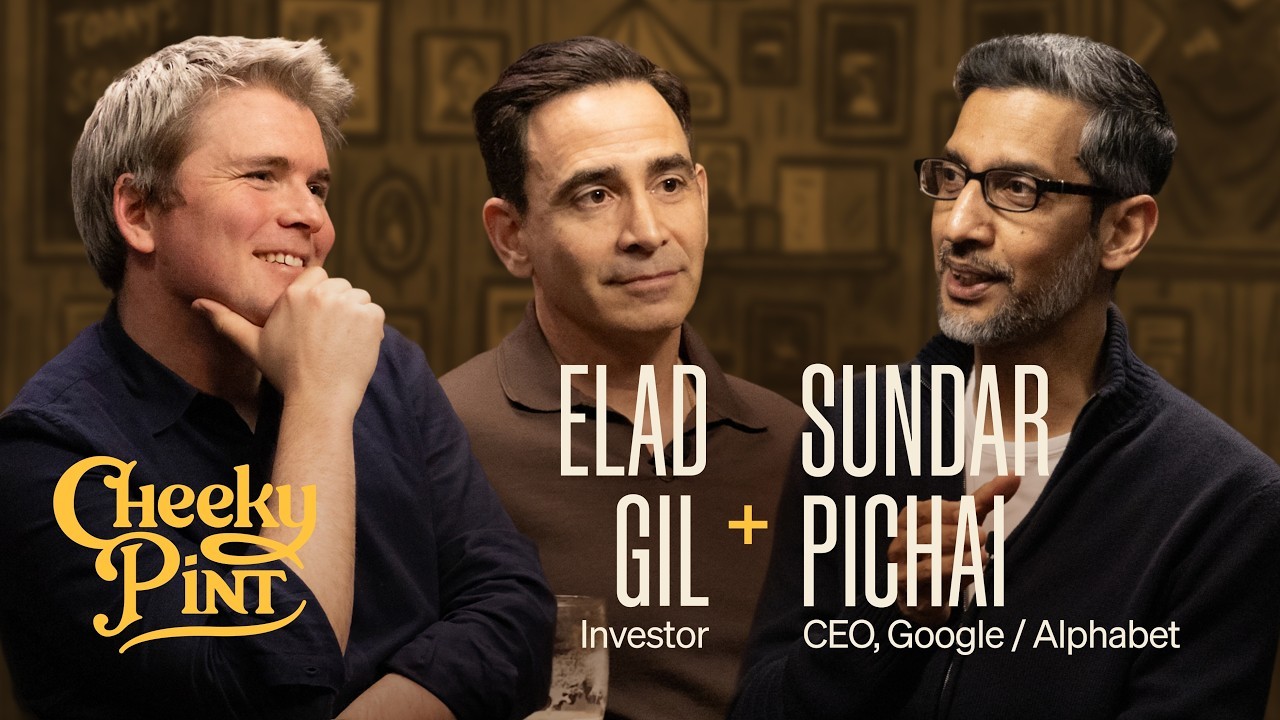
Pichai's edge is genuine and structural, not narrative. It derives from three sources: (1) Operating position: He is the CEO of the company that invented Transformers, built seven generations of TPUs, runs one of the largest inference fleets on Earth, and manages the allocation of what he identifies as the scarcest resource in AI (compute). His knowledge of supply constraints—memory bottlenecks, wafer start limitations, permitting timelines—comes from direct procurement and planning authority, not secondhand analysis. When he says memory is 'one of the most critical components,' that is informed by Google being among the world's largest memory buyers. (2) First-party product telemetry: Google measures search quality 'religiously,' has millisecond-level latency budgets, and has direct dashboards showing that Search latency improved 30% over five years even as functionality expanded massively. This is proprietary operational data no external analyst can replicate. (3) Portfolio visibility: He has direct line-of-sight into Waymo's safety curves, Quantum's logical qubit error rates, Isomorphic's drug discovery pipeline, Wing's delivery scaling, and internal AI diffusion metrics—all of which inform capital allocation decisions. The credibility assessment is strong: this is not a fund manager constructing a narrative from public filings. This is the operator of the largest AI infrastructure in the world describing what he sees from the inside. The one area where his edge is weaker is in assessing competitive dynamics—his dismissal of the ChatGPT moment as 'consumer internet surprises that always happen' has a self-serving quality, minimizing a genuine strategic miss. His framing of the 9-month gap as trivial elides the fact that OpenAI captured enormous mindshare and enterprise adoption during that window. But on the core thesis—that Google's vertical integration creates compounding advantage and that the market is expansionary rather than zero-sum—his informational advantage is real and difficult to replicate from outside.
//
CONVICTION DETECTED
• 'We are supply-constrained. We are seeing the demand across all the surface areas. I actually don't have any doubt that this is a massive market and outcome.' • 'I didn't view it as a zero-sum moment at all.' • 'I felt like everything is going to scale up 10X.' • 'The company was built for that moment.' • 'It was a very intentful…' • 'I fundamentally felt like Quantum would have an edge there.' • 'I'm confident quantum will have many, many applications if you can actually make it work.' • 'You don't do it if you don't think about the curve a certain way.' (on scaling CapEx from $30B to ~$180B) • 'Anything we commit to a customer is sacrosanct.' • 'I do think companies which are… That's one advantage startups are going to have.' • 'These models are definitely really going to break pretty much all software out there.'
//
HEDGE DETECTED
• 'I think it's a reasonable framework to think about it that way.' (on compute oligopoly) • 'There are things which are… I'm coming here as we just shipped Gemma 4.' (deflection from direct answer) • 'I think the picture will again be dynamic in a few months.' • 'Maybe the language of how we talk about it might be different.' (on AGI-pilled culture) • 'We may get there with classical computing techniques in a surprising way or get at it with enough compression.' (on quantum necessity) • 'I think it's tough to… I think you can paralyze yourself thinking 10 years ahead.' • 'Maybe there was a signal we were missing.' (on coding use case for GPT) • 'This constraint may be less severe than it appears.' • 'I don't want to be specific about the second one, but we'll publish it one day, I'm sure.' • 'I would say that, but I think in generally, at least, we might have gotten the decision wrong.' The ratio of conviction to hedging reveals a speaker who is genuinely certain on the macro thesis—Google's structural advantages, the expansionary nature of AI, the value of vertical integration—and hedges primarily on timing, competitive positioning at the frontier, and specific technical bets like quantum. This pattern is consistent with an operator who has high internal confidence in the trajectory but appropriate uncertainty about the path and pace. The hedging is calibrated and domain-specific rather than broad or defensive, which suggests the conviction markers should be weighted heavily. This is not performed certainty; it is the confidence profile of someone who controls the relevant variables and knows which ones they do not control.