dstl

TERMINAL

TERMINAL

LIBRARY

LIBRARY

//

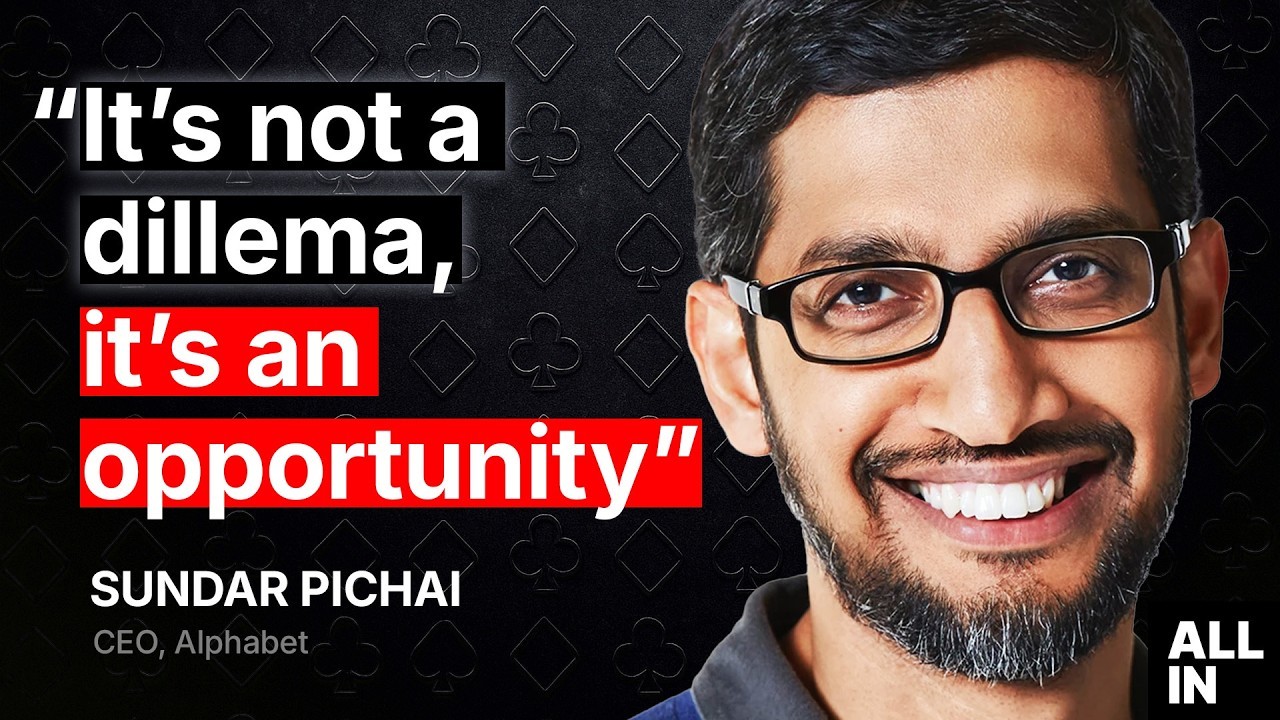
Sundar Pichai, CEO of Alphabet | The All-In Interview

Sundar Pichai, CEO of Alphabet | The All-In Interview

Sundar Pichai, CEO of Alphabet | The All-In Interview

May 16, 2025

May 16, 2025

All-In Podcast

All-In Podcast

1:02:20

1:02:20

592K Views

592K Views

THESIS

Google is successfully navigating the AI platform shift by leveraging a decade of vertically integrated infrastructure investment to defend its Search monopoly while scaling adjacent high-growth ventures like Waymo and Cloud.

Google is successfully navigating the AI platform shift by leveraging a decade of vertically integrated infrastructure investment to defend its Search monopoly while scaling adjacent high-growth ventures like Waymo and Cloud.

Google is successfully navigating the AI platform shift by leveraging a decade of vertically integrated infrastructure investment to defend its Search monopoly while scaling adjacent high-growth ventures like Waymo and Cloud.

ASSET CLASS

ASSET CLASS

SECULAR

SECULAR

CONVICTION

CONVICTION

HIGH

HIGH

TIME HORIZON

TIME HORIZON

10+ Years (Secular Transition)

10+ Years (Secular Transition)

01

01

//

PREMISE

PREMISE

The Misunderstood 'Innovator's Dilemma'

The Misunderstood 'Innovator's Dilemma'

The prevailing market narrative suggests Google faces an existential 'Innovator's Dilemma' where AI chat interfaces disrupt the core Search ad business. This view posits that moving to AI will cannibalize high-margin search queries. However, this perspective underestimates Google's 'AI First' strategy (initiated in 2015), which views AI as an expansive technology that broadens the types of queries users ask, rather than a zero-sum replacement for traditional search links.

The prevailing market narrative suggests Google faces an existential 'Innovator's Dilemma' where AI chat interfaces disrupt the core Search ad business. This view posits that moving to AI will cannibalize high-margin search queries. However, this perspective underestimates Google's 'AI First' strategy (initiated in 2015), which views AI as an expansive technology that broadens the types of queries users ask, rather than a zero-sum replacement for traditional search links.

02

02

//

MECHANISM

MECHANISM

Vertical Integration & Cost Curve Suppression

Vertical Integration & Cost Curve Suppression

Google defeats the dilemma through a massive infrastructure advantage. By controlling the entire stack—from subsea cables to custom silicon (seven generations of TPUs) to the Gemini model layer—Google drives down the 'cost to serve' AI queries drastically (falling dramatically in an 18-month timeframe), neutralizing the margin erosion threat. Simultaneously, the deployment of 'AI Overviews' and 'AI Mode' increases query complexity and volume, with monetization per query already recovering to baseline levels, proving the business model can transition without collapsing unit economics.

Google defeats the dilemma through a massive infrastructure advantage. By controlling the entire stack—from subsea cables to custom silicon (seven generations of TPUs) to the Gemini model layer—Google drives down the 'cost to serve' AI queries drastically (falling dramatically in an 18-month timeframe), neutralizing the margin erosion threat. Simultaneously, the deployment of 'AI Overviews' and 'AI Mode' increases query complexity and volume, with monetization per query already recovering to baseline levels, proving the business model can transition without collapsing unit economics.

03

03

//

OUTCOME

OUTCOME

Platform Expansion & Multi-Engine Growth

Platform Expansion & Multi-Engine Growth

Google retains its Search dominance by evolving the product into a hybrid AI/Search engine, creating a 'Pareto frontier' of performance and cost that competitors relying on merchant silicon (Nvidia) cannot match. This transition buys time for 'other bets' to mature into massive revenue drivers: Waymo is effectively scaling, Cloud has become a major enterprise software player, and long-term R&D in Quantum and Robotics is nearing commercial viability.

Google retains its Search dominance by evolving the product into a hybrid AI/Search engine, creating a 'Pareto frontier' of performance and cost that competitors relying on merchant silicon (Nvidia) cannot match. This transition buys time for 'other bets' to mature into massive revenue drivers: Waymo is effectively scaling, Cloud has become a major enterprise software player, and long-term R&D in Quantum and Robotics is nearing commercial viability.

//

NECESSARY CONDITION

Google must successfully overcome physical energy constraints (grid capacity/power access) to sustain data center scaling and maintain low latency for AI user experiences.

I think the dilemma only exists if you treat it as a dilemma... you have to innovate to stay ahead and you kind of lean in that direction. It's like one of the original principles of Google follow the user all else will follow.

I think the dilemma only exists if you treat it as a dilemma... you have to innovate to stay ahead and you kind of lean in that direction. It's like one of the original principles of Google follow the user all else will follow.

07:04

RISK

Steel Man Counter-Thesis

Google's pivot to AI is capital-intensive and physically constrained by a US energy grid that cannot expand fast enough to support the demand. The CEO admits to being 'supply constrained' in Cloud and reliant on external workforce and permitting factors. While Google defends its Search margin through custom chips, the shift from 'serving links' to 'serving answers' inherently caps ad inventory. If the energy bottleneck persists, Google cannot deploy the compute necessary to maintain its monopoly against leaner, faster-moving competitors who do not carry the Innovator's Dilemma of protecting a $200B ad run rate.

//

RISK 01

RISK 01

Physical Infrastructure & Energy Grid Saturation

Physical Infrastructure & Energy Grid Saturation

THESIS

Google faces immediate, tangible constraints in scaling its physical footprint to meet AI demand. The CEO admits the company is 'supply constrained' in its Cloud business this year. These bottlenecks are not software problems but physical ones: delays in project permitting, a lack of access to power, and a shortage of skilled labor (electricians). Unlike chip design, these factors are external to Google's direct control.

Google faces immediate, tangible constraints in scaling its physical footprint to meet AI demand. The CEO admits the company is 'supply constrained' in its Cloud business this year. These bottlenecks are not software problems but physical ones: delays in project permitting, a lack of access to power, and a shortage of skilled labor (electricians). Unlike chip design, these factors are external to Google's direct control.

DEFENSE

While acknowledged, the defense relies on macro-optimism rather than a specific corporate strategy. The CEO assumes 'capitalist solutions will innovate' (e.g., SMRs, fusion) to meet the moment , but concedes that if current trend lines continue without a grid breakthrough, constraints will become much more visible.

While acknowledged, the defense relies on macro-optimism rather than a specific corporate strategy. The CEO assumes 'capitalist solutions will innovate' (e.g., SMRs, fusion) to meet the moment , but concedes that if current trend lines continue without a grid breakthrough, constraints will become much more visible.

//

RISK 02

RISK 02

Latency Degradation in Search UX

Latency Degradation in Search UX

THESIS

While cost-per-query has fallen, the CEO identifies latency as the primary constraint for AI Search. Traditional search is near-instant; if AI integration introduces friction or slowness, it breaks the core user value proposition. As models become more complex (agentic workflows, reasoning), maintaining the 'instant' nature of Search becomes physically harder.

While cost-per-query has fallen, the CEO identifies latency as the primary constraint for AI Search. Traditional search is near-instant; if AI integration introduces friction or slowness, it breaks the core user value proposition. As models become more complex (agentic workflows, reasoning), maintaining the 'instant' nature of Search becomes physically harder.

DEFENSE

Google is mitigating this through custom silicon designed specifically for inference. The 'Ironwood' TPU is highlighted as a solution to serve models efficiently at scale , and model efficiency (Flash series) is prioritized to balance speed and intelligence.

Google is mitigating this through custom silicon designed specifically for inference. The 'Ironwood' TPU is highlighted as a solution to serve models efficiently at scale , and model efficiency (Flash series) is prioritized to balance speed and intelligence.

//

RISK 03

RISK 03

Sovereign Efficiency Asymmetry (The 'DeepSeek' Threat)

Sovereign Efficiency Asymmetry (The 'DeepSeek' Threat)

THESIS

Competitors in hardware-constrained environments (China/DeepSeek) are innovating rapidly on algorithmic efficiency out of necessity. This creates a risk that lean, highly efficient foreign models could undercut Google's massive infrastructure-heavy approach, proving that raw scale (CapEx) is not the only moat.

Competitors in hardware-constrained environments (China/DeepSeek) are innovating rapidly on algorithmic efficiency out of necessity. This creates a risk that lean, highly efficient foreign models could undercut Google's massive infrastructure-heavy approach, proving that raw scale (CapEx) is not the only moat.

DEFENSE

Google internally benchmarked DeepSeek against their own 'Flash' models and found them to be comparable in efficiency. They argue that their 'full stack' approach (chips + data center + models) allows them to define the Pareto frontier of cost and performance, preventing disruption from pure efficiency plays.

Google internally benchmarked DeepSeek against their own 'Flash' models and found them to be comparable in efficiency. They argue that their 'full stack' approach (chips + data center + models) allows them to define the Pareto frontier of cost and performance, preventing disruption from pure efficiency plays.

//

ASYMMETRIC SKEW

Upside relies on unproven energy breakthroughs; Downside is rooted in physical supply chain realities.

ALPHA

NOISE

The Consensus

Google faces an existential 'Innovator's Dilemma' where generative AI chat interfaces will displace traditional Search, destroying the company's core high-margin ad revenue model due to higher compute costs and lack of ad real estate.

The unit economics of AI Search are broken for Google; serving an AI answer costs significantly more than 10 blue links, implying inevitable margin compression.

SIGNAL

The Variant

AI is not a zero-sum disruptor but a market expander that increases query complexity and volume. Google's transition is successfully defended by a massive, decade-long investment in vertical infrastructure (TPUs + Data Centers) that creates an insurmountable moat around cost-to-serve and latency.

Infrastructure dominance (7th gen TPUs) has already collapsed the cost of serving AI queries drastically within 18 months. The primary constraint is latency, not cost. Furthermore, user behavior shows that AI expands the 'query types' (video, complex reasoning) rather than just cannibalizing simple commercial queries.

SOURCE OF THE EDGE

Privileged Data Access (1.5 billion users on AI Overviews) & Vertical Integration Insight (Proprietary TPU performance data vs. Merchant Silicon)

//

CONVICTION DETECTED

• Google literally is on the parto frontier • I'd wager on that • The scale of these things are unparalleled • Absolutely confident that we will get there • We kind of know what works

//

HEDGE DETECTED

• It's a fierce competitive moment • Some of it may take time • We have maybe couple cycles away to get to that sweet spot • I quite haven't seen it yet • If the trend continues these constraints will be much more visible