
dstl

TERMINAL

TERMINAL

LIBRARY

LIBRARY

//

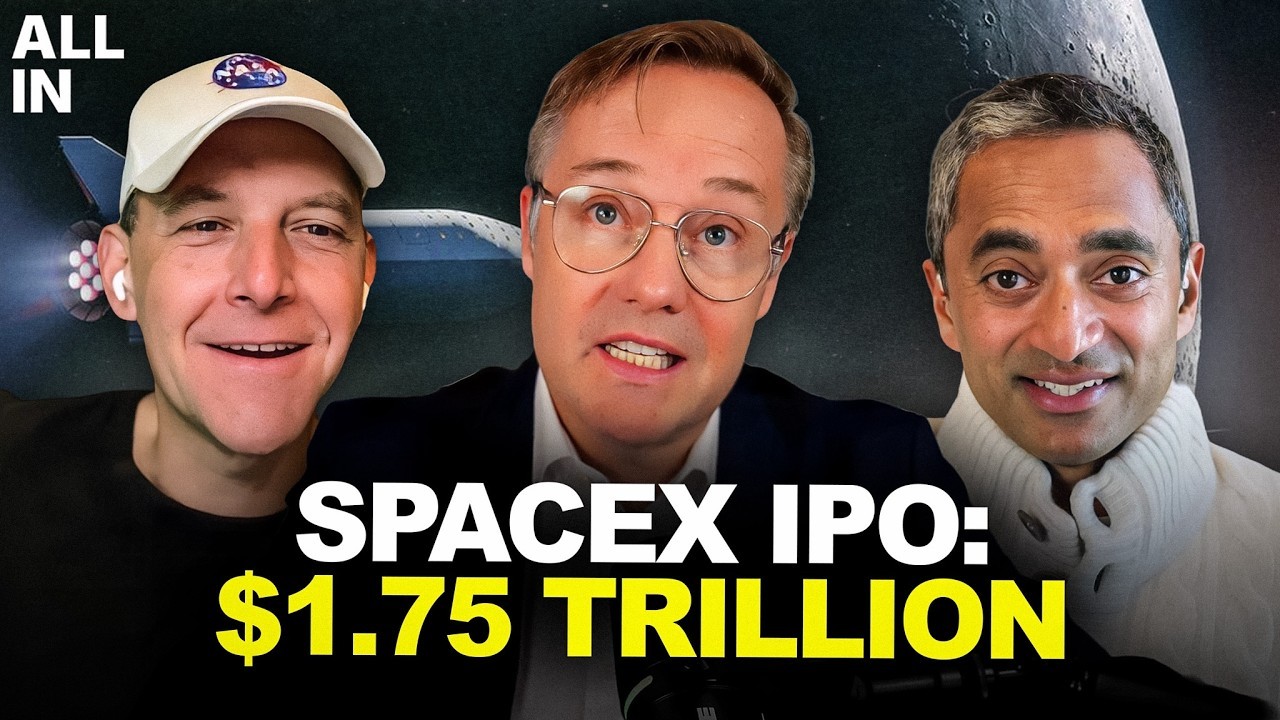
SpaceX IPO, Tesla Merger Thesis, AI Valuation Crisis, and the Iran War's Hidden Supply Chain Shock

SpaceX IPO, Tesla Merger Thesis, AI Valuation Crisis, and the Iran War's Hidden Supply Chain Shock

SpaceX IPO, Tesla Merger Thesis, AI Valuation Crisis, and the Iran War's Hidden Supply Chain Shock

All-In Podcast

All-In Podcast

1:20:26

1:20:26

359K Views

359K Views

THESIS

SpaceX's IPO will trigger a massive repricing of the entire tech sector as AGI-capable companies force software multiples to collapse toward non-tech levels.

SpaceX's IPO will trigger a massive repricing of the entire tech sector as AGI-capable companies force software multiples to collapse toward non-tech levels.

SpaceX's IPO will trigger a massive repricing of the entire tech sector as AGI-capable companies force software multiples to collapse toward non-tech levels.

ASSET CLASS

ASSET CLASS

SECULAR

SECULAR

CONVICTION

CONVICTION

HIGH

HIGH

TIME HORIZON

TIME HORIZON

5 to 7 years

5 to 7 years

01

01

//

PREMISE

PREMISE

The tech sector trades at an unsustainable premium that AGI-native companies will systematically erode

The tech sector trades at an unsustainable premium that AGI-native companies will systematically erode

The current market exhibits a structural valuation gap between tech and non-tech sectors, with software companies trading at dramatically higher PE multiples. This premium is predicated on the assumption that existing software moats — proprietary code, network effects, switching costs — are durable. However, three companies (SpaceX, OpenAI, Anthropic) are simultaneously approaching public markets while building AI technology that directly cannibalizes the competitive advantages sustaining those premiums. The IPO pipeline itself creates a dual problem: trillions of dollars of new equity supply hitting a market with finite absorptive capacity, while the very technology these companies represent threatens the earnings durability of incumbent software businesses. There is also a fundamental logical contradiction in the market — if AGI is real, most software company moats evaporate; if AGI is not real, the hundreds of billions flowing into AI companies needs to be questioned. Both cannot be true simultaneously, yet the market is pricing both as true.

The current market exhibits a structural valuation gap between tech and non-tech sectors, with software companies trading at dramatically higher PE multiples. This premium is predicated on the assumption that existing software moats — proprietary code, network effects, switching costs — are durable. However, three companies (SpaceX, OpenAI, Anthropic) are simultaneously approaching public markets while building AI technology that directly cannibalizes the competitive advantages sustaining those premiums. The IPO pipeline itself creates a dual problem: trillions of dollars of new equity supply hitting a market with finite absorptive capacity, while the very technology these companies represent threatens the earnings durability of incumbent software businesses. There is also a fundamental logical contradiction in the market — if AGI is real, most software company moats evaporate; if AGI is not real, the hundreds of billions flowing into AI companies needs to be questioned. Both cannot be true simultaneously, yet the market is pricing both as true.

02

02

//

MECHANISM

MECHANISM

Sequential IPO saturation combined with AGI-driven moat destruction forces a PE convergence between tech and non-tech

Sequential IPO saturation combined with AGI-driven moat destruction forces a PE convergence between tech and non-tech

The mechanism operates on two simultaneous fronts. First, SpaceX goes public and absorbs the largest share of investor appetite — Chamath uses the Thanksgiving dinner analogy where the first diner gets the fullest plate. SpaceX will perform well because it arrives first with validated mark-to-market pricing. OpenAI and Anthropic follow, absorbing progressively less capital as investor appetite diminishes. The critical forcing function is that once these three AI-native companies are public, their products begin systematically attacking the software sector's moat — the very sector that trades at the highest PE premium. This creates a reflexive dynamic: as AI capabilities advance, the terminal value assumptions embedded in software company multiples become untenable. Money flows from overpriced software into either the new AI-native public companies or into 'HALO' assets (High Asset, Low Obsolescence businesses) that trade at 2-5x cash flow. The tech sector PE compresses toward the non-tech PE. Additional pressure comes from a potential Middle Eastern capital pullback as Gulf sovereign wealth funds and family offices — historically the largest providers of unencumbered, debt-free capital to tech — tighten commitments due to the Iran conflict, reducing the global pool of capital available to absorb new equity issuance.

The mechanism operates on two simultaneous fronts. First, SpaceX goes public and absorbs the largest share of investor appetite — Chamath uses the Thanksgiving dinner analogy where the first diner gets the fullest plate. SpaceX will perform well because it arrives first with validated mark-to-market pricing. OpenAI and Anthropic follow, absorbing progressively less capital as investor appetite diminishes. The critical forcing function is that once these three AI-native companies are public, their products begin systematically attacking the software sector's moat — the very sector that trades at the highest PE premium. This creates a reflexive dynamic: as AI capabilities advance, the terminal value assumptions embedded in software company multiples become untenable. Money flows from overpriced software into either the new AI-native public companies or into 'HALO' assets (High Asset, Low Obsolescence businesses) that trade at 2-5x cash flow. The tech sector PE compresses toward the non-tech PE. Additional pressure comes from a potential Middle Eastern capital pullback as Gulf sovereign wealth funds and family offices — historically the largest providers of unencumbered, debt-free capital to tech — tighten commitments due to the Iran conflict, reducing the global pool of capital available to absorb new equity issuance.

03

03

//

OUTCOME

OUTCOME

Tech sector multiples collapse toward non-tech levels, creating a brutal repricing for late IPO entrants and incumbent software companies

Tech sector multiples collapse toward non-tech levels, creating a brutal repricing for late IPO entrants and incumbent software companies

The blue line (tech PE) converges to the orange line (non-tech PE), and Chamath explicitly states 'it's going to be nasty.' Companies that IPO after the first two or three entrants face dramatically worse outcomes — many will trade below their IPO price within a year or two. The pent-up selling pressure from long-duration private holders, combined with a diminishing buyer pool (since the large institutional buyers already participated pre-IPO in private rounds), creates sustained downward pressure on share prices. The broader software sector — currently trading at elevated multiples based on durable moat assumptions — sees those multiples compress as AGI-capable products from OpenAI and Anthropic demonstrate the ability to replicate or replace proprietary software functionality. The market cannot absorb incrementally trillions of dollars of new demand, so this becomes a reallocation exercise rather than new capital creation, with money rotating from high-multiple tech into low-multiple HALO assets or the new AI-native public companies.

The blue line (tech PE) converges to the orange line (non-tech PE), and Chamath explicitly states 'it's going to be nasty.' Companies that IPO after the first two or three entrants face dramatically worse outcomes — many will trade below their IPO price within a year or two. The pent-up selling pressure from long-duration private holders, combined with a diminishing buyer pool (since the large institutional buyers already participated pre-IPO in private rounds), creates sustained downward pressure on share prices. The broader software sector — currently trading at elevated multiples based on durable moat assumptions — sees those multiples compress as AGI-capable products from OpenAI and Anthropic demonstrate the ability to replicate or replace proprietary software functionality. The market cannot absorb incrementally trillions of dollars of new demand, so this becomes a reallocation exercise rather than new capital creation, with money rotating from high-multiple tech into low-multiple HALO assets or the new AI-native public companies.

//

NECESSARY CONDITION

Regulatory frameworks must remain permissive to innovation (avoiding the 'European' model) and open source development must remain unencumbered by downstream liability.

Everything that happens after that is a total coin toss because once these three companies are public, I think the blue line will converge to the orange line and it's going to be nasty.

Everything that happens after that is a total coin toss because once these three companies are public, I think the blue line will converge to the orange line and it's going to be nasty.

26:45

RISK

Steel Man Counter-Thesis

The bull thesis rests on an unprecedented concentration of value in a single individual (Elon Musk) executing simultaneously across rockets, cars, AI, robotics, brain-computer interfaces, and tunneling — and then merging these into a single entity worth $3+ trillion. History offers no precedent for this succeeding. The strongest counter-argument is structural, not personal: conglomerate discounts exist for a reason. When GE, the last great American conglomerate built on the thesis of cross-divisional synergy and a genius leader (Jack Welch), began to falter, the market discovered that the synergies were largely illusory and the complexity created opacity that masked deteriorating fundamentals. A merged Tesla/SpaceX/XAI/X entity would be the most complex corporate structure ever attempted, subject to extraordinary governance risk, regulatory scrutiny across multiple agencies (FAA, SEC, FCC, DOD), and key-person dependency that no insurance policy can mitigate. Furthermore, the valuation thesis requires simultaneous success across multiple speculative bets: that Starlink maintains its monopoly position despite emerging competitors, that XAI justifies a $250 billion acquisition price in a commoditizing AI market, that Tesla's robotics division delivers on Optimus at scale, and that SpaceX's launch business isn't disrupted by competitors like Rocket Lab or Blue Origin. Each of these has independent failure modes. The probability of all succeeding simultaneously is far lower than the probability of any one succeeding individually. Most critically, the $1.75 trillion IPO valuation prices in the moon industrialization thesis and the 'space economy' narrative as near-certainties, when in reality these are 30-50 year speculative ventures with no proven unit economics. At 7x revenue on a $25 billion revenue base, the market is paying for a future that requires flawless execution across every dimension for decades — while the speakers themselves acknowledge that AGI could make the entire technology stack obsolete, that capital markets may seize up, and that geopolitical instability could choke critical supply chains. The asymmetry of this bet is deeply unfavorable: the upside requires everything to go right across multiple independent variables over decades, while the downside only requires one or two things to go wrong.

//

RISK 01

RISK 01

AGI/ASI Pricing Paradox Destroys the Valuation Foundation

AGI/ASI Pricing Paradox Destroys the Valuation Foundation

THESIS

Chamath himself articulates the core contradiction: if AGI is real, the durability of most companies (including those within a merged Tesla/SpaceX entity) is slim to none because AI erodes competitive moats. If AGI is not real, then the fundraising capacity and valuations of AI companies (XAI, which is now part of SpaceX) collapse. The SpaceX thesis at $1.75 trillion bakes in massive AI optionality through the XAI acquisition at $250 billion and the robotics narrative via Tesla. If AGI arrives and commoditizes software, robotics, and autonomous systems, the premium embedded in SpaceX/Tesla for these capabilities evaporates. Conversely, if AGI doesn't materialize, the moon industrialization thesis (which depends entirely on autonomous robots) and the XAI valuation both collapse. Either horn of this dilemma wounds the combined entity's valuation.

Chamath himself articulates the core contradiction: if AGI is real, the durability of most companies (including those within a merged Tesla/SpaceX entity) is slim to none because AI erodes competitive moats. If AGI is not real, then the fundraising capacity and valuations of AI companies (XAI, which is now part of SpaceX) collapse. The SpaceX thesis at $1.75 trillion bakes in massive AI optionality through the XAI acquisition at $250 billion and the robotics narrative via Tesla. If AGI arrives and commoditizes software, robotics, and autonomous systems, the premium embedded in SpaceX/Tesla for these capabilities evaporates. Conversely, if AGI doesn't materialize, the moon industrialization thesis (which depends entirely on autonomous robots) and the XAI valuation both collapse. Either horn of this dilemma wounds the combined entity's valuation.

DEFENSE

Chamath explicitly raises this paradox ('both cannot be right') and warns about it as a market-wide pricing problem. However, his defense is limited to urging SpaceX to IPO first to capture maximum appetite before the market reprices. He does not resolve the paradox for SpaceX's own valuation — he merely identifies the risk as applying to everyone else while implicitly assuming SpaceX would be insulated by being first to market. This is a tactical defense (timing), not a structural one.

Chamath explicitly raises this paradox ('both cannot be right') and warns about it as a market-wide pricing problem. However, his defense is limited to urging SpaceX to IPO first to capture maximum appetite before the market reprices. He does not resolve the paradox for SpaceX's own valuation — he merely identifies the risk as applying to everyone else while implicitly assuming SpaceX would be insulated by being first to market. This is a tactical defense (timing), not a structural one.

//

RISK 02

RISK 02

Capital Exhaustion and Middle East Sovereign Withdrawal Chokes the IPO Pipeline and Space Economy

Capital Exhaustion and Middle East Sovereign Withdrawal Chokes the IPO Pipeline and Space Economy

THESIS

Freeberg identifies that a substantial portion of the capital fueling tech valuations traces back to Middle East sovereign wealth funds and family offices. The Iran war is disrupting these capital flows. Simultaneously, Chamath's Thanksgiving dinner analogy warns that investor appetite is finite — SpaceX at $75 billion raise would be the largest IPO ever and would consume enormous buy-side capacity. The speakers acknowledge that most institutional investors who would buy at scale post-IPO were already in these companies privately, leaving retail as the marginal buyer. If retail is tapped out and Middle East capital retracts, the entire downstream ecosystem — the 'space economy' of FedEx-of-space, garbage-collection-of-space, moon mining companies, Vast Space stations — starves for capital. The grandiose 20-year vision of moon industrialization requires sustained multi-decade capital deployment that may simply not materialize in a liquidity-constrained environment.

Freeberg identifies that a substantial portion of the capital fueling tech valuations traces back to Middle East sovereign wealth funds and family offices. The Iran war is disrupting these capital flows. Simultaneously, Chamath's Thanksgiving dinner analogy warns that investor appetite is finite — SpaceX at $75 billion raise would be the largest IPO ever and would consume enormous buy-side capacity. The speakers acknowledge that most institutional investors who would buy at scale post-IPO were already in these companies privately, leaving retail as the marginal buyer. If retail is tapped out and Middle East capital retracts, the entire downstream ecosystem — the 'space economy' of FedEx-of-space, garbage-collection-of-space, moon mining companies, Vast Space stations — starves for capital. The grandiose 20-year vision of moon industrialization requires sustained multi-decade capital deployment that may simply not materialize in a liquidity-constrained environment.

DEFENSE

Both Chamath and Freeberg explicitly flag this risk. Freeberg warns about Middle East sovereign capital withdrawal and notes the shock wave hasn't been felt yet. Chamath warns about IPO sequencing risk and appetite exhaustion. However, their defense is again tactical (get out first, get your money, fortify your balance sheet) rather than addressing whether the long-term space industrialization thesis can survive a prolonged capital drought. They also note China may gain a capital advantage, which would undermine the US-led space economy narrative.

Both Chamath and Freeberg explicitly flag this risk. Freeberg warns about Middle East sovereign capital withdrawal and notes the shock wave hasn't been felt yet. Chamath warns about IPO sequencing risk and appetite exhaustion. However, their defense is again tactical (get out first, get your money, fortify your balance sheet) rather than addressing whether the long-term space industrialization thesis can survive a prolonged capital drought. They also note China may gain a capital advantage, which would undermine the US-led space economy narrative.

//

RISK 03

RISK 03

Moon Industrialization Timeline and Physics Constraints Are Wildly Speculative

Moon Industrialization Timeline and Physics Constraints Are Wildly Speculative

THESIS

Freeberg's moon industrialization thesis — autonomous mining, mass drivers shooting processed ore back to Earth every 10-15 minutes, semiconductor manufacturing on the moon — is presented with extraordinary confidence but rests on speculative physics and engineering that has never been demonstrated at any scale. Mass drivers have never been built or tested on the moon. The heat dissipation problem he acknowledges (no atmosphere) is not trivially solved. The claim that shipping goods from the moon to Earth costs 'less than a boat, airplane, or railroad' ignores the enormous capital cost of establishing lunar infrastructure, the failure rates of autonomous systems in extreme environments, and the fact that no robotic mining or manufacturing has ever operated autonomously on another celestial body. The entire 20-year vision conflates what is theoretically possible with what is economically viable and engineeringly achievable. Meanwhile, terrestrial mining and manufacturing continue to improve via AI and automation, potentially undercutting the economic rationale for lunar production before it ever reaches scale.

Freeberg's moon industrialization thesis — autonomous mining, mass drivers shooting processed ore back to Earth every 10-15 minutes, semiconductor manufacturing on the moon — is presented with extraordinary confidence but rests on speculative physics and engineering that has never been demonstrated at any scale. Mass drivers have never been built or tested on the moon. The heat dissipation problem he acknowledges (no atmosphere) is not trivially solved. The claim that shipping goods from the moon to Earth costs 'less than a boat, airplane, or railroad' ignores the enormous capital cost of establishing lunar infrastructure, the failure rates of autonomous systems in extreme environments, and the fact that no robotic mining or manufacturing has ever operated autonomously on another celestial body. The entire 20-year vision conflates what is theoretically possible with what is economically viable and engineeringly achievable. Meanwhile, terrestrial mining and manufacturing continue to improve via AI and automation, potentially undercutting the economic rationale for lunar production before it ever reaches scale.

DEFENSE

No speaker challenges the feasibility, timeline, or economic viability of moon industrialization. Freeberg's claims about mass drivers, zero-cost shipping, and 500 square meters of solar panels powering a 4km mass driver are presented without skepticism. The comparison to the American frontier and railroads is emotionally compelling but historically misleading — the frontier had breathable air, water, and a labor force. No one raises the possibility that terrestrial automation could eliminate the economic rationale for lunar mining, or that the capital costs of establishing lunar infrastructure could be orders of magnitude higher than projected. The speakers collectively treat this as an inevitability rather than a speculative scenario with enormous execution risk.

No speaker challenges the feasibility, timeline, or economic viability of moon industrialization. Freeberg's claims about mass drivers, zero-cost shipping, and 500 square meters of solar panels powering a 4km mass driver are presented without skepticism. The comparison to the American frontier and railroads is emotionally compelling but historically misleading — the frontier had breathable air, water, and a labor force. No one raises the possibility that terrestrial automation could eliminate the economic rationale for lunar mining, or that the capital costs of establishing lunar infrastructure could be orders of magnitude higher than projected. The speakers collectively treat this as an inevitability rather than a speculative scenario with enormous execution risk.

//

ASYMMETRIC SKEW

The downside is concentrated and near-term while the upside is diffuse and multi-decade. Downside scenarios — AGI commoditization of moats, capital market exhaustion, Middle East capital withdrawal, conglomerate governance failures, key-person risk — can each independently compress valuation by 40-60% within 1-3 years. The upside scenarios — moon industrialization, trillion-dollar space economy, successful merger synergies — require 10-30 years of flawless execution across multiple speculative frontiers with no proven unit economics. The risk-reward is roughly 2:1 skewed to the downside on a 3-5 year horizon, improving to more balanced only on a 15-20+ year horizon if execution is sustained. The IPO pricing at $1.75 trillion leaves minimal margin of safety for any execution stumble.

ALPHA

NOISE

The Consensus

The market consensus is that 2026 will be a blockbuster year for tech IPOs, with SpaceX, Anthropic, OpenAI, and Databricks all coming to market at extraordinary valuations (potentially trillions of dollars combined). The consensus view is that the AI boom justifies these valuations, that capital markets can absorb massive new issuance, and that the MAG-7 expands to a MAG-17 as these companies go public. The market also broadly assumes Middle East conflict risk is manageable and contained, and that AI companies' growth trajectories justify premium multiples indefinitely.

The market's logic is linear and additive: more great companies going public means more opportunity, retail and institutional demand will absorb the issuance, AI growth justifies extreme multiples, Middle East conflict is a temporary headwind that markets can look through, and the IPO pipeline represents a healthy maturation of the private tech ecosystem. The implicit assumption is that capital supply is elastic — that sovereign wealth funds, retail investors, and institutional allocators will step up to meet whatever issuance comes to market.

SIGNAL

The Variant

Chamath's core variant view is that the IPO window is far narrower than the market believes, and that capital absorption capacity will exhaust rapidly after the first two or three major IPOs. He argues there is a fundamental pricing paradox in AI: if AGI is real, most existing software companies' moats are worthless and their valuations must compress; if AGI is not real, the fundraising of AI companies at hundreds of billions of dollars is unjustified. Both cannot be true simultaneously, yet the market is pricing both as true. He predicts the tech sector PE will converge downward toward non-tech PE as SpaceX, OpenAI, and Anthropic go public and their AI capabilities cannibalize incumbent software moats. Freeberg adds that Middle Eastern sovereign capital — a critical but underappreciated funding source for these companies — is likely to contract due to the Iran conflict, creating a liquidity crunch that the market hasn't priced in. Additionally, they argue quantum computing timelines have compressed to 5-7 years (not 25-30), posing an existential threat to cryptocurrency that the crypto community is not adequately preparing for.

Chamath's causal logic is a Thanksgiving dinner analogy applied to capital markets: investor appetite is finite and depletes sequentially. The first IPO (SpaceX) gets full appetite, the second gets diminished appetite, and subsequent ones face a 'full plate' problem. The deeper causal mechanism is a reflexive trap: AI companies going public will publicly demonstrate capabilities that erode confidence in incumbent software valuations, triggering a reallocation away from tech (blue line converging to orange line on PE charts), which simultaneously reduces the available capital pool for subsequent AI IPOs. Freeberg's causal chain on Middle East capital is: Iran conflict → Gulf sovereign risk-off → reduced LP commitments and primary/secondary transactions → lagged shock wave hits mega-funds → capital crunch for capital-intensive AI companies. On fertilizer: Strait of Hormuz closure → 35% of global nitrogen fertilizer blocked → China weaponizes its swing producer position by halting exports → farmers can't afford inputs → food supply crisis within months, with damaged Qatar facilities taking 3-5 years to rebuild, meaning no quick fix. On quantum: algorithm improvements (Shor's to Regev's, reducing operations from 28M to 500K) are happening independently of hardware progress, and when hardware catches up in 5-7 years, crypto becomes the most obvious honeypot for non-state actors.

SOURCE OF THE EDGE

The speakers' edge draws from several sources of varying credibility. Chamath's IPO sequencing thesis is informed by genuine deal-making experience — his references to Wachtell Lipton attorneys, DNO insurance mechanics, and the tort ecosystem around IPOs reflect real operational knowledge of how public offerings actually work, not armchair speculation. His 'Thanksgiving dinner' capital absorption framework is a practitioner's insight, not academic theory. Freeberg's fertilizer analysis is his strongest edge and is genuinely structural: he has deep agricultural domain expertise (former NASA background, currently building a potato seed company shipping to farmers), and his granular knowledge of nitrogen fertilizer production chains — the Haber-Bosch process, facility rebuild timelines, the Qatar-specific damage, China's strategic export shutdown, the specific economics of corn farming profitability at $700/ton urea — represents proprietary operating knowledge that most financial commentators simply do not possess. His 30-day global food calorie buffer statistic is the kind of detail that comes from years in the space. However, several claims are more narrative than edge: the SpaceX-Tesla merger prediction (99.999%) is conviction-as-entertainment rather than analysis; the moon manufacturing thesis, while intellectually interesting, is speculative futurism without near-term investment implications; and the quantum-crypto timeline compression (5-7 years) cites research directionally but the specific timeline is a judgment call without proprietary insight. The Middle East capital withdrawal thesis from Freeberg is plausible and informed but is a prediction about sovereign behavior, not an observation from inside those capital flows. Overall, the strongest and most credible edges are Chamath's IPO market mechanics and Freeberg's agricultural supply chain analysis — these are genuine informational advantages from operating experience. The space/moon thesis and merger predictions are more constructed narrative.

//

CONVICTION DETECTED

• 100% is what you're putting it on (Tesla-SpaceX merger) • 99.999% (Tesla-SpaceX merger probability) • Both cannot be right (AGI pricing paradox) • It's a non-starter (countries getting nuclear weapons) • He's 100% going to wrap this up (Trump ending Iran war) • It will cost less to move goods, manufactured goods, processed ore, precious metals from the moon to a specific point on Earth... than to ship it using any other terrestrial conventional method • There is no way you can make a profitable crop of corn • There is no downtime where you can just turn on excess production in the world • You have 5 to 7 years to get your shit in order (crypto community on quantum) • It's going to be nasty (tech PE convergence) • Dollars to donuts, these things are going to merge • That just doesn't make sense (unpredictable actors having nuclear weapons) • I think the big event risk in the market is AI real or not real

//

HEDGE DETECTED

• How profitable they are, I don't know. What their terminal valuation is, I don't know. What will people pay for at IPO? I don't know. • Is it going to come from the sidelines? I don't know. • I'm speculating in a bunch of different ways (Freeberg on moon manufacturing) • None of us know is the truth (on Iran intelligence) • I don't have any information on that. I'm not in the CIA. • It's above my pay grade • History will sort out which one is right (AGI pricing) • I don't know if you saw that story • Hegath, I'm not so sure. I'm not sure if I know what I think of him yet • I don't think we've really felt the shock wave yet • Let's see it is a risk • I don't know how far this is going to go or when this capital crunch is going to emerge The ratio of conviction to hedging reveals a deliberate asymmetry: the speakers use absolute language on structural theses they've thought deeply about (IPO sequencing, fertilizer supply chains, nuclear proliferation) and hedge heavily on geopolitical predictions and timing questions where they genuinely lack information (Iran intelligence, Trump's motivations, exact quantum timelines). This is the pattern of experienced operators who know the difference between their domain expertise and their speculation — they are genuinely certain on the mechanics and genuinely uncertain on the politics. This makes their high-conviction claims more trustworthy, not less, because they demonstrate the ability to distinguish what they know from what they don't. Weight should be placed heavily on their structural market and supply chain claims, and lightly on their geopolitical timing predictions.