
dstl

TERMINAL

TERMINAL

LIBRARY

LIBRARY

//

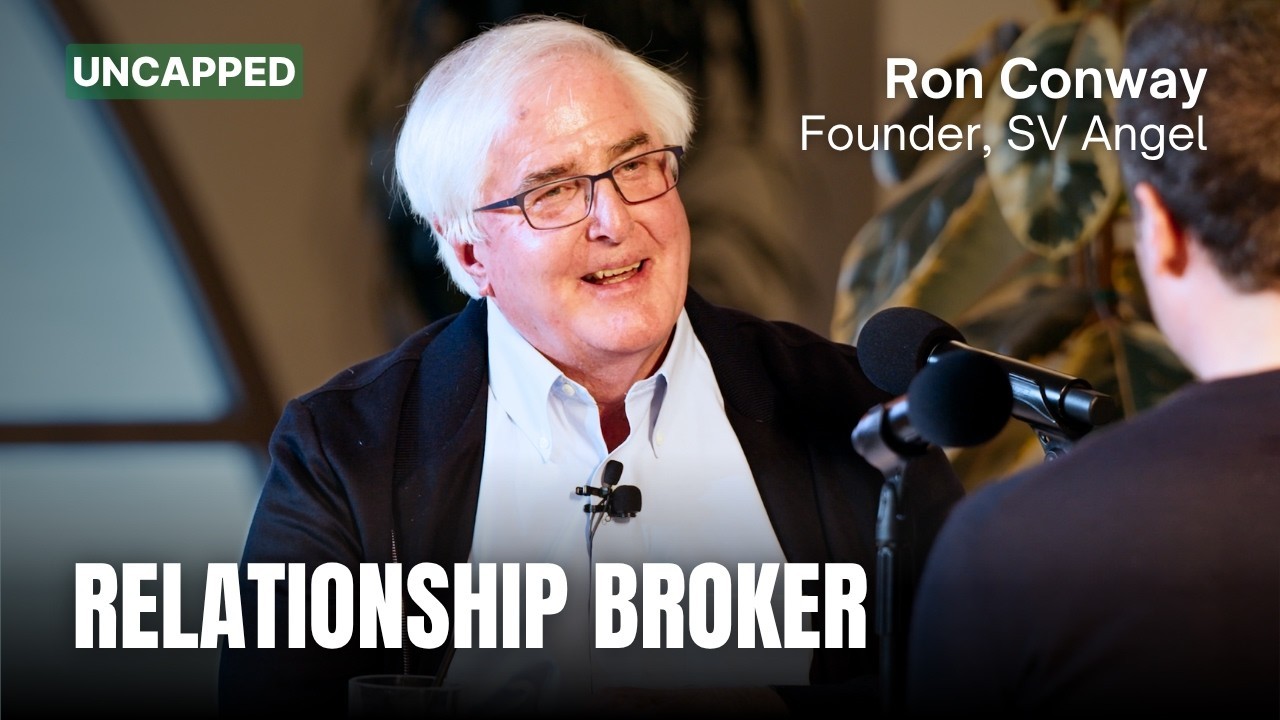
Ron Conway on Building the Relationship Network Behind Four Decades of Defining Tech Investments

Ron Conway on Building the Relationship Network Behind Four Decades of Defining Tech Investments

Ron Conway on Building the Relationship Network Behind Four Decades of Defining Tech Investments

Uncapped with Jack Altman

Uncapped with Jack Altman

40:57

40:57

1K Views

1K Views

THESIS

The angel investor who backed Google, Stripe, and Airbnb reveals why the relationship network—not the check—is the most valuable asset in venture capital.

The angel investor who backed Google, Stripe, and Airbnb reveals why the relationship network—not the check—is the most valuable asset in venture capital.

The angel investor who backed Google, Stripe, and Airbnb reveals why the relationship network—not the check—is the most valuable asset in venture capital.

ASSET CLASS

ASSET CLASS

SECULAR

SECULAR

CONVICTION

CONVICTION

HIGH

HIGH

TIME HORIZON

TIME HORIZON

Multi-decade compounding

Multi-decade compounding

01

01

//

PREMISE

PREMISE

Seed investing returns are driven by relationship leverage, not capital deployment

Seed investing returns are driven by relationship leverage, not capital deployment

Conway argues that the defining characteristic of successful angel investing is not financial capacity but the accumulated density of relationships across technology cycles, political institutions, and operational networks. Having started in semiconductors and witnessed every subsequent technology wave—computers, software, internet, AI—he built compounding relationship capital that creates asymmetric access for founders. The premise holds that founders face non-financial bottlenecks (regulatory challenges, distribution deals, medical crises, existential board conflicts) that determine company survival, and investors who can resolve these bottlenecks through relationship activation generate returns that pure capital providers cannot match.

Conway argues that the defining characteristic of successful angel investing is not financial capacity but the accumulated density of relationships across technology cycles, political institutions, and operational networks. Having started in semiconductors and witnessed every subsequent technology wave—computers, software, internet, AI—he built compounding relationship capital that creates asymmetric access for founders. The premise holds that founders face non-financial bottlenecks (regulatory challenges, distribution deals, medical crises, existential board conflicts) that determine company survival, and investors who can resolve these bottlenecks through relationship activation generate returns that pure capital providers cannot match.

02

02

//

MECHANISM

MECHANISM

Relationship networks convert founder crises into company-defining outcomes through rapid escalation pathways

Relationship networks convert founder crises into company-defining outcomes through rapid escalation pathways

The mechanism operates through what Conway calls 'inflection point' intervention—deploying relationship capital precisely when founders face existential threats. When COVID threatened Airbnb and the board signaled defeat, Conway activated Silverlake relationships to close emergency financing in 10 days. When Silicon Valley Bank collapsed, he escalated directly to FDIC oversight through Senator Sherrod Brown and Congresswoman Maxine Waters, forcing deposit guarantees before Tokyo markets opened. When OpenAI's board ousted Sam Altman, Conway mobilized to reverse the decision. The forcing function is founder crisis; the mechanism is pre-built escalation pathways that can be activated faster than competitors can build them. This creates a moat: relationship networks compound over 40 years and cannot be replicated by hiring or capital.

The mechanism operates through what Conway calls 'inflection point' intervention—deploying relationship capital precisely when founders face existential threats. When COVID threatened Airbnb and the board signaled defeat, Conway activated Silverlake relationships to close emergency financing in 10 days. When Silicon Valley Bank collapsed, he escalated directly to FDIC oversight through Senator Sherrod Brown and Congresswoman Maxine Waters, forcing deposit guarantees before Tokyo markets opened. When OpenAI's board ousted Sam Altman, Conway mobilized to reverse the decision. The forcing function is founder crisis; the mechanism is pre-built escalation pathways that can be activated faster than competitors can build them. This creates a moat: relationship networks compound over 40 years and cannot be replicated by hiring or capital.

03

03

//

OUTCOME

OUTCOME

Sustained access to defining companies across technology cycles through founder loyalty and referral networks

Sustained access to defining companies across technology cycles through founder loyalty and referral networks

The portfolio includes Google, PayPal, Facebook, LinkedIn, Stripe, Airbnb, Pinterest, Twitter, Square, and OpenAI—companies that define their respective technology eras. The outcome is not merely financial return but perpetual deal flow: founders who experienced crisis support become evangelists who refer the next generation of founders. The relationship network becomes self-reinforcing, with each intervention adding density to the network and each successful company adding executives who become future relationship nodes. Conway's access to Nancy Pelosi, UCSF department heads, and Fortune 500 CEOs creates capabilities that founders cannot access elsewhere, driving preference for SV Angel even at similar economics.

The portfolio includes Google, PayPal, Facebook, LinkedIn, Stripe, Airbnb, Pinterest, Twitter, Square, and OpenAI—companies that define their respective technology eras. The outcome is not merely financial return but perpetual deal flow: founders who experienced crisis support become evangelists who refer the next generation of founders. The relationship network becomes self-reinforcing, with each intervention adding density to the network and each successful company adding executives who become future relationship nodes. Conway's access to Nancy Pelosi, UCSF department heads, and Fortune 500 CEOs creates capabilities that founders cannot access elsewhere, driving preference for SV Angel even at similar economics.

//

NECESSARY CONDITION

Regulatory frameworks must remain permissive to innovation (avoiding the 'European' model) and open source development must remain unencumbered by downstream liability.

I can call people up now and say, 'You want to do it the hard way or the easy way?'

I can call people up now and say, 'You want to do it the hard way or the easy way?'

00:45

RISK

Steel Man Counter-Thesis

The SV Angel model represents a one-generation arbitrage on accumulated social capital that cannot survive its founder. The relationship-brokering competitive advantage is structurally similar to a depleting natural resource: it was built through specific historical circumstances (being present at National Semiconductor when Apple recruited executives, investing early in Google/Facebook/Twitter when they had few institutional relationships) that cannot be recreated. New seed investors cannot replicate Conway's 40-year head start, but crucially, neither can his successors inherit it—relationships are personal, not institutional. The firms that have attempted to institutionalize relationship value (Andreessen Horowitz with its platform team) have done so by hiring dedicated staff at scale, a model Conway explicitly rejects. Furthermore, the 'fight for founders' mentality, while admirable, creates adversarial relationships with counterparties (boards, acquirers, regulators) that may generate short-term wins while burning bridges that harm future portfolio companies. The SVB intervention and OpenAI coup involvement demonstrate willingness to apply maximum pressure, but each such action depletes goodwill with institutions that must be approached again. Finally, the California wealth tax situation reveals that even decades of relationship-building with politicians cannot prevent existential policy threats, calling into question whether the political engagement strategy produces durable protection or merely delays inevitable regulatory hostility toward concentrated tech wealth.

//

RISK 01

RISK 01

Relationship Network Depreciation and Key-Person Dependency

Relationship Network Depreciation and Key-Person Dependency

THESIS

The entire SV Angel model is predicated on Ron Conway's personal relationship network built over 40+ years across semiconductor, PC, software, and internet cycles. This network is inherently non-transferable and subject to biological depreciation. As Conway ages and his contemporaries retire or pass away, the core asset—privileged access to decision-makers at Google, Meta, regulators, and healthcare systems—erodes. The firm's value proposition of being 'advocates for founders' through crisis intervention depends entirely on Conway's personal reputation and accumulated social capital, which cannot be institutionalized or replicated by successors regardless of training.

The entire SV Angel model is predicated on Ron Conway's personal relationship network built over 40+ years across semiconductor, PC, software, and internet cycles. This network is inherently non-transferable and subject to biological depreciation. As Conway ages and his contemporaries retire or pass away, the core asset—privileged access to decision-makers at Google, Meta, regulators, and healthcare systems—erodes. The firm's value proposition of being 'advocates for founders' through crisis intervention depends entirely on Conway's personal reputation and accumulated social capital, which cannot be institutionalized or replicated by successors regardless of training.

DEFENSE

Conway mentions his sons joining the business organically and operating from the same office, but provides no structural framework for relationship transfer. The examples given (UCSF connections, Nancy Pelosi access, SVB crisis intervention) all depend on his personal standing. There is no discussion of how these relationships would persist post-Conway or whether his sons have independently cultivated equivalent access at the same institutional level.

Conway mentions his sons joining the business organically and operating from the same office, but provides no structural framework for relationship transfer. The examples given (UCSF connections, Nancy Pelosi access, SVB crisis intervention) all depend on his personal standing. There is no discussion of how these relationships would persist post-Conway or whether his sons have independently cultivated equivalent access at the same institutional level.

//

RISK 02

RISK 02

Thematic Investing in AI Concentration Risk

Thematic Investing in AI Concentration Risk

THESIS

Conway states 'today it's kind of easy because everything's AI' and describes SV Angel as 'thematic investors' currently focused almost entirely on artificial intelligence. This concentration creates correlated portfolio risk where a single adverse event—regulatory crackdown, compute cost explosion, model commoditization, or an AI winter triggered by capability plateau—could simultaneously impair the majority of portfolio companies. The claim that AI is 'bigger than all previous cycles combined' may represent peak-cycle enthusiasm rather than durable structural insight, mirroring similar confidence expressed before previous technology corrections.

Conway states 'today it's kind of easy because everything's AI' and describes SV Angel as 'thematic investors' currently focused almost entirely on artificial intelligence. This concentration creates correlated portfolio risk where a single adverse event—regulatory crackdown, compute cost explosion, model commoditization, or an AI winter triggered by capability plateau—could simultaneously impair the majority of portfolio companies. The claim that AI is 'bigger than all previous cycles combined' may represent peak-cycle enthusiasm rather than durable structural insight, mirroring similar confidence expressed before previous technology corrections.

DEFENSE

Conway acknowledges SV Angel was 'way too early' on natural language and video streaming themes, demonstrating pattern recognition errors occur. However, he provides no hedging strategy or discussion of what happens if the AI theme faces a multi-year contraction. The assertion that they are 'thematic within AI' suggests diversification within concentration rather than true portfolio protection.

Conway acknowledges SV Angel was 'way too early' on natural language and video streaming themes, demonstrating pattern recognition errors occur. However, he provides no hedging strategy or discussion of what happens if the AI theme faces a multi-year contraction. The assertion that they are 'thematic within AI' suggests diversification within concentration rather than true portfolio protection.

//

RISK 03

RISK 03

Crisis Intervention Model Scalability Limits

Crisis Intervention Model Scalability Limits

THESIS

The high-touch intervention model described—3 AM calls, personally negotiating with UCSF department heads, driving to companies, pressuring senators during SVB crisis—is fundamentally unscalable. Conway explicitly states he dislikes managing people and discovered this managing nearly 1,000 employees at Altos. Yet the value proposition requires the same person to be simultaneously available for multiple portfolio companies during concurrent crises. As portfolio size grows and founders expect this level of access, the model either requires Conway to decline new investments, disappoint existing founders, or compromise intervention quality.

The high-touch intervention model described—3 AM calls, personally negotiating with UCSF department heads, driving to companies, pressuring senators during SVB crisis—is fundamentally unscalable. Conway explicitly states he dislikes managing people and discovered this managing nearly 1,000 employees at Altos. Yet the value proposition requires the same person to be simultaneously available for multiple portfolio companies during concurrent crises. As portfolio size grows and founders expect this level of access, the model either requires Conway to decline new investments, disappoint existing founders, or compromise intervention quality.

DEFENSE

Conway partially addresses this by stating SV Angel only engages at 'inflection points' rather than continuously, and by noting founders should come to them when facing life-or-death situations. This triage approach provides some scalability, but the examples given suggest even inflection-point engagement requires substantial personal bandwidth that cannot be delegated.

Conway partially addresses this by stating SV Angel only engages at 'inflection points' rather than continuously, and by noting founders should come to them when facing life-or-death situations. This triage approach provides some scalability, but the examples given suggest even inflection-point engagement requires substantial personal bandwidth that cannot be delegated.

//

ASYMMETRIC SKEW

Downside is bounded by portfolio diversification across many companies but amplified by AI thematic concentration and key-person dependency. Upside is theoretically unlimited through AI cycle participation but capped by the biological lifespan of the relationship network and the inherent unscalability of the high-touch intervention model. The risk-reward becomes increasingly asymmetric to the downside as time passes and the founder ages.

ALPHA

NOISE

The Consensus

Market consensus holds that angel and seed investing is primarily a deal-sourcing and capital deployment activity, where success is driven by pattern recognition, sector expertise, and access to proprietary deal flow. The prevailing view emphasizes portfolio construction through diversification, thesis-driven investing, and passive engagement post-investment. Institutional LPs and most practitioners view seed investing as fundamentally a financial product business where returns compound through selection skill.

The market believes seed returns are driven by a combination of deal access, investment timing, sector selection, and portfolio math (power law distribution). VCs compete on brand, thesis differentiation, and value-add services that are increasingly productized. The causal chain is: better brand leads to better deal flow leads to better selection leads to better returns.

SIGNAL

The Variant

Conway's view reframes angel investing as fundamentally a relationship-brokering and crisis-intervention business rather than a capital deployment exercise. His thesis is that the durable edge in seed investing comes from being an 'advocate for founders' through a holistic service model—solving personal crises, brokering introductions, and intervening at existential inflection points. The capital is secondary to the network and the willingness to fight. He explicitly states SV Angel's most valuable asset is its relationship network, not its capital or thesis.

Conway's causal model is different: longevity and relationship compounding create a flywheel where solving problems for founders generates trust, which generates preferential access, which generates more relationships. The key differentiator is not selection but intervention—being the person who picks up the phone at 2am and solves the unsolvable. He explicitly traces his edge back 40+ years through technology cycles (semiconductors to PCs to software to internet to AI), arguing that each wave deposited relationship capital that compounds forward. His thesis is that relationships are the durable moat, not thesis or brand.

SOURCE OF THE EDGE

Conway claims three sources of edge: (1) a 40+ year relationship network built through operating experience and proximity to every major tech cycle, (2) a personality trait that enjoys meeting and connecting people, and (3) willingness to fight for founders at existential moments. The first two sources are genuine structural advantages—they cannot be replicated by a new entrant regardless of capital or intelligence. The network he describes (from National Semiconductor to Apple to Google to OpenAI) is real and verifiable through public record. The third source—willingness to fight—is harder to assess. However, the specific anecdotes he provides (SVB crisis, OpenAI board removal, Airbnb COVID fundraise) are all verifiable public events where his involvement is corroborated by other parties. His edge appears genuine: this is not narrative construction but actual accumulated structural advantage from tenure, operating experience, and a personality suited to relationship-building. The credibility is high. A new investor cannot replicate this edge through effort; it requires decades of compounding.

//

CONVICTION DETECTED

• The AI boom is bigger than all of those combined. I swear to God. • If you don't disrupt yourself you will be disrupted. • SV Angel is all in or don't bother. • Our most valuable asset is the relationship network. • You're being given a bunch of shitty advice and we're going to go raise the money. • You bet your ass we have a company. • We were going to make that right and we were taking no prisoners. • I do not like losing. I am competitive. • If I had a gravestone—just fearless for founders. • We must keep this off the ballot.

//

HEDGE DETECTED

• I'm guess but... (on IPO year) • I couldn't remember but... (on intro story) • Probably not (on whether Silicon Valley has enough toughness) • It could (on wealth tax ballot risk) • This might sound trivial, but... (before competitive statement) The hedging is minimal and exclusively on factual details (dates, names) rather than thesis elements. When Conway discusses his core beliefs—relationship primacy, founder advocacy, willingness to fight—there is no hedging. This pattern suggests genuine internal conviction on his thesis. He is not performing certainty; he simply has it. The ratio strongly favors conviction, which indicates the thesis should be weighted seriously. This is someone who has tested his beliefs over four decades and is not recalibrating in real-time.