
THESIS
//
//
//
//
NECESSARY CONDITION
Regulatory frameworks must remain permissive to innovation (avoiding the 'European' model) and open source development must remain unencumbered by downstream liability.
22:45
RISK
Steel Man Counter-Thesis
The strongest counter-thesis is that OpenAI is not building a durable business but rather a transient capability advantage that is structurally self-undermining. First, the company's own open research ethos and employee diaspora (acknowledged by Lightfoot when referencing companies that 'spun out of OpenAI') systematically diffuse its core intellectual property to competitors. Second, the economic model requires ever-increasing compute expenditure to train each successive frontier model, but the revenue model depends on customers who exhibit zero loyalty to any given model generation and will instantly migrate to whichever provider offers the best capability-per-dollar. This means OpenAI is locked into a capex arms race where the winner's curse applies: the entity that spends the most to train the best model captures revenue only until the next model cycle, at which point the race resets. Third, the 'individual empowerment' thesis — that AI will enable anyone anywhere to build anything — is internally contradictory with OpenAI's own market position. If AI truly democratizes creation to that degree, then the barrier to creating a competitive AI model or product also collapses, eroding OpenAI's differentiation. Fourth, the forward-deployed engineering strategy (custom solutions for every business problem) is historically the domain of consulting firms and systems integrators — businesses with structurally lower margins and weaker competitive moats than platform companies. By moving in this direction, OpenAI may be trading a platform's economics for a services company's economics precisely when it needs platform-scale returns to justify its capital structure. Finally, the 40-50 year diffusion timeline Lightfoot suggests for current AI capabilities implies that much of the value creation will be captured by downstream implementers, not by the foundational model provider — just as the value of electricity was ultimately captured by appliance manufacturers and utility operators, not by the companies that built the first generators.
//
THESIS
DEFENSE
//
THESIS
DEFENSE
//
THESIS
DEFENSE
//
ASYMMETRIC SKEW
The upside case requires multiple assumptions to hold simultaneously: Jevons Paradox applying cleanly to knowledge work, OpenAI maintaining model superiority across every generation, the forward-deployed engineering business achieving platform-like margins, and ecosystem trust persisting despite OpenAI's expanding product surface area. The downside case requires only one of several plausible scenarios: a single model generation stumble, a competitor achieving parity, regulatory intervention on training data or deployment, or the commoditization of inference making model capability a commodity rather than a differentiator. The asymmetry skews toward downside risk being underappreciated because the narrative is told entirely from inside the expansion phase, with no structural analysis of what happens when growth rates normalize or competitive dynamics intensify. The risk-reward is further skewed by the capital intensity: OpenAI must keep spending exponentially more to stay ahead, while challengers can potentially match capability at lower cost using open-source foundations or more efficient architectures.
ALPHA
NOISE
The Consensus
The market consensus is bifurcated: the tech/VC ecosystem believes AI is transformative but is increasingly skeptical about near-term monetization and competitive moats for software companies, as evidenced by the selloff in public software stocks. The broader public and institutional investor base sees AI as potentially disruptive but is anxious about job displacement, commoditization of software, and the risk that foundation model providers (like OpenAI) will continuously absorb the value layer, leaving little room for startups or legacy software incumbents. The prevailing view is that we are in a hype cycle where the easy productivity gains have been captured (chatbots), agents are still unproven at scale, and the diffusion into the real economy will be slower and messier than bulls suggest.
The market's causal logic runs: foundation models are commoditizing rapidly (GPT-5x, Claude, Gemini all converging), which means the application layer built on top will face constant platform risk. Startups building AI applications are vulnerable to the next model release absorbing their functionality. Legacy software companies face existential threat because AI-native startups can rebuild their products faster and cheaper. Therefore, value accrues primarily to the model providers and to hyperscalers providing compute infrastructure, not to the middleware or application layer.
SIGNAL
The Variant
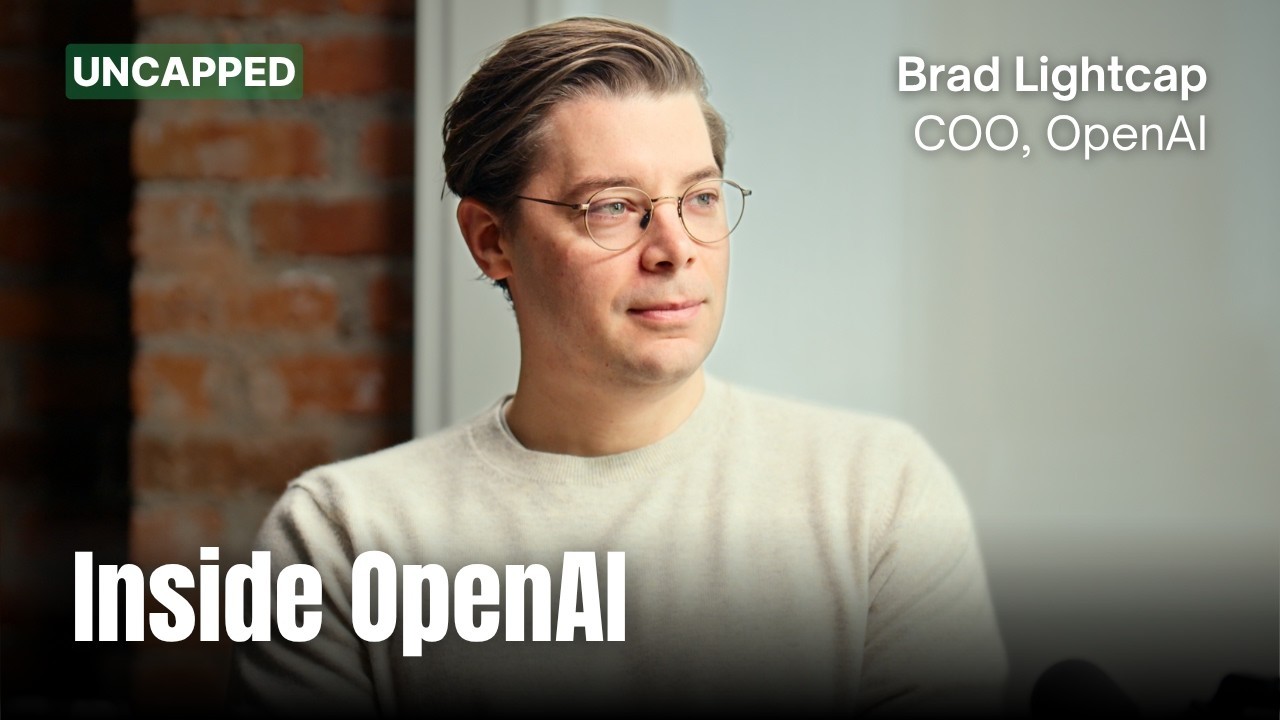
Lightcap believes we are dramatically underestimating the size and duration of the AI opportunity. His core variant view is threefold: (1) Software penetration in the global economy is at roughly 1%, not 80%, meaning the addressable market for AI-generated software is orders of magnitude larger than anyone is pricing in. (2) The cost-collapse dynamic in software engineering will not destroy demand but massively expand it — analogous to how reducing the cost of computation didn't eliminate computing jobs but created entirely new categories of demand. (3) Legacy public software companies are not the sitting ducks the market is treating them as; they are moving with startup-level urgency, possess irreplaceable customer relationships and domain knowledge, and may represent a contrarian long opportunity. He explicitly frames the selloff in public software as potentially mispriced, suggesting you could be 'long legacy software' as a contrarian bet.
Lightcap's causal logic inverts the consensus in a critical way. He argues the binding constraint is not model capability but diffusion — the gap between what models can do and what the economy has absorbed. Even if you froze model progress today, there is a 10-to-50-year diffusion cycle of innovation. His causal chain: (1) Models get dramatically better → (2) Cost of building custom software collapses to near-zero → (3) Every specific problem inside every business becomes economically viable to solve with custom-built software (not off-the-shelf SaaS) → (4) This creates massive new demand for people who can oversee design, implementation, and maintenance of potentially 10,000x more software → (5) The companies with the deepest customer relationships and domain knowledge (incumbents) have a structural advantage in this world because the hard part is no longer building the software but understanding the problem. The critical difference from consensus: he sees the application and services layer expanding, not compressing, and he sees incumbency as an asset rather than a liability because domain knowledge and customer trust cannot be replicated by a model release.
SOURCE OF THE EDGE
Lightcap's claimed edge rests on three pillars: (1) Operating experience as COO/CFO of OpenAI since 2018, giving him direct visibility into model capability trajectories, customer adoption patterns, and the actual behavior of enterprise customers engaging with AI — this is genuine and rare. (2) Direct daily engagement with essentially every major NASDAQ-listed software company as an OpenAI partner, giving him a proprietary read on how legacy software incumbents are actually responding to AI disruption — this is a real informational advantage that outside investors simply do not have. (3) A YC/investing background that gives him a comparative framework for technology cycles. The first two edges are credible and structural. He is not theorizing about how enterprises are responding; he is literally in the room with their CEOs and founders. His claim that legacy software companies are 'moving as fast as any startup' and that 'it's happening at the CEO and founder level' is an observation from direct commercial engagement, not a narrative construct. However, there is a clear conflict of interest: as OpenAI's COO, he is financially and reputationally incentivized to paint the most optimistic possible picture of AI adoption, market expansion, and the value of OpenAI's platform to all participants. His 'software is 1% penetrated' claim is directionally interesting but unverifiable and serves his commercial narrative. His suggestion to be 'long legacy software' is also self-serving — those companies are OpenAI's largest customers. The edge is real but the framing is biased. A listener should weight the observational data (what he's seeing enterprises actually do) heavily, while discounting the magnitude of his optimism by the degree of his commercial interest.
//
CONVICTION DETECTED
• 'I think that that entire era is over' • 'only good things can happen in my mind' • 'it's just kind of lazy' (on people who think there are no more good ideas) • 'I think we'll laugh' (about current models by end of year) • 'I think we'd be at 1%' (software penetration) • 'I think that is going to be one of the greatest gifts to the world' • 'everyone is as motivated to figure this out...as anyone else is' • 'we don't see those walls' • 'the amount of demand and the amount of opportunity that we see' • 'that to me is like an incredibly large opportunity' • 'I think the industry has a more of a duty' • 'I think amazing things are going to happen' • 'far and away our kind of most dominant model'
//
HEDGE DETECTED
• 'no one knows the future exactly. So I think everything here is speculation on all sides' • 'I personally I feel totally unmoored here I don't know' • 'I don't know if this is true and I don't know if this will hold. I'm certainly not qualified to judge that' • 'it's hard to comment on specifically that' • 'my guess' (on beginning of a new cycle) • 'I don't know if you're experiencing it one way or another' • 'it's a personal view of course' • 'I don't know that just seems more interesting than investing in tech' (hedging his original decision) • 'in practice is it going to work that way? I don't I don't know. I don't think so but maybe' The ratio of conviction to hedging reveals a speaker who hedges strategically at meta-level questions (will AGI arrive? what is the future exactly?) but speaks with near-absolute conviction on commercial and market-level claims (software is 1% penetrated, legacy software is undervalued, demand will explode). This is a pattern consistent with genuine internal confidence on the thesis that matters to him — the commercial opportunity — while maintaining intellectual humility on the existential questions he cannot control. The hedging is not performative uncertainty; it is scoped to domains where uncertainty is genuinely warranted. The conviction markers on market sizing, adoption dynamics, and enterprise behavior should be taken seriously because they align with his direct operational visibility. This is not a speaker performing certainty — he is genuinely certain about the commercial opportunity while genuinely uncertain about the ultimate trajectory of the technology itself.