
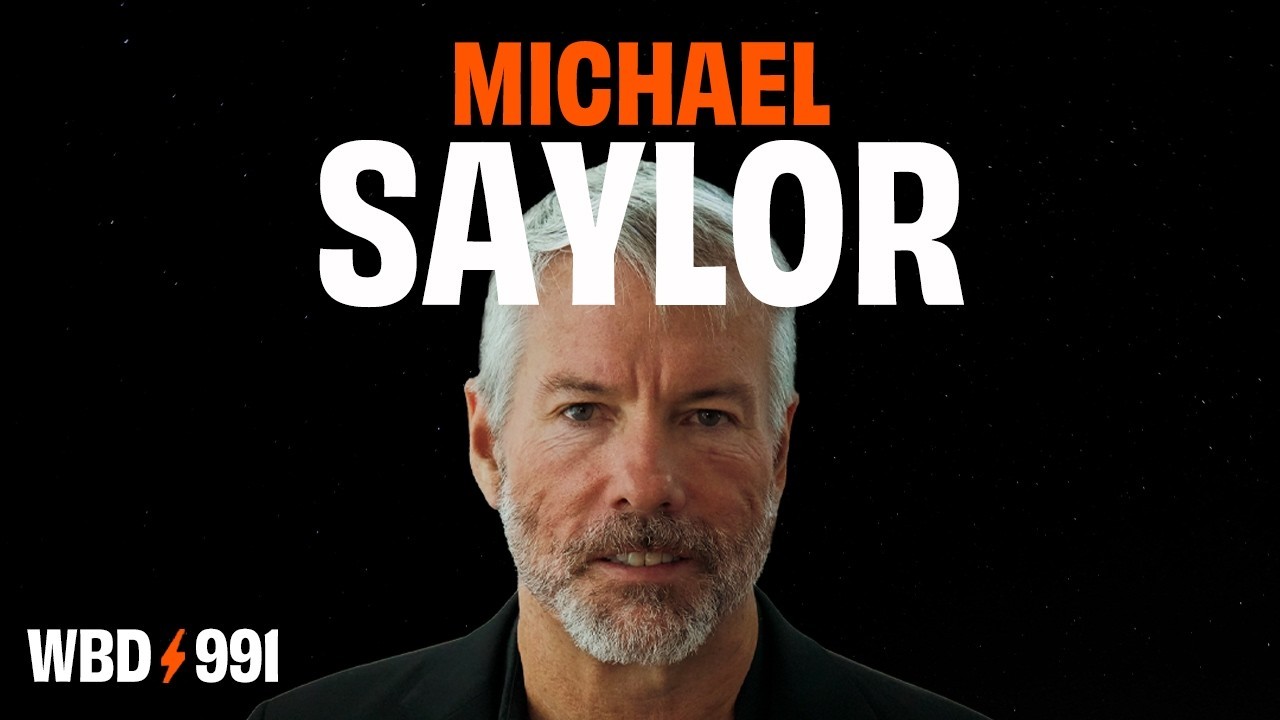
THESIS
//
//
//
//
NECESSARY CONDITION
Regulatory frameworks must remain permissive to innovation (avoiding the 'European' model) and open source development must remain unencumbered by downstream liability.
16:45
RISK
Steel Man Counter-Thesis
The strongest counter-thesis is that Strategy and the broader Bitcoin treasury company ecosystem represent a historically recognizable financial structure: a leveraged carry trade disguised as technological inevitability. The core mechanism is simple — issue equity and debt at favorable terms during bull markets, use proceeds to buy a volatile asset, and rely on the asset's appreciation to validate the issuance. This is structurally identical to the Japanese carry trade, the GBTC premium arbitrage, or the 2006-2007 CDO machine, all of which appeared to be perpetual motion machines until the underlying assumption (yen stability, GBTC premium persistence, housing appreciation) broke. Saylor's framework requires Bitcoin to compound at 30%+ annually to sustain the promised yields on preferred instruments, cover operating losses for treasury companies, and maintain the NAV premiums necessary for continued capital raising. But as Bitcoin's market cap grows from $2 trillion toward $10-20 trillion, its return profile must mathematically compress — there is insufficient global capital formation to sustain 30% annual returns on a $20 trillion asset indefinitely. When returns compress, the spread between Bitcoin appreciation and promised credit yields narrows, collateral buffers thin, and the entire digital credit → digital money pyramid becomes vulnerable to a liquidity crisis. Furthermore, the current regulatory tailwinds Saylor cites — pro-Bitcoin SEC, CFTC, Treasury, and White House — are administration-specific and could reverse entirely within one election cycle, as demonstrated by the 180-degree shift from the prior administration. The 50-year nuclear power moratorium Saylor himself cites is proof that political sentiment can destroy even objectively superior technologies for generations. Finally, the reflexive nature of Strategy's own market impact — purchasing $25 billion of Bitcoin in a single year while simultaneously being the primary evangelist for the thesis that drives others to buy — creates a concentration of correlated positioning that is indistinguishable from systemic risk. The bullish case requires every variable to go right simultaneously and indefinitely; the bearish case requires only one to fail.
//
THESIS
DEFENSE
//
THESIS
DEFENSE
//
THESIS
DEFENSE
//
ASYMMETRIC SKEW
The downside skew is severe and nonlinear. Upside is bounded by Bitcoin's mathematically compressing return profile as market cap grows — even in the bull case, 30% annualized returns cannot persist at $10T+ market cap, meaning the thesis gradually weakens even if correct directionally. Downside is catastrophic and path-dependent: a 50-70% Bitcoin drawdown (which has occurred three times historically) simultaneously destroys NAV, closes capital markets access for equity and debt issuance, compresses or inverts MNAV premiums, triggers potential margin calls or covenant breaches on credit instruments, and eliminates the reflexive buying pressure that supports the price. The preferred instruments (STRC/STRK) create fixed obligations that must be serviced regardless of Bitcoin's price, introducing structural fragility absent from simple Bitcoin holding. The asymmetry is approximately 2:1 to 3:1 skewed to the downside on a risk-adjusted basis when accounting for the leverage embedded in the capital structure and the reflexive feedback loops, despite Saylor's framing suggesting unlimited upside with manageable volatility.
ALPHA
NOISE
The Consensus
The market consensus heading into 2026 is that Bitcoin had a disappointing 2025 — the price ended the year lower than it started, the four-year cycle may be playing out as a top, and the proliferation of Bitcoin treasury companies (many trading below 1x mNAV) signals market saturation and questionable sustainability. The broader market view treats the ~95-day drawdown from the all-time high as evidence of cyclical exhaustion, and there is widespread skepticism about whether the ecosystem of smaller treasury companies represents genuine value creation or speculative excess.
The market's causal logic runs: Bitcoin's price peaked in early October 2025 and has declined since → the four-year cycle pattern is reasserting → treasury companies that issued equity/debt to buy Bitcoin are now underwater with stocks trading below NAV → the model of leveraged Bitcoin accumulation has limits → market cannot sustain 200+ treasury companies doing variants of the same strategy → therefore Bitcoin and the treasury company ecosystem are in a corrective or exhaustion phase.
SIGNAL
The Variant
Saylor's variant perception is that 2025 was one of the most structurally transformative years in Bitcoin's history and the market is catastrophically wrong to focus on short-term price action. His thesis: the price drawdown is noise against a signal of irreversible institutional infrastructure buildout — fair value accounting (FASB), banking acceptance (JP Morgan, Morgan Stanley, Citi, Schwab), regulatory clarity (pro-Bitcoin SEC, CFTC, Treasury), derivatives market commercialization (CME), in-kind ETF create/redeem, corporate alternative minimum tax resolution, insurance market re-entry, and a 3-4x expansion in the number of companies holding Bitcoin on balance sheets. He believes 2026 will be a great year because the structural preconditions for mass commercialization and globalization of Bitcoin have been satisfied, and the market is mispricing the present by fixating on a 95-day window instead of recognizing a generational infrastructure shift. He further believes the real opportunity is not Bitcoin-the-asset but Bitcoin as the base layer for an entirely new digital financial system — digital capital feeding digital credit feeding digital money — with a total addressable market in the hundreds of trillions of dollars.
Saylor's causal logic is fundamentally different and operates on a much longer time horizon. His chain: (1) Bitcoin is digital capital, analogous to electricity as a general-purpose technology → (2) General-purpose technologies take 10-30+ years for 75% adoption (electricity took 30 years to reach 75% of factories; nuclear power suffered a 50-year bear market from 1973-2023) → (3) Short-term price movements are meaningless noise within this adoption curve → (4) What matters is infrastructure: accounting standards, banking integration, regulatory frameworks, derivatives markets, credit instruments → (5) All of these infrastructure pieces were delivered in 2025 → (6) The next phase is building digital credit (STRF/STRK) as feedstock for digital money, which can be integrated into existing banking systems globally → (7) Banks, insurers, sovereign wealth funds, and nation-states will adopt this because it offers 2-3x better yields than existing instruments → (8) Strategy's role is to be the 'humble supplier' of digital credit, not to compete with banks/insurers/exchanges → (9) Therefore the current price and mNAV discounts of treasury companies are irrelevant to the long-term trajectory, which is the digitization of the entire $300+ trillion global credit and money system.
SOURCE OF THE EDGE
Saylor's claimed edge rests on three pillars, each of which deserves separate credibility assessment. First, operating experience: he has been running the largest corporate Bitcoin treasury for nearly five years, has personally underwritten the company's insurance when no insurer would, and has navigated the full cycle of debanking, accounting hostility, and regulatory uncertainty. This is a genuine structural advantage — he has lived through problems most analysts only theorize about, and his granular knowledge of insurance markets, banking relationships, and capital markets mechanics for Bitcoin is real and hard to replicate. Second, his framework for digital capital → digital credit → digital money is an intellectually coherent vision, but it is largely forward-looking and unfalsifiable on any near-term horizon. The claim that STRF-type instruments will become the feedstock for a $300 trillion credit market transformation is not an edge derived from proprietary information — it is a thesis about the future architecture of finance. It may prove correct, but the 'edge' here is conviction and narrative construction, not information asymmetry. Third, and most critically, Saylor is the single largest interested party in Bitcoin's success. His company holds 650,000+ Bitcoin. Every statement he makes is simultaneously analysis and advocacy. His dismissal of any criticism of Bitcoin treasury companies as 'toxic,' 'ignorant,' and 'offensive' — including what were fairly standard analytical questions about market sustainability — reveals that his edge is inseparable from his position. He cannot afford to see the bear case because his entire net worth and corporate existence depends on the bull case. This does not make him wrong, but it means his 'edge' is better understood as maximum concentrated exposure producing maximum conviction, rather than as a dispassionate analytical advantage. The structural knowledge from operating experience is real. The macro thesis is plausible but unverifiable. The objectivity is compromised by position size.
//
CONVICTION DETECTED
• I think 2026 is going to be a great year for Bitcoin • The fundamentals look pretty good to me • I'm feeling pretty bullish and I'm pretty happy about where we are • I would give up the all-time high • I'm going to go on the record and say that I have an endurance of more than 94 days • Has my conviction been swayed by 94 days of not hitting an all-time high? No. • There's room for 400 million companies to buy Bitcoin, Danny • The industry is evolving the right way. The network is evolving the right way • We're not competing with each other • Bitcoin is for everybody. Everybody is better with Bitcoin • Laser like laser focused • You have the world's greatest product • If a hundred companies copy it and they also issue digital credit, that will accelerate the transformation of the credit markets and we all win together • The future is we embrace Bitcoin as digital capital. We rebuild the entire economy with that as the base layer
//
HEDGE DETECTED
• I think trying to guess where the market goes over a 100 day time frame is a fool's errand • I think you shouldn't be roped into trying to forecast what is the price in 90 days or the price in 188 days • I don't think we should be spending time on negativity • Maybe you put on a volatility buffer. Maybe you don't need a volatility buffer • It'll take a mount of time The ratio of conviction to hedging is extremely skewed toward conviction. The few hedging statements that exist are not genuine expressions of uncertainty about Bitcoin's trajectory — they are tactical deflections designed to reframe timeframes rather than acknowledge downside risk. Saylor never once hedges on Bitcoin's fundamental value proposition, on Strategy's business model, on the viability of digital credit, or on the long-term price direction. He never says 'I could be wrong,' 'there are scenarios where this doesn't work,' or 'the risk is X.' The complete absence of substantive hedging from someone with a $60+ billion concentrated position is not a sign of genuine certainty — it is a sign of someone who has made a bet so large that acknowledging uncertainty would be existentially threatening to the thesis, the stock, and the capital-raising machine that depends on unwavering confidence. This is performed certainty fused with genuine belief, and listeners should weight the thesis accordingly: the analytical framework has merit, but it is being delivered by someone who literally cannot afford to express doubt.