
dstl

TERMINAL

TERMINAL

LIBRARY

LIBRARY

//

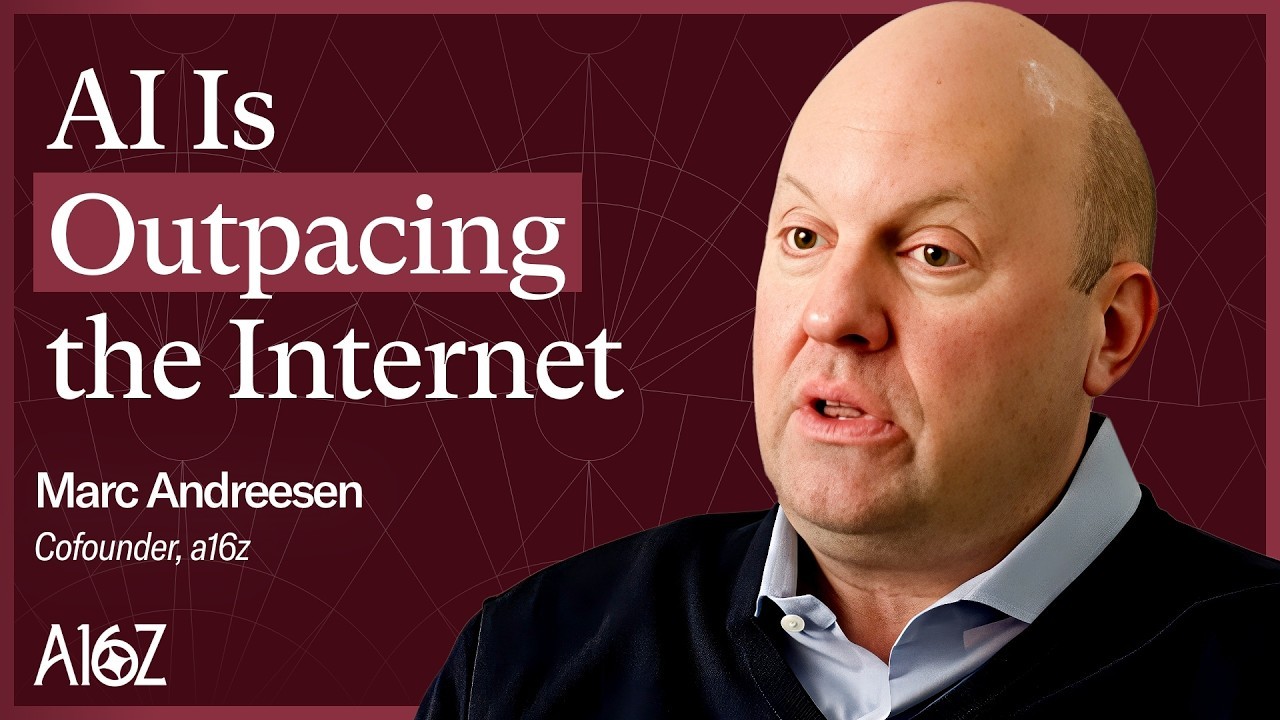
Marc Andreessen's 2026 Outlook: AI Timelines, US vs. China, and The Price of AI

Marc Andreessen's 2026 Outlook: AI Timelines, US vs. China, and The Price of AI

Marc Andreessen's 2026 Outlook: AI Timelines, US vs. China, and The Price of AI

Jan 7, 2026

Jan 7, 2026

A16Z

A16Z

1:21:17

1:21:17

164K Views

164K Views

THESIS

The AI revolution is a secular transformation driven by the hyper-deflation of intelligence costs and pre-existing internet distribution rails, creating an unprecedented revenue takeoff.

The AI revolution is a secular transformation driven by the hyper-deflation of intelligence costs and pre-existing internet distribution rails, creating an unprecedented revenue takeoff.

The AI revolution is a secular transformation driven by the hyper-deflation of intelligence costs and pre-existing internet distribution rails, creating an unprecedented revenue takeoff.

ASSET CLASS

ASSET CLASS

SECULAR

SECULAR

CONVICTION

CONVICTION

HIGH

HIGH

TIME HORIZON

TIME HORIZON

5 to 10 years

5 to 10 years

01

01

//

PREMISE

PREMISE

Hyper-Deflation of Intelligence Costs

Hyper-Deflation of Intelligence Costs

The per-unit cost of AI intelligence is collapsing faster than Moore's Law, while the internet provides a pre-built carrier wave to deploy these capabilities instantly to 5 billion people.

The per-unit cost of AI intelligence is collapsing faster than Moore's Law, while the internet provides a pre-built carrier wave to deploy these capabilities instantly to 5 billion people.

02

02

//

MECHANISM

MECHANISM

Elasticity of Demand via Infrastructure Scale

Elasticity of Demand via Infrastructure Scale

Massive capital investment is converting hardware shortages into future gluts, driving prices down further. This cost reduction triggers extreme demand elasticity, where lower prices unlock vast new consumer and enterprise applications that were previously economically unviable.

Massive capital investment is converting hardware shortages into future gluts, driving prices down further. This cost reduction triggers extreme demand elasticity, where lower prices unlock vast new consumer and enterprise applications that were previously economically unviable.

03

03

//

OUTCOME

OUTCOME

Ubiquitous Application and Revenue Growth

Ubiquitous Application and Revenue Growth

The market will structure into a few massive 'God models' and countless specialized small models, fueling an application layer that generates actual revenue at takeoff rates faster than any previous tech cycle.

The market will structure into a few massive 'God models' and countless specialized small models, fueling an application layer that generates actual revenue at takeoff rates faster than any previous tech cycle.

//

NECESSARY CONDITION

Regulatory frameworks must remain permissive to innovation (avoiding the 'European' model) and open source development must remain unencumbered by downstream liability.

This new wave of AI companies is is growing revenue like just like actual customer revenue, actual demand translated through to dollars showing up in bank accounts at like an absolutely unprecedented takeoff rate.

This new wave of AI companies is is growing revenue like just like actual customer revenue, actual demand translated through to dollars showing up in bank accounts at like an absolutely unprecedented takeoff rate.

00:00

RISK

Steel Man Counter-Thesis

The AI industry is entering a dangerous 'shortage-to-glut' cycle where trillions in infrastructure spend will collide with a deflationary revenue environment driven by state-subsidized Chinese 'dumping' and open-source proliferation. While revenue is growing, the 'messy' reality of enterprise adoption and the threat of regulatory fragmentation (state-level liability laws) could permanently impair the unit economics required to sustain the current valuation multiples.

//

RISK 01

RISK 01

Regulatory Balkanization and Downstream Liability

Regulatory Balkanization and Downstream Liability

THESIS

The emergence of 50 disparate state-level AI laws creates a catastrophic compliance environment. Specifically, legislation assigning 'downstream liability' to open-source developers (e.g., holding a developer liable if their model is used years later in a nuclear plant failure) would effectively kill open-source development, academic research, and the startup ecosystem.

The emergence of 50 disparate state-level AI laws creates a catastrophic compliance environment. Specifically, legislation assigning 'downstream liability' to open-source developers (e.g., holding a developer liable if their model is used years later in a nuclear plant failure) would effectively kill open-source development, academic research, and the startup ecosystem.

DEFENSE

The firm is actively deploying a 'Little Tech Agenda' in Washington to advocate for federal preemption and protect the freedom to innovate, noting that the risk of ruinous federal legislation has decreased.

The firm is actively deploying a 'Little Tech Agenda' in Washington to advocate for federal preemption and protect the freedom to innovate, noting that the risk of ruinous federal legislation has decreased.

//

RISK 02

RISK 02

State-Subsidized Commoditization ('Dumping')

State-Subsidized Commoditization ('Dumping')

THESIS

Chinese competitors (like DeepSeek) are releasing state-of-the-art models as open source, potentially as a strategic move to 'dump' subsidized product into the market. This commoditizes the intelligence layer immediately, undercutting the high-margin business models of Western incumbents who rely on high prices to fund R&D.

Chinese competitors (like DeepSeek) are releasing state-of-the-art models as open source, potentially as a strategic move to 'dump' subsidized product into the market. This commoditizes the intelligence layer immediately, undercutting the high-margin business models of Western incumbents who rely on high prices to fund R&D.

DEFENSE

The firm employs a portfolio approach, betting on multiple contradictory strategies simultaneously (open vs. closed, big vs. small models) to hedge against any single market structure winning out.

The firm employs a portfolio approach, betting on multiple contradictory strategies simultaneously (open vs. closed, big vs. small models) to hedge against any single market structure winning out.

//

RISK 03

RISK 03

Infrastructure Investment-Demand Mismatch (The 'Glut')

Infrastructure Investment-Demand Mismatch (The 'Glut')

THESIS

The industry is in a classic 'shortage causes glut' cycle where massive over-investment in chips and data centers is occurring. If the 'messy' adoption process and application layer revenue do not scale linearly to absorb this capacity, the industry faces a severe correction where unit costs collapse faster than demand elasticity can compensate.

The industry is in a classic 'shortage causes glut' cycle where massive over-investment in chips and data centers is occurring. If the 'messy' adoption process and application layer revenue do not scale linearly to absorb this capacity, the industry faces a severe correction where unit costs collapse faster than demand elasticity can compensate.

DEFENSE

The defense relies on the belief that demand for intelligence is highly elastic; as costs drop 'like a rock,' the usage will expand to fill the available capacity, similar to historical trends in bandwidth and compute.

The defense relies on the belief that demand for intelligence is highly elastic; as costs drop 'like a rock,' the usage will expand to fill the available capacity, similar to historical trends in bandwidth and compute.

//

ASYMMETRIC SKEW

High Upside Skew (Trillions in value creation vs. localized capital destruction in infrastructure gluts)

ALPHA

NOISE

The Consensus

AI is a capital-intensive bubble where 'ruinous expenses' outpace revenue. The public narrative is dominated by fear of job loss, regulatory panic (safety), and skepticism that current 'GPT wrappers' have durable value. There is a belief that model capabilities may be 'topping out.'

High infrastructure costs (CapEx) will crush margins. Regulatory fragmentation (50 state laws) and open-source commoditization (China 'dumping') threaten the economic viability of the sector.

SIGNAL

The Variant

This is the single biggest technological revolution since the wheel—bigger than the internet. We are witnessing an 'absolutely unprecedented takeoff rate' in actual revenue (real dollars in bank accounts). The 'panic' is noise; 'revealed preferences' show mass adoption is already happening.

Infrastructure over-investment (shortage-to-glut) is a feature, not a bug. It will drive intelligence costs down 'faster than Moore's Law,' triggering massive demand elasticity. Lower costs unleash the application layer, which is not just 'wrapping' models but backward-integrating into deep tech.

SOURCE OF THE EDGE

Privileged Data Access (Real-time visibility into portfolio company bank accounts/revenue growth) and Historical Pattern Recognition (comparing current adoption to Internet/Mobile cycles).

//

CONVICTION DETECTED

• This is the biggest tech technological revolution of my life • Clearly bigger than the internet • Absolutely unprecedented takeoff rate • The capabilities are truly magical • Just no question tokens by the drink are going to get a lot cheaper • Price of AI is falling much faster than Moore's law

//

HEDGE DETECTED

• These are trillion dollar questions, not answers • I'm very skeptical that the form and shape... is what they're going to be using in 5 or 10 years • It's going to kind of come in fits and starts • My kind of working assumption is... • It's impossible to prove • I don't know. I don't want to predict