
THESIS
//
//
//
//
NECESSARY CONDITION
Regulatory frameworks must remain permissive to innovation (avoiding the 'European' model) and open source development must remain unencumbered by downstream liability.
75:32
RISK
Steel Man Counter-Thesis
The strongest counter-argument is that Nvidia's extraordinary current position represents peak advantage in a transitional moment, not a durable structural moat. Historical precedent shows that dominant hardware platforms in computing transitions (Cisco in networking, Intel in CPUs, Sun in servers) eventually face margin compression and share erosion as standards mature and alternatives proliferate. The CUDA moat, while formidable today, could weaken as PyTorch/JAX frameworks increasingly abstract hardware, as hyperscalers optimize their custom silicon for specific workloads, and as open-source inference optimization (like the distributed training breakthrough mentioned) democratizes performance. The trillion-dollar forward pipeline depends on AI infrastructure buildout continuing at current pace, but enterprise AI adoption showing only 17% US popularity and regulatory headwinds could slow deployment. Most critically, the inference market that Jensen describes as exploding 10,000x is precisely the market where Nvidia faces most competition - inference is more amenable to specialization than training. If Grok, TPUs, and custom ASICs capture disproportionate inference share while training demand plateaus post-frontier model development, Nvidia's growth could decelerate faster than the bull case assumes. The company's own pivot from GPU company to AI factory company implicitly acknowledges that chip superiority alone is insufficient - but competing on full-stack solutions exposes Nvidia to competition from vertically integrated players with captive demand.
//
THESIS
DEFENSE
//
THESIS
DEFENSE
//
THESIS
DEFENSE
//
ASYMMETRIC SKEW
Downside risk is concentrated in geopolitical supply chain disruption (binary, catastrophic) and gradual share erosion to custom silicon (cumulative, persistent). Upside depends on AI compute demand scaling to millions-fold current levels while Nvidia maintains pricing power and market share - a scenario requiring both macro tailwinds and competitive moat durability. The asymmetry favors downside in a 3-5 year window because multiple independent risk factors (China, Taiwan, hyperscaler defection, open-source commoditization) need not all materialize - any single failure mode could significantly impair the thesis, while the upside requires all favorable conditions to persist simultaneously.
ALPHA
NOISE
The Consensus
The market believes AI infrastructure investment faces diminishing returns, with Nvidia losing share to cheaper alternatives (custom ASICs, AMD) and growth decelerating sharply (30% next year, 20% the year after, 7% by 2029). The consensus view holds that AI compute demand, while growing, will normalize as training scaling laws hit limits and inference becomes commoditized. The market also believes Nvidia's dominance is primarily in GPUs for hyperscalers, with limited expansion into adjacent markets.
The market's logic rests on three pillars: (1) Nvidia's $50 billion inference factory costs 60-70% more than alternatives at $25-30 billion, creating inevitable margin pressure and share loss; (2) hyperscalers are developing competitive custom silicon (Google TPU, Amazon Inferentia/Trainium), reducing dependency; (3) the law of large numbers makes sustained hypergrowth mathematically implausible for a company approaching $350+ billion in revenue.
SIGNAL
The Variant
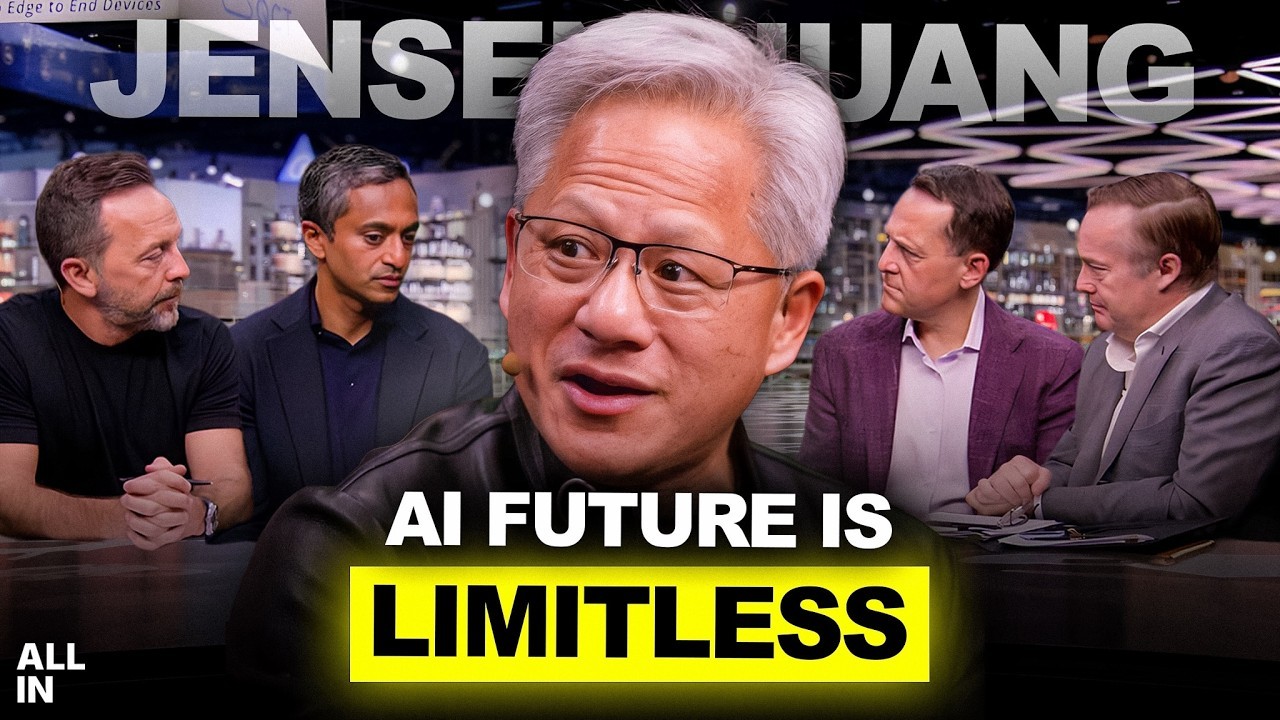
Huang believes AI compute demand will scale 1 million times from current levels, driven by three compounding waves: the transition from generative AI (100x compute) to reasoning (another 100x) to agentic systems (another 100x) in just two years, with further expansion ahead. He rejects the framing of Nvidia as a chip company, positioning it instead as an AI factory company whose total addressable market has expanded 33-50% through disaggregated computing architectures spanning GPUs, CPUs, networking, storage (BlueField), and now Grock processors. He argues analysts fundamentally misunderstand the breadth of AI adoption beyond hyperscalers, missing enterprise, edge, regional, and industry-specific deployment.
Huang's counterlogic inverts the cost equation: he argues the $50 billion factory produces tokens at 10x the efficiency of alternatives, making cost-per-token dramatically lower despite higher upfront capital expenditure. He breaks down the $50 billion figure to show that $20 billion is land, power, and shell that any competitor must also spend, while the incremental GPU cost difference is marginal relative to the throughput advantage. On custom silicon competition, he claims Nvidia is actually gaining share because: (1) open-source models (the second largest category after OpenAI) run exclusively on Nvidia; (2) Anthropic and Meta have shifted workloads to Nvidia; (3) 40% of Nvidia's business requires full-stack AI factory capability that chip-only competitors cannot provide; (4) Nvidia is the only architecture portable across every cloud, on-premise, edge, and space deployment.
SOURCE OF THE EDGE
Huang's claimed edge derives from three sources of varying credibility. First, operational access: he has direct visibility into customer purchase orders, including AWS's announced commitment to buy one million chips and newly approved Chinese export licenses, giving him forward demand signals analysts lack. This is genuine structural information asymmetry. Second, architectural control: as both platform provider and de facto standard (CUDA, Dynamo operating system), he observes compute consumption patterns across the entire AI ecosystem, from training to inference to agentic workloads, creating a ground-truth view of actual compute intensity analysts cannot access. This is also credible. Third, however, his market sizing claims (1 millionx compute scaling, trillion-dollar visibility) require accepting his framework that AI demand is fundamentally unbounded, which is a narrative construction rather than provable fact. His dismissal of analyst growth deceleration models as 'they just don't understand the scale and breadth of AI' is tautological. The edge on near-term demand signals appears real; the edge on long-term market structure is a bet on his vision being correct rather than demonstrated fact.
//
CONVICTION DETECTED
• 'We're at 0%' (on China market share loss) • '100% in Israel. We are 100% behind the families there. We are 100% in the Middle East' • 'Three years to five years we're going to have robots all over the place' • 'I believe that though many of those chauffeurs will actually be in the car' • 'I do. I'm not doomer' • 'Way better than that' (on Anthropic's revenue trajectory) • 'In five years time I completely believe that the healthcare industry where digital biology is going to inflect' • 'We are absolutely at a millionx' • 'Every single instrument whether it's ultrasound or CT...will be agentic' • 'The $50 billion factory will generate for you the lowest cost tokens'
//
HEDGE DETECTED
• 'My sense is' (when discussing TAM expansion) • 'I'm hoping' (on Grock processors contributing to the stack) • 'Depending on the type of problem you're having' • 'It'll take years. It's okay. We got plenty of time' (on space data centers) • 'I wouldn't be surprised actually if' • 'I think helium could be a problem, but it's also the case that the supply chain probably has a lot of buffer in it' • 'These kind of things tend to have a lot of buffer' • 'We're going to go explore it' (on space architecture) The ratio reveals high genuine confidence with selective tactical hedging. Huang hedges primarily on timeline and external dependencies (helium supply, space architecture development) while expressing near-absolute conviction on strategic direction and competitive position. This pattern suggests authentic internal confidence rather than performed certainty. When he hedges, it is on variables outside his control; when he asserts, it is on proprietary operational knowledge. The asymmetry lends credibility to his conviction claims, though listeners should note his incentive structure as CEO requires projecting confidence regardless of private uncertainty.