
dstl

TERMINAL

TERMINAL

LIBRARY

LIBRARY

//

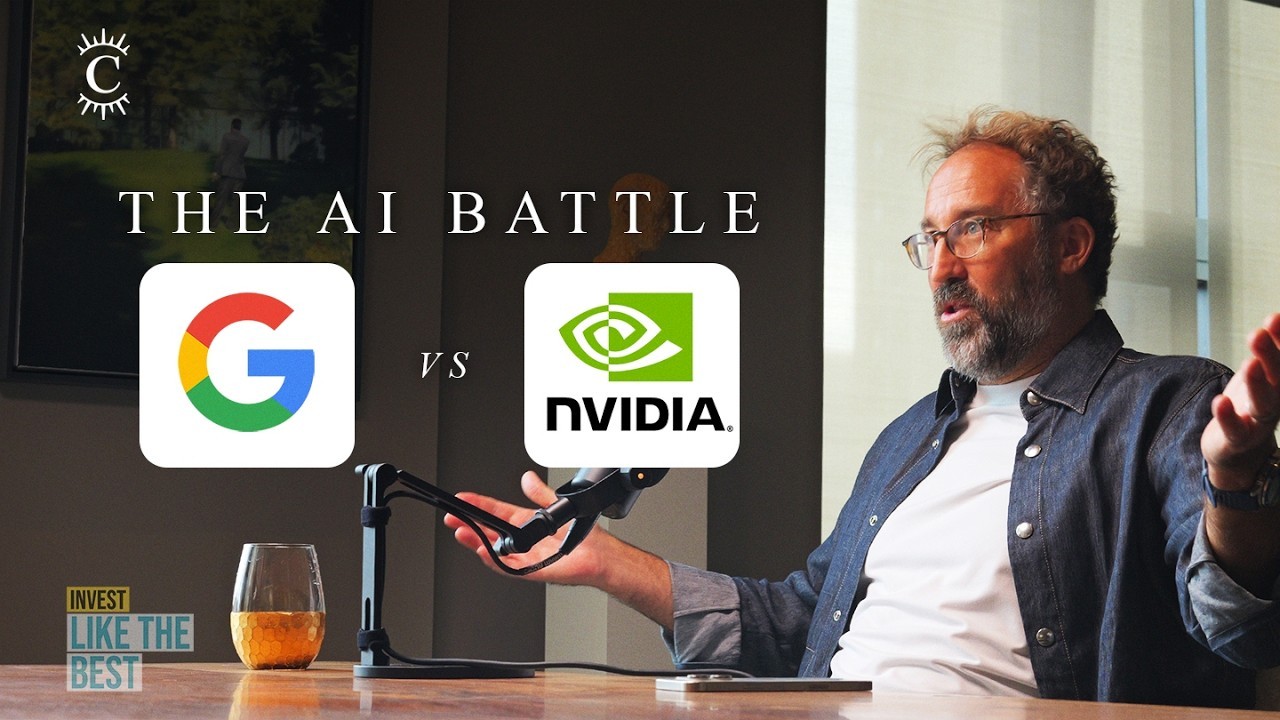
GPUs, TPUs, & The Economics of AI Explained | Gavin Baker Interview

GPUs, TPUs, & The Economics of AI Explained | Gavin Baker Interview

GPUs, TPUs, & The Economics of AI Explained | Gavin Baker Interview

Dec 9, 2025

Dec 9, 2025

Invest Like The Best

Invest Like The Best

1:28:25

1:28:25

221K Views

221K Views

THESIS

The arrival of Nvidia's Blackwell architecture neutralizes Google's historic ASIC cost advantage, fueling a 'Prisoner's Dilemma' CapEx supercycle that cements merchant silicon dominance while forcing software models to compress margins.

The arrival of Nvidia's Blackwell architecture neutralizes Google's historic ASIC cost advantage, fueling a 'Prisoner's Dilemma' CapEx supercycle that cements merchant silicon dominance while forcing software models to compress margins.

The arrival of Nvidia's Blackwell architecture neutralizes Google's historic ASIC cost advantage, fueling a 'Prisoner's Dilemma' CapEx supercycle that cements merchant silicon dominance while forcing software models to compress margins.

ASSET CLASS

ASSET CLASS

SECULAR

SECULAR

CONVICTION

CONVICTION

HIGH

HIGH

TIME HORIZON

TIME HORIZON

18-24 Months (spanning the Blackwell deployment through 2026/2027)

18-24 Months (spanning the Blackwell deployment through 2026/2027)

01

01

//

PREMISE

PREMISE

Intact Scaling Laws & The 'Low-Cost Producer' Distortion

Intact Scaling Laws & The 'Low-Cost Producer' Distortion

AI scaling laws for pre-training remain empirically intact, but the industry is shifting toward 'post-training' reasoning (test-time compute). Historically, Google has used its proprietary TPUs to be the low-cost producer of tokens, allowing them to 'suck the economic oxygen' out of the ecosystem by running at negative margins that competitors couldn't match.

AI scaling laws for pre-training remain empirically intact, but the industry is shifting toward 'post-training' reasoning (test-time compute). Historically, Google has used its proprietary TPUs to be the low-cost producer of tokens, allowing them to 'suck the economic oxygen' out of the ecosystem by running at negative margins that competitors couldn't match.

02

02

//

MECHANISM

MECHANISM

The Blackwell Equalizer & XAI's Velocity

The Blackwell Equalizer & XAI's Velocity

The deployment of Nvidia's Blackwell chips (specifically GB200/GB300), led by XAI's rapid data center build-out, radically lowers the cost per token for merchant silicon users. This effectively eliminates the cost moat of proprietary ASICs (like TPUs/Trainium), as Nvidia's annual release cadence creates a performance gap that internal chip teams cannot match due to friction and conservative design.

The deployment of Nvidia's Blackwell chips (specifically GB200/GB300), led by XAI's rapid data center build-out, radically lowers the cost per token for merchant silicon users. This effectively eliminates the cost moat of proprietary ASICs (like TPUs/Trainium), as Nvidia's annual release cadence creates a performance gap that internal chip teams cannot match due to friction and conservative design.

03

03

//

OUTCOME

OUTCOME

Infrastructure Bifurcation & The End of High-Margin SaaS

Infrastructure Bifurcation & The End of High-Margin SaaS

As the cost advantage shifts to Nvidia-based infrastructure, the 'Prisoner's Dilemma' compels hyperscalers to sustain massive CapEx or risk obsolescence. Simultaneously, the abundance of 'reasoning' compute forces application SaaS companies to transition from high-margin (80%) seat-based models to lower-margin (40%) 'agent' models, a transition most incumbents (except Microsoft) are currently failing to make.

As the cost advantage shifts to Nvidia-based infrastructure, the 'Prisoner's Dilemma' compels hyperscalers to sustain massive CapEx or risk obsolescence. Simultaneously, the abundance of 'reasoning' compute forces application SaaS companies to transition from high-margin (80%) seat-based models to lower-margin (40%) 'agent' models, a transition most incumbents (except Microsoft) are currently failing to make.

//

NECESSARY CONDITION

Scaling laws must continue to hold across new generations (e.g., Blackwell models showing clear gains) and 'reasoning' must translate to economic usefulness.

AI is the first time in my career as a tech investor that being the low cost producer has ever mattered... The companies that use the GB300's, they are going to be the low cost producer of tokens... This has pretty profound implications for the economics of AI.

AI is the first time in my career as a tech investor that being the low cost producer has ever mattered... The companies that use the GB300's, they are going to be the low cost producer of tokens... This has pretty profound implications for the economics of AI.

11:18

RISK

Steel Man Counter-Thesis

The 'Prisoner's Dilemma' forcing function collapses if 'Edge AI' achieves competence faster than 'God Models' achieve omniscience. If a local phone chip can run a pruned 115-IQ model for free, the economic rationale for trillion-dollar centralized server farms vanishes, turning the current CapEx surge into the largest capital misallocation in history.

//

RISK 01

RISK 01

The Edge AI Demand Deflation

The Edge AI Demand Deflation

THESIS

The emergence of efficient, pruned models (e.g., Gemini 5 or Grok 4 derivatives) running locally on smartphones could satisfy the vast majority of user queries (30-60 tokens/second) at zero marginal cost. If 'good enough' intelligence moves to the edge, the demand for massive, centralized 'God Model' inference on Blackwell clusters evaporates, breaking the capex justification for hyperscalers.

The emergence of efficient, pruned models (e.g., Gemini 5 or Grok 4 derivatives) running locally on smartphones could satisfy the vast majority of user queries (30-60 tokens/second) at zero marginal cost. If 'good enough' intelligence moves to the edge, the demand for massive, centralized 'God Model' inference on Blackwell clusters evaporates, breaking the capex justification for hyperscalers.

DEFENSE

The speaker explicitly acknowledges this as 'by far the most plausible and scariest bear case' , noting that Apple's strategy is to be a distributor of privacy-safe, on-device AI while only calling larger cloud models for complex tasks.

The speaker explicitly acknowledges this as 'by far the most plausible and scariest bear case' , noting that Apple's strategy is to be a distributor of privacy-safe, on-device AI while only calling larger cloud models for complex tasks.

//

RISK 02

RISK 02

The Blackwell ROI 'Air Gap'

The Blackwell ROI 'Air Gap'

THESIS

A potential 3-4 quarter period where capital expenditures skyrocket due to purchasing expensive Blackwell chips, but Return on Invested Capital (ROIC) declines because those chips are locked in training (which generates no revenue) rather than inference. This financial optical illusion could cause public market investors to panic and force a pullback in spending.

A potential 3-4 quarter period where capital expenditures skyrocket due to purchasing expensive Blackwell chips, but Return on Invested Capital (ROIC) declines because those chips are locked in training (which generates no revenue) rather than inference. This financial optical illusion could cause public market investors to panic and force a pullback in spending.

DEFENSE

The speaker was 'really worried' about this but cites recent non-tech sector earnings (e.g., C.H. Robinson) showing tangible productivity uplifts (20% stock rise) as evidence that immediate productivity gains might bridge this financial gap.

The speaker was 'really worried' about this but cites recent non-tech sector earnings (e.g., C.H. Robinson) showing tangible productivity uplifts (20% stock rise) as evidence that immediate productivity gains might bridge this financial gap.

//

RISK 03

RISK 03

TSMC's 'Trauma-Induced' Supply Conservatism

TSMC's 'Trauma-Induced' Supply Conservatism

THESIS

Taiwan Semiconductor (TSMC) is refusing to expand capacity as fast as customers demand because they fear a repeat of the 2000s fiber/tech glut. Their skepticism regarding the durability of AI demand acts as an artificial bottleneck, potentially stalling the deployment speed necessary to sustain the 'supercycle'.

Taiwan Semiconductor (TSMC) is refusing to expand capacity as fast as customers demand because they fear a repeat of the 2000s fiber/tech glut. Their skepticism regarding the durability of AI demand acts as an artificial bottleneck, potentially stalling the deployment speed necessary to sustain the 'supercycle'.

DEFENSE

The speaker reframes this bottleneck as a positive 'natural governor' that prevents a catastrophic bubble burst, arguing that a constrained supply chain leads to a 'smoother and longer' cycle rather than a boom-bust crash.

The speaker reframes this bottleneck as a positive 'natural governor' that prevents a catastrophic bubble burst, arguing that a constrained supply chain leads to a 'smoother and longer' cycle rather than a boom-bust crash.

//

ASYMMETRIC SKEW

High Upside / Catastrophic Downside (The thesis relies on a fragile chain: Scaling Laws -> Centralized Compute Demand -> Infinite ROI. If the link between 'Intelligence' and 'Revenue' breaks, the massive fixed costs of the new infrastructure become a liability.)

ALPHA

NOISE

The Consensus

The market believes proprietary ASICs (Google TPUs, Amazon Trainium) provide a durable long-term cost advantage over merchant silicon. Additionally, investors fear an 'ROI Air Gap' where massive CapEx spend yields diminishing returns, and view high-margin SaaS (80% gross margins) as a defensive fortress.

Hyperscalers invest in custom silicon to lower Total Cost of Ownership (TCO) and reduce reliance on Nvidia. SaaS companies can layer AI features on top of existing seats to expand revenue while protecting margins.

SIGNAL

The Variant

The speaker argues Nvidia's Blackwell cycle completely neutralizes the ASIC cost advantage, rendering Google's low-cost dominance obsolete. He views high-margin SaaS as a 'burning platform' analogous to 1990s brick-and-mortar retail—companies must embrace low-margin (35-40%) AI agents immediately or face extinction.

Nvidia's new annual release cadence creates a performance velocity that internal ASIC teams cannot match (the 'F4 Phantom vs. F-35' gap). Consequently, the 'Prisoner's Dilemma' forces all players to buy Nvidia to survive. For SaaS, AI is not a feature but a deflationary force; trying to protect 80% margins guarantees failure against AI-native competitors running at 40%.

SOURCE OF THE EDGE

First Principles Reasoning (Physics of space/thermodynamics, Unit Economics of production) & Historical Pattern Recognition (Retail vs. E-commerce analogy).

//

CONVICTION DETECTED

• This is a life or death decision that essentially everyone except Microsoft is failing it. • In every way, data centers in space from a first principles perspective are superior to data centers on earth. • Empirically, factually, unambiguously been positive. • Absolute guarantee. • Scaling laws for pre-training are intact.

//

HEDGE DETECTED

• I don't know if he's in the top hundred. • We can debate when that will happen. • I don't know that we're going to be curing cancer. • Maybe China or Russia will be able to land a rocket. • It's hard to see differences.