
dstl

TERMINAL

TERMINAL

LIBRARY

LIBRARY

//

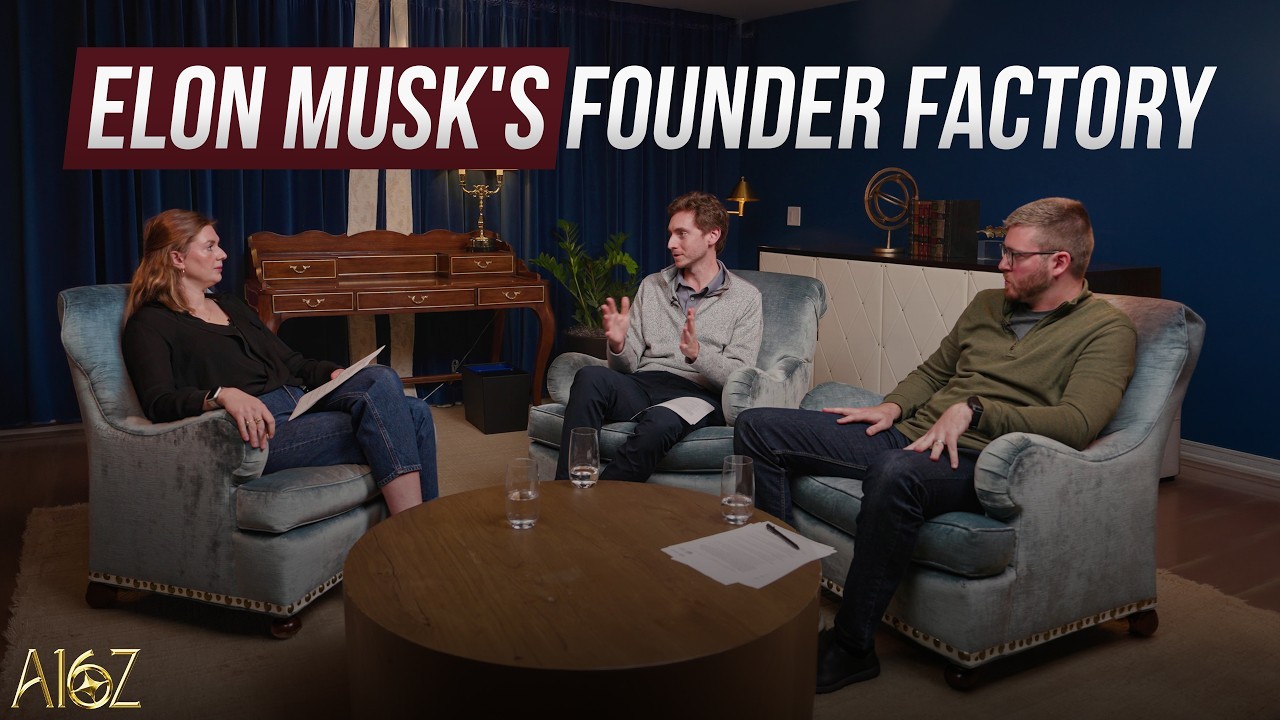
From Starship to Startups: How SpaceX and Tesla Alumni Build Next-Gen Defense and Mining Companies

From Starship to Startups: How SpaceX and Tesla Alumni Build Next-Gen Defense and Mining Companies

From Starship to Startups: How SpaceX and Tesla Alumni Build Next-Gen Defense and Mining Companies

a16z

a16z

50:04

50:04

24K Views

24K Views

THESIS

SpaceX and Tesla alumni argue that radical information democratization and aggressive critical-path targeting are the transplantable operating principles that unlock hardware startup velocity.

SpaceX and Tesla alumni argue that radical information democratization and aggressive critical-path targeting are the transplantable operating principles that unlock hardware startup velocity.

SpaceX and Tesla alumni argue that radical information democratization and aggressive critical-path targeting are the transplantable operating principles that unlock hardware startup velocity.

ASSET CLASS

ASSET CLASS

SECULAR

SECULAR

CONVICTION

CONVICTION

HIGH

HIGH

TIME HORIZON

TIME HORIZON

3 to 5 years

3 to 5 years

01

01

//

PREMISE

PREMISE

Legacy defense and mining industries suffer from structural stagnation: outdated production methods, shrinking talent pools, and massive software deficiency

Legacy defense and mining industries suffer from structural stagnation: outdated production methods, shrinking talent pools, and massive software deficiency

The missile industry produces too few units at too high a cost using decades-old approaches, while the critical minerals and mining sector is dominated by 50-to-100-year-old incumbents that are massively software-deficient. Both industries face shrinking talent pools and deeply entrenched ways of operating. The coordination and orchestration layers in mining and refining are manual, riddled with data silos, and lack the short-interval control and quantification that manufacturing environments take for granted. Construction sites run on verbal daily check-ins rather than algorithmic resource allocation. These structural deficiencies create enormous openings for founders who can transplant high-velocity operational culture from SpaceX and Tesla into these stagnant sectors.

The missile industry produces too few units at too high a cost using decades-old approaches, while the critical minerals and mining sector is dominated by 50-to-100-year-old incumbents that are massively software-deficient. Both industries face shrinking talent pools and deeply entrenched ways of operating. The coordination and orchestration layers in mining and refining are manual, riddled with data silos, and lack the short-interval control and quantification that manufacturing environments take for granted. Construction sites run on verbal daily check-ins rather than algorithmic resource allocation. These structural deficiencies create enormous openings for founders who can transplant high-velocity operational culture from SpaceX and Tesla into these stagnant sectors.

02

02

//

MECHANISM

MECHANISM

Transplanting SpaceX/Tesla operational DNA — flat orgs, high-conviction decision velocity, critical-path obsession, and integrated data systems — into defense and mining

Transplanting SpaceX/Tesla operational DNA — flat orgs, high-conviction decision velocity, critical-path obsession, and integrated data systems — into defense and mining

The mechanism is the direct transfer of specific, repeatable practices from SpaceX and Tesla into new companies. First, flat organizational structures that democratize information access so any junior engineer can reach any decision-maker without funneling through management layers. Second, high-conviction leadership that makes fast decisions to absolve risk from junior engineers and eliminate decision paralysis — accepting that you cannot wait for complete information and must iterate rapidly. Third, obsessive critical-path identification, where super-aggressive timelines are set not as literal targets but as forcing functions to surface the 100 out of 1,000 tasks that actually cannot be done in the compressed timeframe, which then become the priority list. Fourth, building integrated data backbones that auto-populate shift pass-downs, eliminate data silos between engineering, procurement, and construction teams, and layer LLMs on top for navigation. Fifth, applying tact-time analysis — breaking every process into discrete measurable steps — to domains like construction and mining where it has never been applied, enabling short-interval control equivalent to manufacturing dashboards. Sixth, strategic vertical integration driven not by cost savings but by existential necessity: does the company exist or not if you don't vertically integrate into a specific capability? These practices collectively compress development cycles and production timelines in industries that have never experienced this operational intensity.

The mechanism is the direct transfer of specific, repeatable practices from SpaceX and Tesla into new companies. First, flat organizational structures that democratize information access so any junior engineer can reach any decision-maker without funneling through management layers. Second, high-conviction leadership that makes fast decisions to absolve risk from junior engineers and eliminate decision paralysis — accepting that you cannot wait for complete information and must iterate rapidly. Third, obsessive critical-path identification, where super-aggressive timelines are set not as literal targets but as forcing functions to surface the 100 out of 1,000 tasks that actually cannot be done in the compressed timeframe, which then become the priority list. Fourth, building integrated data backbones that auto-populate shift pass-downs, eliminate data silos between engineering, procurement, and construction teams, and layer LLMs on top for navigation. Fifth, applying tact-time analysis — breaking every process into discrete measurable steps — to domains like construction and mining where it has never been applied, enabling short-interval control equivalent to manufacturing dashboards. Sixth, strategic vertical integration driven not by cost savings but by existential necessity: does the company exist or not if you don't vertically integrate into a specific capability? These practices collectively compress development cycles and production timelines in industries that have never experienced this operational intensity.

03

03

//

OUTCOME

OUTCOME

Order-of-magnitude improvements in production rate, cost, and speed for missiles and critical mineral supply chains

Order-of-magnitude improvements in production rate, cost, and speed for missiles and critical mineral supply chains

Galedine targets 10,000 missiles per year using liquid propulsion technology transferred from Starship, aiming to get a rocket in the air by June through a six-person team executing against an ambitious but technically grounded schedule. Mariana Minerals is building both a software company and a mining company simultaneously — because a pure-play software company cannot penetrate mining's slow technology adoption rate — applying autonomous systems from automotive and humanoid robotics to refineries and mining operations. The outcome is that these founders expect to run construction like manufacturing, run analytical labs like manufacturing processes, and deliver large-scale infrastructure projects ahead of schedule and under budget by measuring and quantifying what legacy industries have never bothered to measure. The broader outcome is a new generation of defense and critical minerals companies that operate at SpaceX/Tesla velocity in sectors where incumbents move at geological pace.

Galedine targets 10,000 missiles per year using liquid propulsion technology transferred from Starship, aiming to get a rocket in the air by June through a six-person team executing against an ambitious but technically grounded schedule. Mariana Minerals is building both a software company and a mining company simultaneously — because a pure-play software company cannot penetrate mining's slow technology adoption rate — applying autonomous systems from automotive and humanoid robotics to refineries and mining operations. The outcome is that these founders expect to run construction like manufacturing, run analytical labs like manufacturing processes, and deliver large-scale infrastructure projects ahead of schedule and under budget by measuring and quantifying what legacy industries have never bothered to measure. The broader outcome is a new generation of defense and critical minerals companies that operate at SpaceX/Tesla velocity in sectors where incumbents move at geological pace.

//

NECESSARY CONDITION

Regulatory frameworks must remain permissive to innovation (avoiding the 'European' model) and open source development must remain unencumbered by downstream liability.

when Elon sets like super aggressive targets, the goal is actually to get the team to think really deliberately and very what doesn't work in that like what actually doesn't solve for the aggressive time frame.

when Elon sets like super aggressive targets, the goal is actually to get the team to think really deliberately and very what doesn't work in that like what actually doesn't solve for the aggressive time frame.

24:45

RISK

Steel Man Counter-Thesis

The strongest counter-thesis is that SpaceX and Tesla operational principles are not transferable competitive advantages but rather contextual outcomes of specific conditions that do not exist at Galadine or Mariana. SpaceX's iteration speed was enabled by being its own customer (launching its own payloads), eliminating the procurement bureaucracy that Galadine will face selling missiles to the DoD. Tesla's manufacturing innovations were enabled by cumulative billions in capital expenditure over 15+ years with patient capital. Both companies' flat organizations worked because they attracted the absolute top percentile of engineering talent globally — a talent density that a 6-person missile startup and an early-stage mining software company cannot replicate. Empirically, the history of defense startups and mining technology companies is littered with ventures founded by alumni of elite technology companies who believed their operational culture would overcome industry structure, only to discover that defense procurement timelines, mining permitting cycles, and capital intensity requirements are not organizational problems but structural ones. Anduril is perhaps the only recent counterexample at scale in defense, and it succeeded largely by avoiding traditional procurement channels initially — a luxury that a missile company (which must ultimately sell through established DoD channels) may not have. In mining, the failure rate of technology-first mining companies is extraordinarily high because geological risk, commodity price volatility, and multi-decade project timelines dominate outcomes regardless of operational efficiency. The thesis that 'we will apply SpaceX speed to missiles/mining' may confuse correlation (SpaceX succeeded and had these cultural traits) with causation (these cultural traits caused SpaceX to succeed), when the actual causal factors — Elon Musk's willingness to invest billions of personal capital, NASA anchor contracts, a consumer market with elastic demand for Tesla vehicles — are not present in either new venture.

//

RISK 01

RISK 01

SpaceX/Tesla Methodology Cargo-Culting Without Underlying Resource Advantages

SpaceX/Tesla Methodology Cargo-Culting Without Underlying Resource Advantages

THESIS

Both founders explicitly frame their companies as applying SpaceX/Tesla operational principles (flat orgs, aggressive timelines, vertical integration, iteration speed) to new domains (missiles, mining). However, SpaceX and Tesla succeeded with these methods backed by billions in capital, massive engineering teams, established supplier relationships, and a decade-plus runway of iterative learning. Chandler himself admits Galadine cannot parallel-path like SpaceX due to resource constraints, and the team is only six people. The risk is that the operational playbook is necessary but radically insufficient without the capital intensity and scale that made it work at the origin companies. A six-person missile company applying SpaceX cadence to a 10,000-missiles-per-year ambition faces a orders-of-magnitude gap between methodology and execution capacity. The principles may produce marginal improvements but cannot replicate the transformative outcomes without commensurate capital and talent density.

Both founders explicitly frame their companies as applying SpaceX/Tesla operational principles (flat orgs, aggressive timelines, vertical integration, iteration speed) to new domains (missiles, mining). However, SpaceX and Tesla succeeded with these methods backed by billions in capital, massive engineering teams, established supplier relationships, and a decade-plus runway of iterative learning. Chandler himself admits Galadine cannot parallel-path like SpaceX due to resource constraints, and the team is only six people. The risk is that the operational playbook is necessary but radically insufficient without the capital intensity and scale that made it work at the origin companies. A six-person missile company applying SpaceX cadence to a 10,000-missiles-per-year ambition faces a orders-of-magnitude gap between methodology and execution capacity. The principles may produce marginal improvements but cannot replicate the transformative outcomes without commensurate capital and talent density.

DEFENSE

Chandler explicitly acknowledges this gap, noting that parallel pathing is not currently possible at Galadine's scale and that vertical integration must be strategic rather than idealistic. Turner echoes that vertical integration decisions should be binary survival questions rather than cost optimizations. However, the defense is partial — they acknowledge the constraint but do not articulate a concrete bridge from their current 6-person team to the scale required for their stated production ambitions. The acknowledgment is honest but the path from here to there remains unaddressed.

Chandler explicitly acknowledges this gap, noting that parallel pathing is not currently possible at Galadine's scale and that vertical integration must be strategic rather than idealistic. Turner echoes that vertical integration decisions should be binary survival questions rather than cost optimizations. However, the defense is partial — they acknowledge the constraint but do not articulate a concrete bridge from their current 6-person team to the scale required for their stated production ambitions. The acknowledgment is honest but the path from here to there remains unaddressed.

//

RISK 02

RISK 02

Flat Organization and Decision Velocity Break Down at Scale — And Both Companies Must Scale

Flat Organization and Decision Velocity Break Down at Scale — And Both Companies Must Scale

THESIS

Turner and Chandler both champion flat organizations and rapid decision-making as core operating principles. Turner specifically notes that data silos form naturally once teams exceed ~100 people, even when leadership explicitly forbids them. He also acknowledges Tesla had to layer in structure at 130,000+ people. Both companies — Galadine targeting mass missile production, Mariana targeting large-scale mining and refinery operations — require significant scaling to achieve their missions. The very principles they cite as differentiators are the ones most fragile under scaling pressure. Mariana's solution is a software backbone with LLM-queryable data repositories, but this is itself an unproven product being built simultaneously with the core business. Galadine has no articulated scaling plan beyond 'keeping an eye on it.' The risk is that the organizational principles that work at 6-30 people catastrophically degrade as they approach the hundreds or thousands of employees needed for their production targets, and neither company has demonstrated they can maintain these principles at scale — they only observed them degrading at their prior employers.

Turner and Chandler both champion flat organizations and rapid decision-making as core operating principles. Turner specifically notes that data silos form naturally once teams exceed ~100 people, even when leadership explicitly forbids them. He also acknowledges Tesla had to layer in structure at 130,000+ people. Both companies — Galadine targeting mass missile production, Mariana targeting large-scale mining and refinery operations — require significant scaling to achieve their missions. The very principles they cite as differentiators are the ones most fragile under scaling pressure. Mariana's solution is a software backbone with LLM-queryable data repositories, but this is itself an unproven product being built simultaneously with the core business. Galadine has no articulated scaling plan beyond 'keeping an eye on it.' The risk is that the organizational principles that work at 6-30 people catastrophically degrade as they approach the hundreds or thousands of employees needed for their production targets, and neither company has demonstrated they can maintain these principles at scale — they only observed them degrading at their prior employers.

DEFENSE

Turner acknowledges the problem empirically — he saw data silos form at Tesla despite executive mandates against them — and proposes software infrastructure as the solution. But this creates a circular dependency: the software platform IS the product Mariana is building, meaning the organizational scaling solution and the commercial product are the same unproven thing. Chandler does not address scaling at all beyond noting it is 'top of mind.' Neither founder presents evidence that their specific implementations will avoid the degradation they observed at Tesla/SpaceX. This is a structural blind spot because both companies' theses require operating at a scale where their stated operating principles have historically failed.

Turner acknowledges the problem empirically — he saw data silos form at Tesla despite executive mandates against them — and proposes software infrastructure as the solution. But this creates a circular dependency: the software platform IS the product Mariana is building, meaning the organizational scaling solution and the commercial product are the same unproven thing. Chandler does not address scaling at all beyond noting it is 'top of mind.' Neither founder presents evidence that their specific implementations will avoid the degradation they observed at Tesla/SpaceX. This is a structural blind spot because both companies' theses require operating at a scale where their stated operating principles have historically failed.

//

RISK 03

RISK 03

Defense and Mining Sectors Have Structural Barriers That Reject Silicon Valley Speed Doctrines

Defense and Mining Sectors Have Structural Barriers That Reject Silicon Valley Speed Doctrines

THESIS

Both founders frame incumbent industries (defense/missiles and mining/refining) as slow, conservative, and ripe for disruption through SpaceX/Tesla-style speed and iteration. However, these industries are slow for deeply structural reasons: defense procurement involves ITAR regulations, classified requirements, multi-year government contracting cycles, and qualification testing regimes that cannot be compressed by organizational culture alone. Mining involves geological uncertainty, environmental permitting timelines measured in years to decades, community engagement requirements, and physical constraints of ore bodies. A missile cannot iterate like a software deployment — it must meet military specification and qualification standards. A mine cannot sprint — permitting, environmental review, and geological characterization have externally-imposed timelines. The risk is that the founders are pattern-matching from industries where the product cycle was largely internally controlled (rockets for SpaceX's own missions, cars for consumer markets) to industries where external gatekeepers and regulatory frameworks impose irreducible timeline floors that no amount of organizational velocity can compress.

Both founders frame incumbent industries (defense/missiles and mining/refining) as slow, conservative, and ripe for disruption through SpaceX/Tesla-style speed and iteration. However, these industries are slow for deeply structural reasons: defense procurement involves ITAR regulations, classified requirements, multi-year government contracting cycles, and qualification testing regimes that cannot be compressed by organizational culture alone. Mining involves geological uncertainty, environmental permitting timelines measured in years to decades, community engagement requirements, and physical constraints of ore bodies. A missile cannot iterate like a software deployment — it must meet military specification and qualification standards. A mine cannot sprint — permitting, environmental review, and geological characterization have externally-imposed timelines. The risk is that the founders are pattern-matching from industries where the product cycle was largely internally controlled (rockets for SpaceX's own missions, cars for consumer markets) to industries where external gatekeepers and regulatory frameworks impose irreducible timeline floors that no amount of organizational velocity can compress.

DEFENSE

Neither founder addresses regulatory, procurement, or permitting constraints at any point in the conversation. Chandler describes himself as 'somewhat foreign to the missile industry' and frames the opportunity purely in terms of production speed and cost, never mentioning defense acquisition processes, qualification testing, or regulatory compliance. Turner discusses construction and mining operations as if the primary constraint is internal coordination rather than external permitting and regulatory timelines. The complete absence of discussion about these structural barriers — which are among the most commonly cited reasons defense and mining innovation is slow — represents a significant blind spot. It is possible they are well aware of these issues and simply did not discuss them, but the omission in a conversation specifically about applying SpaceX/Tesla principles to new domains is notable.

Neither founder addresses regulatory, procurement, or permitting constraints at any point in the conversation. Chandler describes himself as 'somewhat foreign to the missile industry' and frames the opportunity purely in terms of production speed and cost, never mentioning defense acquisition processes, qualification testing, or regulatory compliance. Turner discusses construction and mining operations as if the primary constraint is internal coordination rather than external permitting and regulatory timelines. The complete absence of discussion about these structural barriers — which are among the most commonly cited reasons defense and mining innovation is slow — represents a significant blind spot. It is possible they are well aware of these issues and simply did not discuss them, but the omission in a conversation specifically about applying SpaceX/Tesla principles to new domains is notable.

//

ASYMMETRIC SKEW

The downside is substantial and structurally weighted: both companies face multi-year capital-intensive build-outs in heavily regulated industries where externally-imposed timelines create irreducible floors on speed-to-market, meaning the core thesis (SpaceX/Tesla speed as competitive moat) may be neutralized by industry structure. The upside is genuine but contingent on multiple unproven assumptions holding simultaneously — that operational culture transfers across domains, that software platforms can solve coordination problems that have persisted for decades, that defense procurement and mining permitting will accommodate startup iteration cycles, and that early-stage companies can attract SpaceX-caliber talent without SpaceX-caliber brand or compensation. The skew favors downside in the near term (12-24 months) as structural barriers become apparent, but could shift to meaningful upside over a 5-10 year horizon if the companies survive long enough to build credibility and institutional relationships — making survival and capitalization the key variables rather than operational velocity.

ALPHA

NOISE

The Consensus

The market broadly believes that Tesla and SpaceX culture principles — vertical integration, flat organizations, aggressive timelines, intense work culture — can be directly transplanted into new hard-tech startups as a proven playbook. The prevailing narrative in the American Dynamism / defense-tech ecosystem is that SpaceX/Tesla alumni carry a transferable operating system that, once applied, will reliably produce similar results in new domains (defense, mining, critical minerals). The market also generally assumes vertical integration is a default best practice for hardware startups seeking cost and speed advantages.

The market's logic chain is: Elite alumni from SpaceX/Tesla → apply proven playbook (vertical integration, flat orgs, aggressive timelines, intense culture) → achieve similar speed and cost breakthroughs in new domains → win. The assumption is that the principles are the independent variable and the results follow deterministically.

SIGNAL

The Variant

Both speakers argue the transplant is far more nuanced than the market mythology suggests. The principles are directionally correct but require significant 'massaging' in implementation depending on company stage, resource constraints, and domain. Specifically: (1) Vertical integration should NOT be pursued as a default — it should only be pursued when the binary question 'does the company exist or not without it?' is answered 'no'; cost-driven vertical integration is a later-stage luxury, not an early-stage strategy. (2) SpaceX-style parallel pathing and resource-intensive approaches are not available to startups with six-person teams. (3) The aggressive timeline-setting (Elon time) is not about actually hitting the deadline — it's a diagnostic tool to surface the critical path items that cannot meet the timeline, thereby generating a priority list. (4) Burnout is not caused by long hours but by churn — erratic decisions, politics, data silos, and hoarding information — and so the cultural focus should be on eliminating churn rather than merely invoking mission alignment.

The speakers' logic chain is fundamentally different: The principles are necessary but insufficient — the actual independent variables are (1) information architecture (how data flows across teams, eliminating silos, democratizing access), (2) decision velocity enabled by technically credible leaders who can absorb risk from junior engineers, (3) rigorous requirement questioning that deletes unnecessary complexity before design begins, and (4) measurement culture transplanted from manufacturing into domains that lack it (construction, mining, refining). Turner specifically argues that the binding constraint in mining/refining is not hardware or capital but software deficiency and the inability of incumbents to adopt technology — meaning Mariana must be both a software company AND a mining company simultaneously, not because vertical integration is philosophically superior but because the customer base's technology adoption rate would kill a pure-play SaaS approach. Chandler argues the missile industry's constraint is not technology per se but the application of existing liquid propulsion technology (proven at SpaceX) to missile systems — a lateral transfer the incumbents haven't made because they are locked into legacy solid propulsion paradigms.

SOURCE OF THE EDGE

Both speakers claim edge rooted in direct operating experience at SpaceX and Tesla, which is genuine and verifiable. Chandler was the lead propulsion engineer on Starship (flights 3 through V2/V3 development) and has hands-on knowledge of liquid propulsion systems that he is laterally applying to missiles — an area dominated by solid propulsion incumbents. This is a legitimate structural advantage: he has designed, built, and iterated flight-qualified liquid propulsion hardware at scale, which is not replicable through reading or study. Turner spent a decade at Tesla running battery supply chain and minerals/metals operations, including building the Corpus Christi lithium refinery. His edge claim — that the mining/refining industry is 'massively software deficient' and that the talent pool is shrinking — is credible because it comes from direct engagement with 50-100 year old incumbents as a customer/partner while at Tesla, giving him visibility into their operational limitations. However, there are important caveats. The edge is strongest in problem identification and team-building credibility, not necessarily in execution proof. Galedine is pre-revenue with six people and no missile yet fired. Mariana's core thesis — applying autonomy and software to mining/refining — is increasingly consensus in the market, and the claim of being 'ahead of schedule and under budget' is unverifiable from this conversation. The SpaceX/Tesla pedigree is real but is also becoming commoditized as hundreds of alumni launch companies; the pedigree alone is no longer a differentiator. The genuine edge is narrower than presented: Chandler's specific liquid propulsion expertise applied to missiles, and Turner's specific insight that Mariana must own operations (not just sell software) because mining companies won't adopt technology fast enough.

//

CONVICTION DETECTED

• 'We don't have enough. They cost too much and we can't make them fast enough.' • 'In order to get drastically different results, you have to do things drastically differently.' • 'There's a very real way to apply this technology to missile systems and we're going to go do it.' • 'The industry is massively software deficient.' • 'You have to go full bore kind of leveraging the advances in autonomy.' • 'Writing down things is freaking massive.' • 'Simple is fast, simple is cheap.' • 'Does the company exist or not if you don't make the decision to vertically integrate — that makes the decision easy.' • 'I couldn't leave. Like it was the dream.' • 'I don't think I could start Galadine without having spent a handful of years doing the things I did at SpaceX.' • 'Vertically integrating for the point of vertical integrating... is just going to spend a lot of money, that's for sure.' • 'I think almost naive in a way — vertical integration is not easy.' • 'The thing that actually causes burnout is churn.'

//

HEDGE DETECTED

• 'I'm sure Turner has some impact of this but there's Elon time always and that's a hard one to battle with.' • 'I definitely say I lean towards that in setting these very milestones.' • 'We're still very small so it's not really saying much.' • 'I wouldn't actually say that there's any like one pinpointed thing.' • 'It's more like kind of massaging the implementation of those.' • 'I won't even take credit for all of that ideation — actually another guy on the team brought it to my plate.' • 'There's no recipe. It's not like you stay somewhere for 10 years and then you go start a company.' • 'You'll never actually be fully trained to go and start a company.' • 'Different people are going to have different perspectives on when they feel ready.' • 'For interns, we're figuring out right now.' The ratio of conviction to hedging is moderately high, skewing toward conviction. The hedging that exists is honest and context-appropriate — acknowledging early stage, small team size, and uncertainty about internship processes — rather than hedging on core thesis claims. Neither speaker hedges on their fundamental market assessments (missile undersupply, mining software deficiency) or on the value of their SpaceX/Tesla experience. This pattern suggests genuine confidence in the problem identification and directional thesis, combined with appropriate intellectual honesty about execution uncertainty. The conviction markers carry weight because they are grounded in specific, verifiable operating experience rather than abstract assertions. A listener should weight the thesis meaningfully but recognize that the strongest conviction is around problem diagnosis, not yet around proven execution in their new ventures.