
dstl

TERMINAL

TERMINAL

LIBRARY

LIBRARY

//

Demis Hassabis on AGI Within Five Years, the Future of Drug Discovery, and Why Europe Can Still Win

Demis Hassabis on AGI Within Five Years, the Future of Drug Discovery, and Why Europe Can Still Win

Demis Hassabis on AGI Within Five Years, the Future of Drug Discovery, and Why Europe Can Still Win

20VC with Harry Stebbings

20VC with Harry Stebbings

32:11

32:11

26K Views

26K Views

THESIS

Frontier AI labs with the capability to invent new algorithmic breakthroughs will pull decisively ahead as current scaling ideas are exhausted.

Frontier AI labs with the capability to invent new algorithmic breakthroughs will pull decisively ahead as current scaling ideas are exhausted.

Frontier AI labs with the capability to invent new algorithmic breakthroughs will pull decisively ahead as current scaling ideas are exhausted.

ASSET CLASS

ASSET CLASS

SECULAR

SECULAR

CONVICTION

CONVICTION

HIGH

HIGH

TIME HORIZON

TIME HORIZON

3 to 5 years

3 to 5 years

01

01

//

PREMISE

PREMISE

The easy gains from scaling existing architectures are diminishing, shifting competitive advantage from capital intensity to algorithmic innovation

The easy gains from scaling existing architectures are diminishing, shifting competitive advantage from capital intensity to algorithmic innovation

The initial era of large language model development produced enormous, nearly exponential performance jumps with each generation simply by scaling compute and parameters. Hassabis acknowledges those returns, while still substantial, are now smaller than they were at the outset. The implication is that the commodity strategy of throwing more compute at the same transformer recipe faces sharply diminishing marginal returns. Meanwhile, critical missing capabilities — continual learning, hierarchical long-term planning, robust memory architectures, and consistency across problem framings — remain unsolved and cannot be addressed by scaling alone. These gaps define what Hassabis calls 'jagged intelligence,' where systems excel in narrow contexts but fail unpredictably when conditions shift even slightly. Closing these gaps requires fundamental research breakthroughs, not incremental parameter increases.

The initial era of large language model development produced enormous, nearly exponential performance jumps with each generation simply by scaling compute and parameters. Hassabis acknowledges those returns, while still substantial, are now smaller than they were at the outset. The implication is that the commodity strategy of throwing more compute at the same transformer recipe faces sharply diminishing marginal returns. Meanwhile, critical missing capabilities — continual learning, hierarchical long-term planning, robust memory architectures, and consistency across problem framings — remain unsolved and cannot be addressed by scaling alone. These gaps define what Hassabis calls 'jagged intelligence,' where systems excel in narrow contexts but fail unpredictably when conditions shift even slightly. Closing these gaps requires fundamental research breakthroughs, not incremental parameter increases.

02

02

//

MECHANISM

MECHANISM

Labs with deep research benches capable of inventing new algorithmic paradigms will compound their advantage as each generation of AI tools accelerates the next

Labs with deep research benches capable of inventing new algorithmic paradigms will compound their advantage as each generation of AI tools accelerates the next

Hassabis identifies a self-reinforcing cycle: the three or four frontier labs are already using their own AI tools — coding assistants, math reasoning systems — to build the next generation of models. This creates a compounding loop where research capability begets better tooling which begets faster research. As the remaining juice is squeezed from current ideas, the differentiating factor becomes the ability to originate entirely new algorithmic concepts — areas like novel memory architectures, world models, and continual learning mechanisms. DeepMind's claim to 90% of the foundational breakthroughs underpinning modern AI (transformers, AlphaGo, reinforcement learning, AlphaFold) is presented as evidence that deep, broad research benches are the scarce strategic asset. Open-source models will continue to trail the frontier by roughly six months, meaning the gap is structural and persistent rather than temporary. The organizational consolidation at Google DeepMind — combining talent, compute resources, and focus into a single direction — is presented as the template for how this advantage is operationalized.

Hassabis identifies a self-reinforcing cycle: the three or four frontier labs are already using their own AI tools — coding assistants, math reasoning systems — to build the next generation of models. This creates a compounding loop where research capability begets better tooling which begets faster research. As the remaining juice is squeezed from current ideas, the differentiating factor becomes the ability to originate entirely new algorithmic concepts — areas like novel memory architectures, world models, and continual learning mechanisms. DeepMind's claim to 90% of the foundational breakthroughs underpinning modern AI (transformers, AlphaGo, reinforcement learning, AlphaFold) is presented as evidence that deep, broad research benches are the scarce strategic asset. Open-source models will continue to trail the frontier by roughly six months, meaning the gap is structural and persistent rather than temporary. The organizational consolidation at Google DeepMind — combining talent, compute resources, and focus into a single direction — is presented as the template for how this advantage is operationalized.

03

03

//

OUTCOME

OUTCOME

A durable oligopoly of three to four frontier labs will dominate the path to AGI, with the gap widening over the next five years

A durable oligopoly of three to four frontier labs will dominate the path to AGI, with the gap widening over the next five years

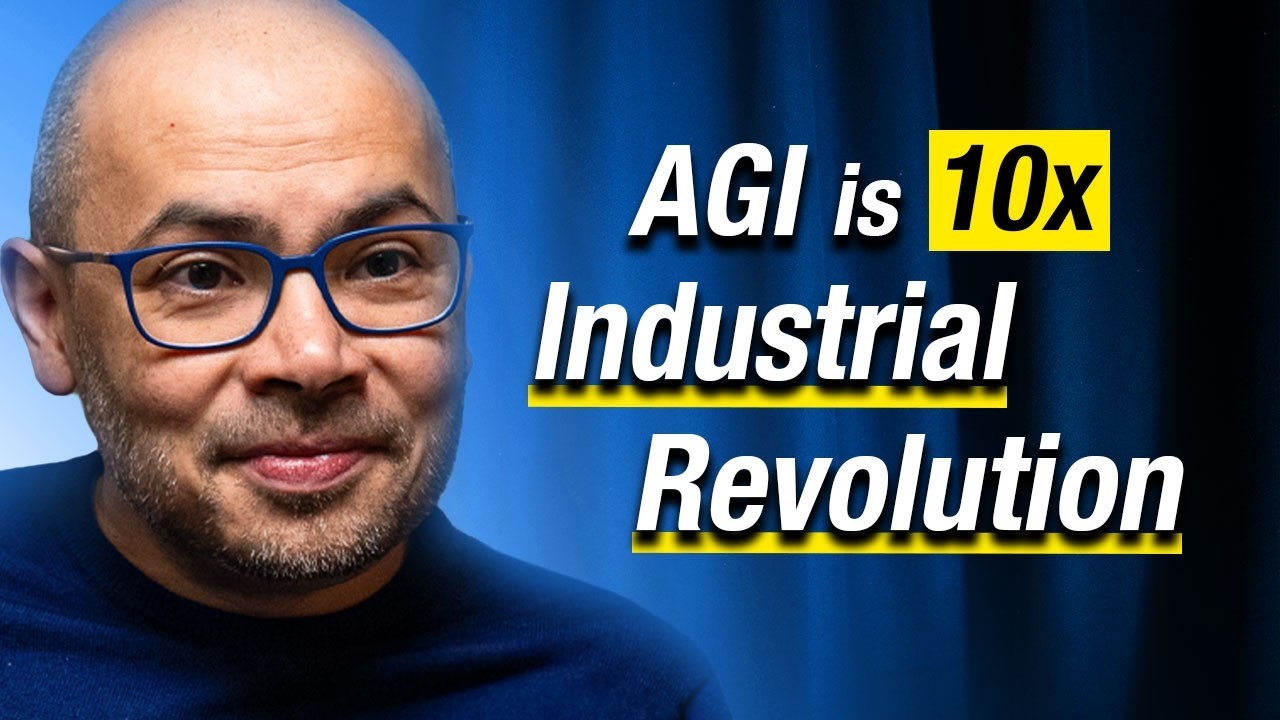
Hassabis projects AGI arrival within five years, consistent with predictions made at DeepMind's founding in 2010. The market structure that emerges is one where the frontier labs pull further away from all other participants. Open-source models serve as useful tools for startups, academics, and edge computing but remain structurally one step behind. The economic implications are vast — Hassabis frames AGI as '10 times the industrial revolution at 10 times the speed,' unfolding over a decade rather than a century. The downstream effects include a potential golden age of scientific discovery, drug design breakthroughs (via Isomorphic Labs), energy system optimization yielding 30-40% grid efficiency gains, and possible fusion energy commercialization. The concentration of this value creation in a small number of entities raises the question of wealth redistribution mechanisms — sovereign wealth funds, pension fund allocations to AI leaders — as necessary policy responses.

Hassabis projects AGI arrival within five years, consistent with predictions made at DeepMind's founding in 2010. The market structure that emerges is one where the frontier labs pull further away from all other participants. Open-source models serve as useful tools for startups, academics, and edge computing but remain structurally one step behind. The economic implications are vast — Hassabis frames AGI as '10 times the industrial revolution at 10 times the speed,' unfolding over a decade rather than a century. The downstream effects include a potential golden age of scientific discovery, drug design breakthroughs (via Isomorphic Labs), energy system optimization yielding 30-40% grid efficiency gains, and possible fusion energy commercialization. The concentration of this value creation in a small number of entities raises the question of wealth redistribution mechanisms — sovereign wealth funds, pension fund allocations to AI leaders — as necessary policy responses.

//

NECESSARY CONDITION

Regulatory frameworks must remain permissive to innovation (avoiding the 'European' model) and open source development must remain unencumbered by downstream liability.

I sometimes quantify the coming of AGI as 10 times the industrial revolution at 10 times the speed.

I sometimes quantify the coming of AGI as 10 times the industrial revolution at 10 times the speed.

06:45

RISK

Steel Man Counter-Thesis

The strongest counter-thesis is that Google/DeepMind's position is structurally analogous to that of a dominant basic research institution that chronically fails to capture the value of its own inventions — and that this pattern is now compounding rather than resolving. First, the claim that 90% of foundational breakthroughs originated at Google is actually evidence against the thesis: it demonstrates that Google's organizational structure systematically converts research leads into competitor advantages (OpenAI built a $150B+ company on Google's Transformer paper). The organizational changes Hassabis describes are reactive catch-up, not evidence of a durable structural fix. Second, the scaling returns narrative contains a concealed regime change: Hassabis admits returns are diminishing and pivots to algorithmic innovation as the new source of advantage, but algorithmic breakthroughs are inherently unpredictable and cannot be reliably capitalized. The entire investment thesis for frontier AI labs was predicated on the predictability of scaling laws — if progress now depends on stochastic research breakthroughs, the risk profile changes fundamentally and Google's massive compute capex may represent malinvestment. Third, and most critically, the 'jagged intelligence' problem Hassabis describes — where frontier models fail unpredictably at elementary tasks — is not merely a temporary limitation but may represent a fundamental architectural constraint of current approaches. If the path to AGI requires solving continual learning, hierarchical planning, consistent reasoning, and novel memory architectures — all of which Hassabis admits are unsolved — then the 5-year AGI timeline is aspirational rather than evidence-based, and the enormous capital being deployed against that timeline may face a multi-year gap between investment and realized returns. The precedent of previous AI winters, where confident predictions of imminent breakthroughs preceded decades of stagnation, is directly relevant and entirely unaddressed.

//

RISK 01

RISK 01

Google/DeepMind's Research Dominance Does Not Guarantee Commercial or Product Dominance

Google/DeepMind's Research Dominance Does Not Guarantee Commercial or Product Dominance

THESIS

Hassabis claims that approximately 90% of foundational AI breakthroughs (Transformers, AlphaGo, reinforcement learning, AlphaFold) originated from Google Brain, Google Research, or DeepMind, and uses this as the basis for asserting that Google/DeepMind will continue to lead. However, the history of technology commercialization repeatedly demonstrates that invention and commercial capture are decoupled. Xerox PARC invented the graphical user interface but Apple and Microsoft captured the value. AT&T Bell Labs invented the transistor but Intel captured the semiconductor market. OpenAI built its business on the Transformer architecture that Google published openly. The thesis that 'if anyone will make the next breakthrough, it should be us' conflates research capability with the ability to ship products, capture users, build developer ecosystems, and maintain organizational velocity. Google's own history of launching and killing products, its well-documented bureaucratic friction, and the fact that it lost first-mover advantage in LLM deployment to OpenAI despite having the core technology internally all undermine this thesis.

Hassabis claims that approximately 90% of foundational AI breakthroughs (Transformers, AlphaGo, reinforcement learning, AlphaFold) originated from Google Brain, Google Research, or DeepMind, and uses this as the basis for asserting that Google/DeepMind will continue to lead. However, the history of technology commercialization repeatedly demonstrates that invention and commercial capture are decoupled. Xerox PARC invented the graphical user interface but Apple and Microsoft captured the value. AT&T Bell Labs invented the transistor but Intel captured the semiconductor market. OpenAI built its business on the Transformer architecture that Google published openly. The thesis that 'if anyone will make the next breakthrough, it should be us' conflates research capability with the ability to ship products, capture users, build developer ecosystems, and maintain organizational velocity. Google's own history of launching and killing products, its well-documented bureaucratic friction, and the fact that it lost first-mover advantage in LLM deployment to OpenAI despite having the core technology internally all undermine this thesis.

DEFENSE

Hassabis partially addresses this by acknowledging that organizational changes were required — consolidating talent, merging compute resources, and operating 'almost like a startup' to reach the frontier. He implicitly concedes that the research advantage was not previously being converted into competitive product leadership. However, he does not address the structural incentive problems within a large conglomerate (Alphabet) that repeatedly allowed smaller, more focused competitors to out-execute Google despite Google having the foundational research.

Hassabis partially addresses this by acknowledging that organizational changes were required — consolidating talent, merging compute resources, and operating 'almost like a startup' to reach the frontier. He implicitly concedes that the research advantage was not previously being converted into competitive product leadership. However, he does not address the structural incentive problems within a large conglomerate (Alphabet) that repeatedly allowed smaller, more focused competitors to out-execute Google despite Google having the foundational research.

//

RISK 02

RISK 02

The 'Scaling Is Not Plateauing' Claim Relies on Redefining Success Metrics Downward

The 'Scaling Is Not Plateauing' Claim Relies on Redefining Success Metrics Downward

THESIS

Hassabis concedes that returns from scaling are 'a bit less than they were at the start' while maintaining the narrative that scaling laws have not plateaued. This is a subtle but critical rhetorical move. The original scaling laws thesis — which drove hundreds of billions in infrastructure investment — posited near-exponential capability gains with compute increases. If those gains are now sub-exponential and diminishing, the economic calculus for massive capex spending fundamentally changes. The distinction between 'still substantial returns' and 'returns that justify the marginal cost of the next dollar of compute' is the entire question that matters for investors. Hassabis also pivots to algorithmic innovation as the next frontier of advantage, effectively admitting that pure scaling is insufficient — which is precisely the 'plateauing' thesis he claims to reject. If the next wave of progress depends on novel algorithmic breakthroughs (continual learning, new memory architectures, hierarchical planning), then progress becomes lumpy and unpredictable rather than the smooth scaling curve that underpinned prior capital allocation decisions.

Hassabis concedes that returns from scaling are 'a bit less than they were at the start' while maintaining the narrative that scaling laws have not plateaued. This is a subtle but critical rhetorical move. The original scaling laws thesis — which drove hundreds of billions in infrastructure investment — posited near-exponential capability gains with compute increases. If those gains are now sub-exponential and diminishing, the economic calculus for massive capex spending fundamentally changes. The distinction between 'still substantial returns' and 'returns that justify the marginal cost of the next dollar of compute' is the entire question that matters for investors. Hassabis also pivots to algorithmic innovation as the next frontier of advantage, effectively admitting that pure scaling is insufficient — which is precisely the 'plateauing' thesis he claims to reject. If the next wave of progress depends on novel algorithmic breakthroughs (continual learning, new memory architectures, hierarchical planning), then progress becomes lumpy and unpredictable rather than the smooth scaling curve that underpinned prior capital allocation decisions.

DEFENSE

Hassabis does not reconcile the tension between claiming scaling returns are still substantial and simultaneously arguing that algorithmic innovation (not scaling) will be the key differentiator going forward. He never addresses whether the diminishing returns from scaling justify the enormous capital expenditures being committed by Alphabet and other hyperscalers. The interviewer does not press on the distinction between 'returns exist' and 'returns exceed cost of capital,' which is the only question that matters from an investment standpoint.

Hassabis does not reconcile the tension between claiming scaling returns are still substantial and simultaneously arguing that algorithmic innovation (not scaling) will be the key differentiator going forward. He never addresses whether the diminishing returns from scaling justify the enormous capital expenditures being committed by Alphabet and other hyperscalers. The interviewer does not press on the distinction between 'returns exist' and 'returns exceed cost of capital,' which is the only question that matters from an investment standpoint.

//

RISK 03

RISK 03

The 10x Industrial Revolution at 10x Speed Framing Undermines the Orderly Transition Narrative

The 10x Industrial Revolution at 10x Speed Framing Undermines the Orderly Transition Narrative

THESIS

Hassabis simultaneously holds two positions that are in deep tension: (1) AGI will be '10 times the industrial revolution at 10 times the speed' — unfolding over a decade rather than a century — and (2) the labor displacement, wealth concentration, regulatory, and philosophical challenges can be managed through incremental policy mechanisms like pension fund investments, sovereign wealth funds, international certification bodies modeled on the IAEA, and AI safety institutes. The original Industrial Revolution — even at 1/10th the posited speed and magnitude — produced decades of mass immiseration, child labor, political revolutions, and social upheaval before institutions caught up. If AGI is truly 100x the total impact (10x magnitude times 10x speed), the gentle policy prescriptions offered are categorically insufficient. Furthermore, Hassabis himself admits that global coordination is deteriorating precisely when it is most needed. His own 'magic wand' answer — an international body with certification standards — is explicitly framed as aspirational, not actionable. The gap between the scale of disruption described and the modesty of proposed mitigations represents a fundamental incoherence in the thesis.

Hassabis simultaneously holds two positions that are in deep tension: (1) AGI will be '10 times the industrial revolution at 10 times the speed' — unfolding over a decade rather than a century — and (2) the labor displacement, wealth concentration, regulatory, and philosophical challenges can be managed through incremental policy mechanisms like pension fund investments, sovereign wealth funds, international certification bodies modeled on the IAEA, and AI safety institutes. The original Industrial Revolution — even at 1/10th the posited speed and magnitude — produced decades of mass immiseration, child labor, political revolutions, and social upheaval before institutions caught up. If AGI is truly 100x the total impact (10x magnitude times 10x speed), the gentle policy prescriptions offered are categorically insufficient. Furthermore, Hassabis himself admits that global coordination is deteriorating precisely when it is most needed. His own 'magic wand' answer — an international body with certification standards — is explicitly framed as aspirational, not actionable. The gap between the scale of disruption described and the modesty of proposed mitigations represents a fundamental incoherence in the thesis.

DEFENSE

Hassabis acknowledges the coordination deficit ('we're getting worse at it') but does not resolve the contradiction. His proposed solutions — AI safety institutes, international standards bodies, benchmark testing — are all incremental institutional mechanisms that operate on multi-year timescales. If AGI arrives within 5 years as he predicts and is truly 100x the industrial revolution in total impact, these mechanisms cannot plausibly be stood up, staffed, internationally ratified, and made operational in time. He offers no contingency for the scenario where the technology outpaces governance, which is the most likely scenario given his own premises.

Hassabis acknowledges the coordination deficit ('we're getting worse at it') but does not resolve the contradiction. His proposed solutions — AI safety institutes, international standards bodies, benchmark testing — are all incremental institutional mechanisms that operate on multi-year timescales. If AGI arrives within 5 years as he predicts and is truly 100x the industrial revolution in total impact, these mechanisms cannot plausibly be stood up, staffed, internationally ratified, and made operational in time. He offers no contingency for the scenario where the technology outpaces governance, which is the most likely scenario given his own premises.

//

ASYMMETRIC SKEW

The downside skew is substantial and asymmetric. Upside scenario: Google/DeepMind's research depth translates into sustained frontier leadership, AGI arrives on schedule, and the company captures disproportionate value — potentially justifying current valuations and capex commitments. Downside scenario: diminishing scaling returns undermine the capex thesis, critical algorithmic breakthroughs prove elusive or are achieved by competitors first, the 'jagged intelligence' problem resists incremental solutions, the 5-year AGI timeline slips significantly, and Google's historical pattern of failing to commercialize its own research repeats — resulting in massive capital destruction on infrastructure that becomes commoditized before yielding transformative returns. The downside is amplified by the fact that the scale of capital commitment is historically unprecedented and largely irreversible, while the upside depends on multiple unsolved technical problems being resolved simultaneously and on organizational dynamics that have historically failed at Google. Approximate skew: downside risk of 40-60% capital impairment on AI infrastructure investments against an upside that requires threading multiple technical and organizational needles simultaneously.

ALPHA

NOISE

The Consensus

The market consensus holds that: (1) AI scaling laws are hitting diminishing returns or plateauing, making frontier model performance increasingly commoditized; (2) AGI remains a distant, poorly-defined aspiration beyond a 10-year horizon; (3) the economic disruption from AI will follow historical patterns of technological adoption — manageable, gradual, and self-correcting through new job creation; (4) open-source models are rapidly closing the gap with proprietary frontier models, eroding competitive moats; and (5) energy constraints represent a hard bottleneck that could slow AI deployment significantly.

The market's causal logic runs: scaling compute yields diminishing marginal intelligence gains → frontier models converge in capability → competitive advantage shifts to distribution, ecosystem, and cost efficiency → open-source catches up → AI becomes infrastructure rather than a proprietary edge. On labor: historical precedent shows technology creates more jobs than it destroys → AI follows this pattern → displacement concerns are overstated.

SIGNAL

The Variant

Hassabis holds a materially different view on nearly every axis. He believes: (1) scaling laws are NOT plateauing — returns are diminishing from their exponential peak but remain 'very substantial,' and the narrative of hitting a wall is an oversimplification; (2) AGI has a 'very good chance' of arriving within 5 years, and this timeline has been roughly on track since DeepMind's 2010 predictions — this is not a recent revision but a longstanding conviction; (3) AGI will be '10 times the industrial revolution at 10 times the speed,' making this categorically different from prior technological disruptions — he explicitly pushes back on the Marc Andreessen view that labor displacement concerns are overblown; (4) the frontier labs (3-4 players including DeepMind) are pulling away from the field, not converging, because algorithmic invention capability is becoming the decisive differentiator as existing ideas get exhausted; and (5) AI will more than pay for its energy costs through grid optimization (30-40% efficiency gains), climate modeling, and breakthrough energy technologies like fusion.

Hassabis's causal logic diverges fundamentally. His chain: (1) The easy gains from scaling existing architectures are tapering, BUT this creates a new competitive dynamic where algorithmic invention — not just compute — becomes the bottleneck. Labs with deep research benches capable of inventing new architectures (not just scaling old ones) will pull ahead, not converge. This is a structural moat argument, not a scaling argument. (2) Several critical capabilities are still missing from current systems — continuous learning, hierarchical long-term planning, memory architectures beyond brute-force context windows, and consistency (what he calls 'jagged intelligence'). These are not incremental improvements but potential paradigm shifts that require genuine research breakthroughs. (3) On labor displacement: the historical pattern holds in kind but not in degree. AGI compresses a century of industrial revolution-scale disruption into a decade, which means the normal self-correcting labor market mechanisms may not operate fast enough. He explicitly refuses to dismiss the concern. (4) On energy: AI is not merely a consumer of energy but will be the tool that solves the energy problem — through grid optimization, material science breakthroughs (superconductors, batteries), and potentially fusion — creating a virtuous cycle rather than a resource constraint.

SOURCE OF THE EDGE

Hassabis's claimed edge rests on three pillars, each of which deserves separate credibility assessment. First, historical track record: the claim that '90% of breakthroughs underpinning modern AI' came from Google Brain, Google Research, or DeepMind is broadly defensible — Transformers, AlphaGo, AlphaFold, and reinforcement learning advances are foundational, and this is verifiable public record. This is a genuine structural advantage in assessing what research breakthroughs are still needed. Second, operational insider position: as the head of Google DeepMind, he has direct visibility into the actual returns from scaling, the state of algorithmic research pipelines, and the competitive dynamics among frontier labs. When he says scaling returns are 'still very substantial' but diminishing, this is not speculation — it is a report from inside the machine. This is a real informational edge that external analysts cannot replicate. Third, the AGI timeline prediction: the 2010 blog post claim (attributable to Shane Legg, verifiable online) that predicted ~20 years to AGI from 2010 is a genuinely impressive calibration marker if accurate. However, there is a survivorship bias concern — had the prediction failed, it would simply be forgotten. The overall assessment: Hassabis possesses a genuine structural informational advantage on the state of frontier AI research and competitive dynamics. His edge on AGI timelines is credible but necessarily uncertain — no one has built AGI before, and confidence about unprecedented events should be discounted. His edge on the drug discovery timeline (via Isomorphic Labs) is real but self-interested — he is talking his own book. The weakest part of his edge is on macro-economic and regulatory predictions, where he has no particular structural advantage over any informed observer.

//

CONVICTION DETECTED

• 'there's a very good chance of it being within the next 5 years' • 'about 90% of the breakthroughs that underpin the modern AI industry were done either by Google Brain or Google Research or DeepMind' • 'in most areas we are ahead of where I thought we would be' • 'I would back us to sort of make those breakthroughs in the future' • 'those labs that have capability to invent new algorithmic ideas are going to start having bigger advantage over the next few years' • '10 times the industrial revolution at 10 times the speed' • 'I do think this is going to be bigger than all of those previous technological breakthroughs' • 'I think we could probably get 30-40% more efficiency out of our national grids' • 'I want to literally cure cancer' • 'No, I don't think so' (on scaling laws plateauing) • 'we're pretty much on track' (on the 2010 AGI prediction)

//

HEDGE DETECTED

• 'I've got a probability distribution around the timings' • 'there's a 50/50 chance there's some things maybe missing that we still need to make breakthroughs in' • 'perhaps their world models' • 'my betting is pretty strongly' (implicit acknowledgment of uncertainty despite conviction) • 'maybe we need something like that' (on sleep-like consolidation for continuous learning) • 'people haven't quite figured out yet' • 'I think there's quite a few things that are missing' • 'it's a bit more nuanced than that' • 'literally today as of today and in the next year things are a bit overhyped in AI' • 'there's different ways that could play out' • 'maybe 10 further years' (on regulatory reform for drug trials) The ratio of conviction to hedging reveals a speaker who is genuinely certain on the macro direction and timeline but intellectually honest about specific technical unknowns. Hassabis hedges on mechanism (how continuous learning will work, what's missing for AGI) but almost never hedges on destination (AGI is coming, it will be transformative, DeepMind will be at the frontier). This is the pattern of a domain expert with high calibration — someone who distinguishes between what they know and what they don't, rather than performing blanket certainty or blanket humility. The notable exception is his explicit acknowledgment that near-term AI is 'overhyped' while long-term impact is 'underappreciated' — this is a rare and credible signal of independent thinking from someone who would benefit commercially from maximum hype. This pattern suggests his thesis deserves significant weight on directional claims but appropriate skepticism on specific timelines and competitive positioning claims where self-interest is present.