
dstl

TERMINAL

TERMINAL

LIBRARY

LIBRARY

//

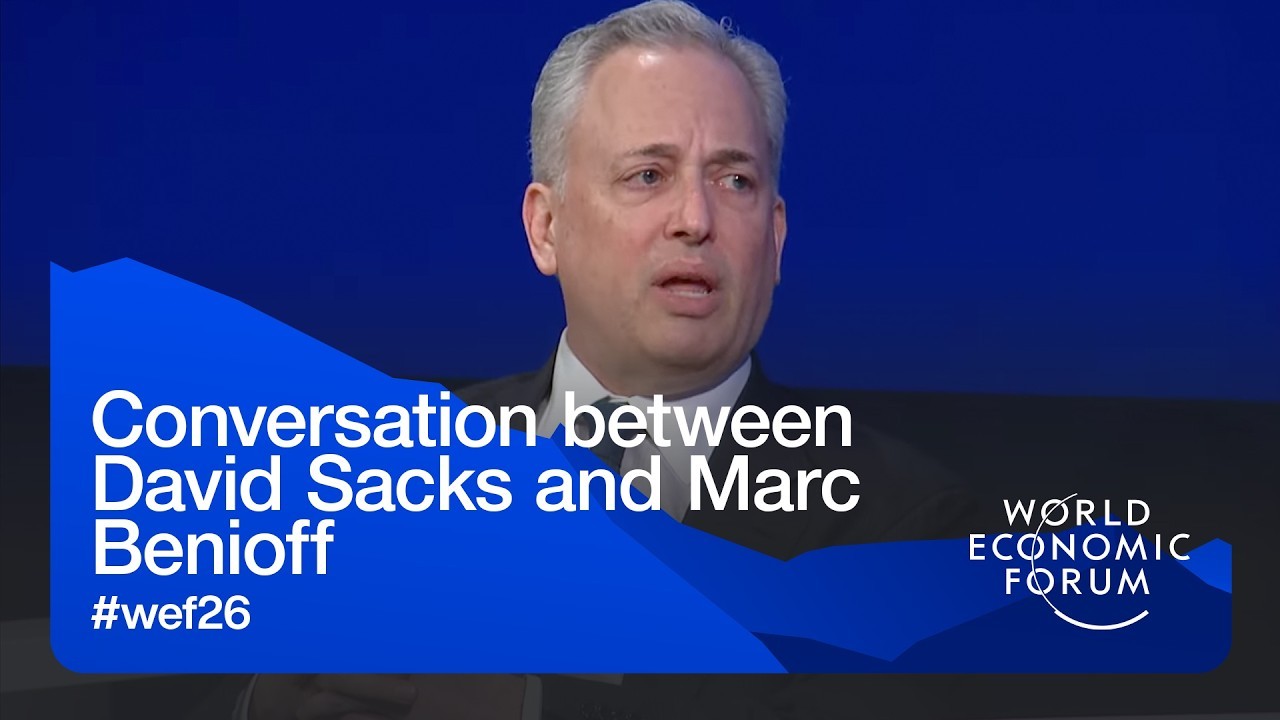
Conversation between David Sacks and Marc Benioff | World Economic Forum Annual Meeting 2026

Conversation between David Sacks and Marc Benioff | World Economic Forum Annual Meeting 2026

Conversation between David Sacks and Marc Benioff | World Economic Forum Annual Meeting 2026

Jan 23, 2026

Jan 23, 2026

World Economic Forum

World Economic Forum

35:29

35:29

6.5K Views

6.5K Views

THESIS

A unified US federal regulatory framework for AI, replacing fragmented state laws, will solidify American technological dominance against global competitors.

A unified US federal regulatory framework for AI, replacing fragmented state laws, will solidify American technological dominance against global competitors.

A unified US federal regulatory framework for AI, replacing fragmented state laws, will solidify American technological dominance against global competitors.

ASSET CLASS

ASSET CLASS

SECULAR

SECULAR

CONVICTION

CONVICTION

HIGH

HIGH

TIME HORIZON

TIME HORIZON

Medium to Long Term

Medium to Long Term

01

01

//

PREMISE

PREMISE

Regulatory Fragmentation Risks Innovation

Regulatory Fragmentation Risks Innovation

The current US landscape faces a threat from 1,200 pending AI-related bills across 50 states, creating a patchwork regulatory environment that burdens startups and erodes the traditional advantage of a seamless national market.

The current US landscape faces a threat from 1,200 pending AI-related bills across 50 states, creating a patchwork regulatory environment that burdens startups and erodes the traditional advantage of a seamless national market.

02

02

//

MECHANISM

MECHANISM

Federal Preemption via Light-Touch Framework

Federal Preemption via Light-Touch Framework

The administration is aggressively pursuing a single federal framework to preempt state regulations, ensuring a consistent rulebook that supports rapid private-sector innovation rather than the precautionary, government-led regulation seen in Europe.

The administration is aggressively pursuing a single federal framework to preempt state regulations, ensuring a consistent rulebook that supports rapid private-sector innovation rather than the precautionary, government-led regulation seen in Europe.

03

03

//

OUTCOME

OUTCOME

Sustained US AI Hegemony

Sustained US AI Hegemony

By avoiding the 'self-inflicted injury' of over-regulation or fragmentation, the US will maintain its lead over China and Europe, driving economic growth through a vibrant, unencumbered venture ecosystem.

By avoiding the 'self-inflicted injury' of over-regulation or fragmentation, the US will maintain its lead over China and Europe, driving economic growth through a vibrant, unencumbered venture ecosystem.

//

NECESSARY CONDITION

Federal legislation must successfully preempt state-level initiatives without imposing restrictive 'precautionary' mandates similar to the EU AI Act.

One of the great advantages that the United States has had is this huge seamless national market. Uh historically, you've only really had to in most industries, uh certainly in the internet business, you only had to worry about complying with a single rule book. Now we're in danger of having 50. And I think the president has been very clear that he would like to see us have a single federal framework for AI regulation.

One of the great advantages that the United States has had is this huge seamless national market. Uh historically, you've only really had to in most industries, uh certainly in the internet business, you only had to worry about complying with a single rule book. Now we're in danger of having 50. And I think the president has been very clear that he would like to see us have a single federal framework for AI regulation.

18:54

RISK

Steel Man Counter-Thesis

While the US maintains a temporary lead in chips and models , its long-term dominance is threatened by a 'self-inflicted injury' of pessimism. With only 39% of the US population optimistic about AI versus 83% in China, the political mandate for a permissive federal framework is weak. If the US fails to match China's speed in physical power generation or if state-level fragmentation persists due to political gridlock, the US will lose the AI race regardless of its current innovation edge.

//

RISK 01

RISK 01

Social Harm & Litigation Blowback

Social Harm & Litigation Blowback

THESIS

The 'light touch' regulatory approach relies on private companies self-correcting after 'adverse consequences' occur, such as the suicide associated with Character AI. If self-regulation fails to prevent further catastrophic harms, the resulting public outcry could force the very heavy-handed regulation the administration seeks to avoid.

The 'light touch' regulatory approach relies on private companies self-correcting after 'adverse consequences' occur, such as the suicide associated with Character AI. If self-regulation fails to prevent further catastrophic harms, the resulting public outcry could force the very heavy-handed regulation the administration seeks to avoid.

DEFENSE

Sacks argues that now that companies know these risks are possible, they will 'program the AI' to prevent them. He further defends the technology by characterizing AI as a useful utility rather than an addictive platform like social media.

Sacks argues that now that companies know these risks are possible, they will 'program the AI' to prevent them. He further defends the technology by characterizing AI as a useful utility rather than an addictive platform like social media.

//

RISK 02

RISK 02

The 'Optimism Gap' & Political Fragility

The 'Optimism Gap' & Political Fragility

THESIS

Only 39% of Americans are 'AI optimists' compared to 83% in China. This lack of domestic buy-in creates a fertile political environment for the 'knee-jerk' restrictive state regulations that the administration is fighting to preempt.

Only 39% of Americans are 'AI optimists' compared to 83% in China. This lack of domestic buy-in creates a fertile political environment for the 'knee-jerk' restrictive state regulations that the administration is fighting to preempt.

DEFENSE

Sacks identifies the metric as a concern but offers no concrete policy to fix it, merely hoping that 'miraculous products' will eventually shift public sentiment.

Sacks identifies the metric as a concern but offers no concrete policy to fix it, merely hoping that 'miraculous products' will eventually shift public sentiment.

//

RISK 03

RISK 03

Infrastructure Velocity Deficit

Infrastructure Velocity Deficit

THESIS

While the thesis focuses on regulatory superiority, Sacks admits China is 'spinning up power generation faster than we are'. A streamlined legal framework is insufficient if the US cannot physically power the data centers required to sustain the compute race.

While the thesis focuses on regulatory superiority, Sacks admits China is 'spinning up power generation faster than we are'. A streamlined legal framework is insufficient if the US cannot physically power the data centers required to sustain the compute race.

DEFENSE

He concedes this is a Chinese advantage but pivots back to the current US lead in chips and models without addressing the looming energy bottleneck.

He concedes this is a Chinese advantage but pivots back to the current US lead in chips and models without addressing the looming energy bottleneck.

//

ASYMMETRIC SKEW

Asymmetric Downside Risk: The thesis relies on a legislative 'hole-in-one' (federal preemption) to maintain the status quo lead. Failure results in a 'patchwork' of 50 regulatory regimes and an energy deficit against China, effectively ceding the sector.

ALPHA

NOISE

The Consensus

The prevailing political and regulatory momentum (at the US state level and in Europe) favors a 'precautionary principle' approach, driven by fear of AI risks. This has led to 1,200 pending state bills and restrictive frameworks like the EU AI Act, based on the belief that immediate, decentralized intervention is necessary to prevent social harm.

Unchecked technology inevitably leads to negative externalities (addiction, mental health crises) similar to the social media era; therefore, safety requires 'ex-ante' (pre-deployment) restrictions and liability.

SIGNAL

The Variant

Sacks argues that this 'knee-jerk' regulatory fragmentation is the primary threat to US technological hegemony. His variant view is that a single, permissive federal framework must preempt state laws to preserve a 'seamless national market,' treating AI as a strategic asset to be accelerated rather than a social risk to be contained.

Innovation creates national security and economic dominance. Sacks posits that AI is a 'utility' (like Google) rather than an addictive media platform, and that safety is best achieved through 'ex-post' (post-deployment) correction of specific harms. He argues that the 'tyranny of 50 rulebooks' stifles the very startup ecosystem needed to compete with China.

SOURCE OF THE EDGE

Direct Policy Architect & Executive Access (As the 'AI and Crypto Czar' and Chairman of PCAST, Sacks operates as a 'Special Government Employee' with direct access to President Trump, witnessing private Oval Office interventions and shaping the administration's specific policy strategy).

//

CONVICTION DETECTED

• This is a tremendously consequential American president • He has a tremendous sense of agency • The numbers have just been phenomenal • We have to win the AI race • He really is the difference maker there • That just you know that number just kind of blew everyone away

//

HEDGE DETECTED

• Some of those regulations may be warranted • Who knows how it's going to, you know, be determined • Probably I'd want to consult some lawyers about this • I worry that we could lose • I hope I'm not over gen over stereotyping anyone