
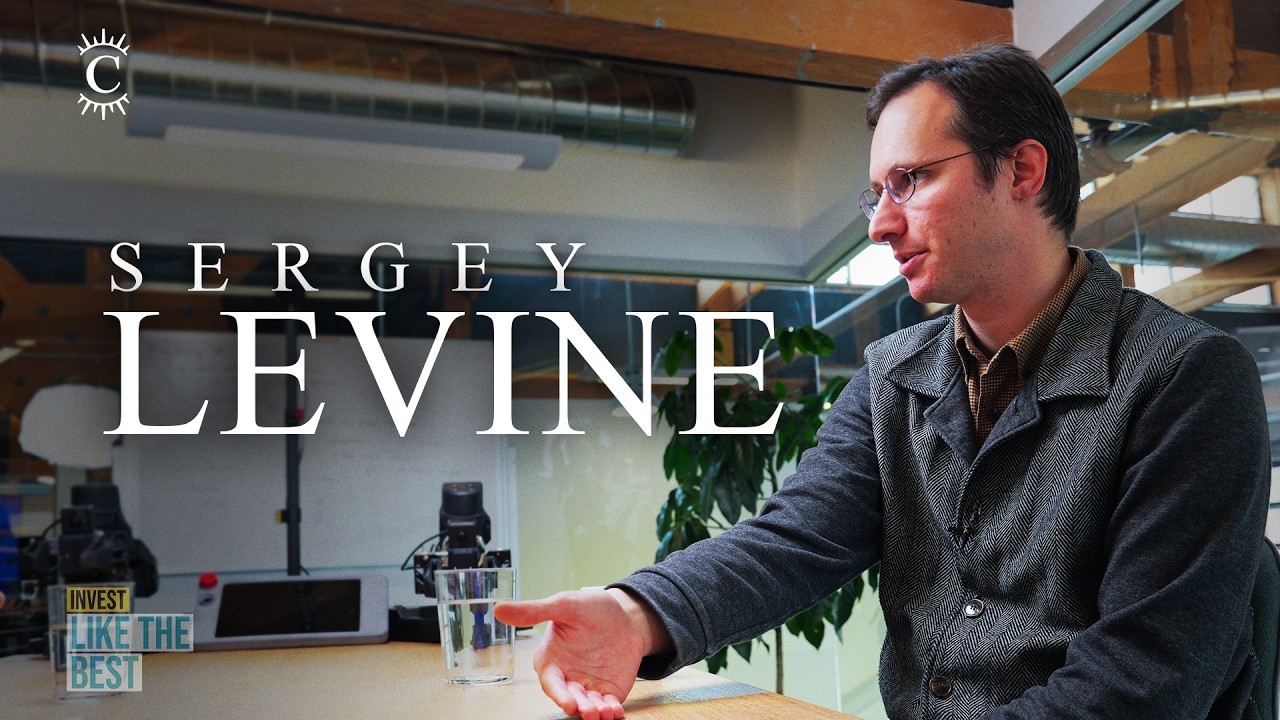
THESIS
//
//
//
//
NECESSARY CONDITION
Regulatory frameworks must remain permissive to innovation (avoiding the 'European' model) and open source development must remain unencumbered by downstream liability.
48:30
RISK
Steel Man Counter-Thesis
The strongest counter-thesis is that Physical Intelligence is pursuing a theoretically elegant but commercially unviable strategy that will be outrun by vertically integrated specialists. The LLM analogy is structurally flawed: language had a free, internet-scale, self-supervised training corpus; robotics has no equivalent and may never have one without first solving the deployment problem, which itself requires solving the intelligence problem — a classic circular dependency. Meanwhile, companies pursuing narrow but deployable robotic solutions in specific verticals (warehouse logistics, food preparation, agricultural harvesting) can achieve commercial deployment within 2-3 years, begin collecting domain-specific data at scale through actual revenue-generating operations, and build compounding data moats that a generalist model cannot match in those specific domains. The historical precedent is not LLMs but rather the autonomous vehicle industry, where the 'general driving AI' thesis (exemplified by early Waymo/Google self-driving ambitions) was eventually overtaken by the reality that even narrow geographic deployment required a decade of iteration. The robotics problem is arguably harder: it spans infinite form factors, infinite task spaces, and infinite environments, whereas driving at least constrains the vehicle type and the road network. Furthermore, the claim that a single foundation model can unify simulation-based locomotion and data-based manipulation — two approaches that the speaker himself admits look 'surprisingly different' — is an untested hypothesis with no supporting evidence. The most likely outcome is that Physical Intelligence produces impressive research demonstrations that advance the field but that commercial value accrues to focused competitors who solve specific deployment problems first and use that deployment to build insurmountable data advantages in their domains, much as Google Search, not Google's general AI research, built the actual business moat.
//
THESIS
DEFENSE
//
THESIS
DEFENSE
//
THESIS
DEFENSE
//
ASYMMETRIC SKEW
The upside is genuinely transformational — a general-purpose robotic foundation model would be a platform technology comparable to the internet or the personal computer, creating trillions of dollars in value across every physical industry. However, the downside is severe and path-dependent: the bootstrapping problem means the company could burn through billions in capital pursuing generality while narrow competitors capture deployment opportunities and data flywheels, leaving Physical Intelligence in an academically prestigious but commercially stranded position. The asymmetry skew is high-upside but with a wide distribution of outcomes and significant probability mass on scenarios where the timeline extends 5-10+ years beyond expectations, during which capital requirements escalate and competitive moats form elsewhere. The risk is not that the thesis is wrong in principle but that it is wrong in sequence — that generality is the endpoint, not the starting point, of commercially viable robotics.
ALPHA
NOISE
The Consensus
The market broadly believes that robotics will advance through specialized, task-specific solutions — purpose-built robots with narrow capabilities for defined environments (warehouse picking, manufacturing assembly, etc.). The prevailing view is that humanoid robots represent the primary form factor for general-purpose robotics, that simulation-heavy approaches are viable paths to physical AI, and that the robotics intelligence problem will be solved incrementally through domain-specific engineering stacks. The consensus also holds that robotics deployment timelines remain long and uncertain, with commercialization likely a decade or more away for truly general systems.
The market's logic is that robotics requires enormous domain-specific engineering because physical environments are too diverse and unpredictable for general models. Each new task or environment requires extensive custom data collection, simulation, and hand-tuned control systems. The hardware form factor matters enormously, and getting a single form factor (especially humanoids) right is prerequisite to broad deployment. Simulation-based approaches are favored for locomotion and agility because they can generate unlimited training data cheaply. Commercial viability requires solving narrow use cases first, then expanding.
SIGNAL
The Variant
Sergey Lavine believes the robotics intelligence problem should be solved at full generality from the outset — building one foundation model that controls any embodied system for any task, analogous to how LLMs solved language tasks more effectively than domain-specific NLP systems. He believes the humanoid form factor is just one of many, that the real bottleneck is the intelligence layer (not hardware), and that the path to useful robotics runs through a platform model that enables a Cambrian explosion of diverse robot applications. Critically, he believes the field is closer to an inflection point than most established robotics researchers think, and that the combination of multimodal LLM knowledge with reinforcement learning — two historically separate AI paradigms — is the key synthesis that unlocks general physical intelligence.
Lavine's causal logic inverts multiple consensus assumptions. First, he argues generality is actually easier than specialization in the long run because a general model that understands physical interaction can bootstrap new tasks with minimal additional data — the same dynamic that made GPT more effective than specialized NLP systems. Second, he argues that multimodal LLMs have created a previously nonexistent path to common sense in robotics: by using chain-of-thought reasoning, robots can leverage web-scale knowledge to handle long-tail scenarios without needing to have experienced them physically. Third, he believes the data flywheel problem is solvable without massive upfront data collection — once robots are useful enough to deploy, they self-generate training data, similar to Tesla's fleet learning model. Fourth, he argues the bottleneck has already shifted from low-level physical execution to mid-level semantic reasoning about what to do next, which can be improved through language-based coaching rather than expensive teleoperation data. This is a fundamentally different cost structure for improvement than the consensus assumes.
SOURCE OF THE EDGE
Lavine's edge is genuine and multi-layered. First, he has direct operating experience: he has been building robotic learning systems for over a decade, including the Google 'arm farm' project that was an early demonstration of collective robot learning. He has personally navigated the failures and dead ends of narrow robotic AI approaches, giving him pattern recognition that outsiders lack. Second, he is sitting on proprietary empirical results — the discovery that models improve from semantic coaching alone (without additional teleoperation data) is a non-obvious finding that emerged from internal experimentation at Physical Intelligence. Third, the Robot Olympics demonstration, where their general-purpose system onboarded a dozen novel tasks without specialized development, is concrete evidence of generalization capability. However, there are important caveats. The interviewer is a disclosed investor, which creates incentive alignment that may soften the questioning. Lavine acknowledges significant uncertainty about timelines and the right data collection paradigm (teleoperation vs. autonomous vs. hybrid), and he explicitly states he hasn't solved the key synthesis of generative AI and reinforcement learning yet. The edge is real in terms of research depth and early empirical signals, but the leap from 'our general model can solve curated challenge tasks' to 'this becomes a commercially viable platform' remains unproven. The structural advantage is credible; the commercial thesis built on top of it is still speculative.
//
CONVICTION DETECTED
• "part of the thesis of this company is that we believe that doing it at the full level of generality might actually in the long run be easier than trying to special case very specific narrow application domains" • "there's basically one problem. not many different problems" • "I fundamentally the intell the challenge of intelligence looks very similar for all these different robots" • "in the long run, if we want that generality, especially generality in the machine's ability to improve, then we need it to primarily be learning from data" • "the bottleneck had actually shifted from the lowest level meaning the robot's ability to physically do the task to this like middle level" • "that's a big deal because now that means that someone can literally talk to the robot coaching basically" • "I think we've made a lot more progress on dexterity than I thought we would" • "the model itself didn't need to change. It didn't even need to be told through any kind of prompt what the robot was" • "I'm on the optimistic end when it comes to established robotics researchers"
//
HEDGE DETECTED
• "I don't think anybody really knows how much robot data is needed to have truly generalizable and powerful embodied AI" • "I do think the timeline is uncertain" • "I'm not even sure if in the long run it's going to have a language model" • "I don't know if the correct design for a robot is to have three cameras" • "I don't know the answer and I have my own subjective opinions" • "I haven't figured out yet but I think we've made some good progress" • "when you've climbed the mountain, only then do you see if there's another mountain after it" • "there is a lot of uncertainty about the timing of that" • "I'm not sure it's like the part of the equation that we most need to figure out right now" • "it's not something that I have even close to like a concrete answer to" • "Will the robots rely more on demonstrations or on reinforcement learning from autonomous data? We're working on both of those things... that's something we're hopefully going to learn about over the next few years" • "I don't think there's like one right answer" The ratio of conviction to hedging reveals a speaker who is genuinely certain about the architectural thesis (generality over specialization, learning over programming, one foundation model for all embodiments) but honestly uncertain about implementation details and timelines. This is the pattern of a rigorous researcher, not a promoter performing certainty. The hedging concentrates on execution variables — how much data, which data collection method, what timeline — while conviction concentrates on the fundamental approach. This pattern suggests the core thesis should be weighted heavily, but any specific timeline or deployment predictions should be heavily discounted. The intellectual honesty actually increases the credibility of the claims where he does express conviction.