
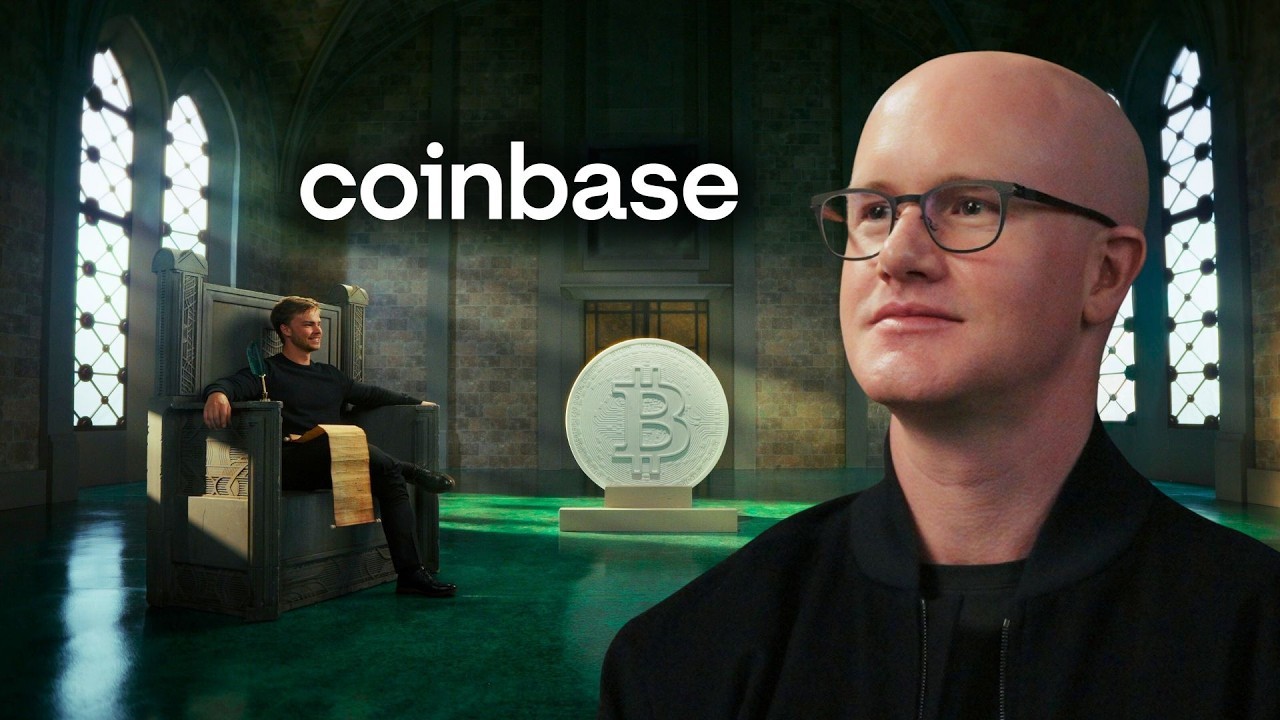
THESIS
//
//
//
//
NECESSARY CONDITION
Regulatory frameworks must remain permissive to innovation (avoiding the 'European' model) and open source development must remain unencumbered by downstream liability.
00:00
RISK
Steel Man Counter-Thesis
Coinbase's competitive position may be fundamentally weaker than the trust narrative suggests because trust itself is a depreciating asset in a maturing market. The premium customers pay for regulatory compliance and institutional credibility exists only during periods of uncertainty. As crypto regulation stabilizes globally, the trust arbitrage collapses. Competitors who grew faster by operating in less regulated environments accumulated larger user bases, more liquidity, and greater product iteration experience. When they achieve regulatory parity, they bring superior scale economics to a now-level playing field. Furthermore, Coinbase's custody concentration creates a paradox: the more successful the strategy of storing more crypto than anyone else, the more attractive the target and the more catastrophic the potential failure. Traditional financial institutions entering the space can offer equivalent custody through established prime brokerage infrastructure while distributing risk across multiple custodians. The wartime CEO identity Armstrong describes may be maladaptive for the actual challenge ahead, which is not crisis navigation but sustained execution in a competitive commodity market where the differentiation premium steadily erodes.
//
THESIS
DEFENSE
//
THESIS
DEFENSE
//
THESIS
DEFENSE
//
ASYMMETRIC SKEW
Downside scenario involves permanent margin compression as regulatory moat erodes, combined with existential tail risk from custody concentration. Upside scenario requires sustained execution advantage and successful revenue diversification before competitive parity is achieved. The asymmetry appears unfavorable: the trust premium is time-limited while the concentration risk is permanent.
ALPHA
NOISE
The Consensus
The market believes that cryptocurrency remains a volatile, speculative asset class with unclear regulatory frameworks, that traditional financial institutions will cautiously approach crypto adoption, and that aggressive regulatory compliance creates competitive disadvantages in a global market where offshore competitors can move faster by operating outside US jurisdiction.
The market's logic holds that crypto volatility is structural and cyclical, that offshore competitors extracting regulatory arbitrage will maintain market share advantages, that institutional adoption will remain incremental and cautious, and that compliance costs create permanent margin compression for US-based operators.
SIGNAL
The Variant
Armstrong believes crypto is undergoing an irreversible transformation into core financial infrastructure, that regulatory clarity is now the dominant global trend favoring compliant players, and that the competitive moat of trust will prove more durable than the first-mover advantages of less regulated competitors. He sees the current period as the inflection point where Coinbase's 13-year investment in compliance converts from drag to structural advantage.
Armstrong's logic inverts causality: regulatory clarity does not compress opportunity but expands TAM by enabling institutional participation; trust compounds into custody deposits which create switching costs and product attachment; winters are shortening because the asset class is maturing; and the offshore operators' advantages are temporary as global regulatory convergence forces cleanup. He sees compliance as investment not cost, and the current legislative progress as confirmation of the thesis.
SOURCE OF THE EDGE
Armstrong claims multiple edge sources: 13 years of operating experience through multiple crypto cycles, direct relationships with regulators and legislators, proprietary data on institutional custody flows, and pattern recognition from surviving existential crises. The credibility of these edges is mixed. The operational experience is genuine and battle-tested. The policy relationships appear real given described outcomes. However, the claim that Coinbase will naturally capture the transformed financial system rests on assumption that trust moats transfer across product categories and that no well-capitalized traditional financial institution will replicate the compliance stack. The most credible edge is the existing custody position and institutional relationships, which creates genuine switching costs. The weakest claim is the inevitability of crypto-rails-as-infrastructure, which remains a thesis rather than demonstrated trajectory. Armstrong is constructing narrative around a real operational position, but the narrative extends beyond what the position guarantees.
//
CONVICTION DETECTED
• I don't see a reason why we shouldn't be the leading company in the world doing that • In that environment, I think Coinbase wins • I actually realize that I like wartime • I think it's wartime all the time • I actually think that I love conflict • We felt we had to preserve the industry in the United States • We were totally right and I was wrong • We ended up winning that lawsuit • That was just one example of me. It's like action just like let's just move • If you're not embarrassed by the first thing you launch, you waited too long • Monday we're launching our institutional product
//
HEDGE DETECTED
• There's been times where I forced it through and I regret it later • Sometimes we get it wrong and sometimes we get it right • That just comes from being in the arena, getting enough experience where you start to trust your instincts versus question it • I don't know without naming exact names • I can also be a little bit of an anti-authority streak • I'm not like the most charismatic storyteller in the world • It's going to be thousands of companies coming in and doing that • Part of me was like three months, that was it? We could, you know, I've been through like three-year crypto winters • Somebody might say you're just running on cortisol all the time and there could be an element of truth to that The ratio reveals a speaker with high operational confidence but selective intellectual humility. Armstrong hedges on personal limitations and past mistakes but rarely hedges on strategic direction or industry trajectory. This pattern suggests genuine conviction on the macro thesis rather than performed certainty. When he hedges, it concerns execution risk or self-assessment, not the fundamental bet. The conviction should be taken seriously on directional claims about crypto adoption and regulatory trajectory; skepticism should apply to the assumption that Coinbase specifically captures disproportionate value from that trajectory.