
THESIS
//
//
//
//
NECESSARY CONDITION
Regulatory frameworks must remain permissive to innovation (avoiding the 'European' model) and open source development must remain unencumbered by downstream liability.
26:45
RISK
Steel Man Counter-Thesis
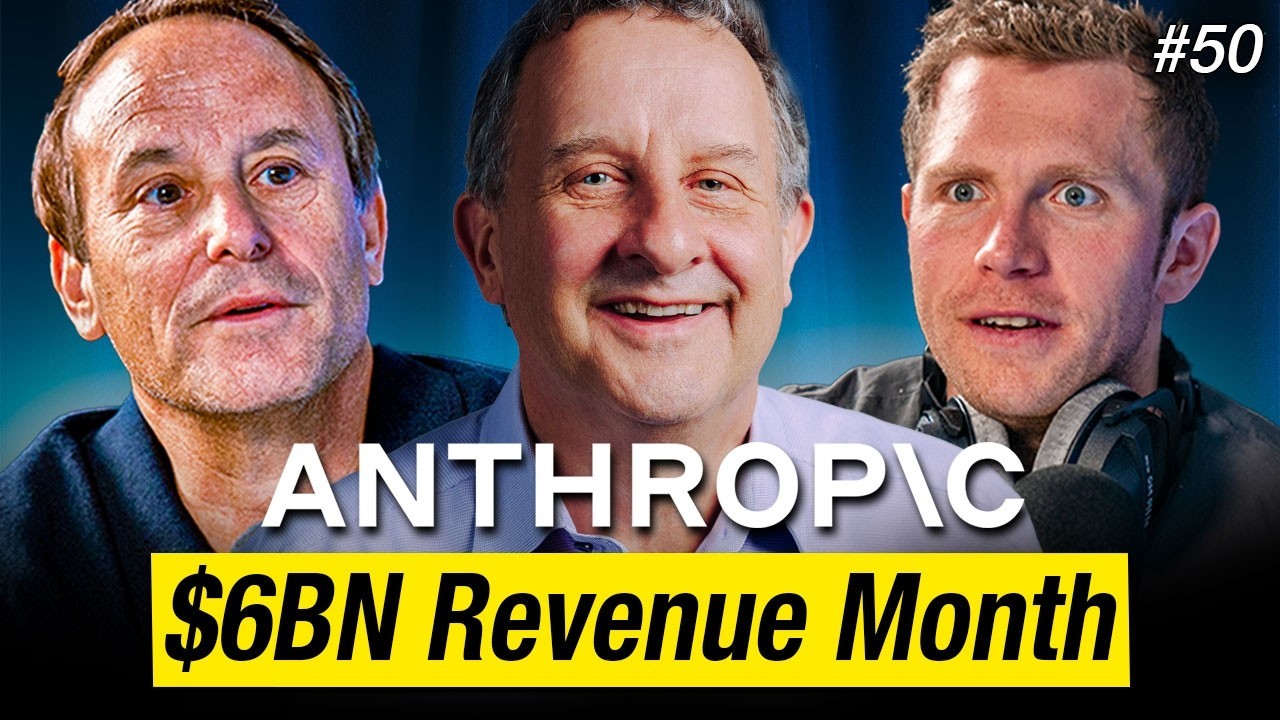
The prevailing thesis is that Anthropic is the disciplined, fast-growing winner pulling away from a dysfunctional OpenAI in a market with limitless demand. The strongest counter-thesis is threefold: First, Anthropic's revenue growth is substantially overstated due to gross revenue recognition on partner channels and industry-wide token reselling — the same token generates ARR at Anthropic, then at AWS, then at Cursor, then at the end customer, creating a Potemkin village of revenue that collapses when profitability becomes the measure. No one on this panel estimated Anthropic's true net revenue, but if AWS takes 20-35% and downstream resellers are recognizing the same tokens, Anthropic's economic revenue could be 40-50% of headline figures. Second, the competitive moat thesis is weak: Claude's capabilities derive primarily from scaling known architectures and training data, not from proprietary defensible technology. The leaked Mythos details — if accurate — show a 10 trillion parameter model, which is an engineering achievement but not a structural moat; any well-capitalized competitor (Google, Meta, xAI) can pursue similar scale. Anthropic has no distribution moat comparable to OpenAI's 500 million monthly users, no platform lock-in comparable to Microsoft's enterprise integration, and no hardware moat comparable to Google's TPUs. Third, the 'disciplined leadership' narrative may be selection bias from a company that simply hasn't been tested yet at OpenAI's scale of public scrutiny, board complexity, and multi-stakeholder management. OpenAI's drama is partly a function of being first and biggest; Anthropic's calm is partly a function of being younger and smaller. History shows that rapid growth creates organizational dysfunction — it doesn't prevent it — and Anthropic's accidental leak is an early signal that operational discipline degrades under velocity pressure. The bear case is that Anthropic is a well-run but undifferentiated model provider with overstated revenue, no distribution advantage, and a safety brand that is one major incident away from evaporating.
//
THESIS
DEFENSE
//
THESIS
DEFENSE
//
THESIS
DEFENSE
//
ASYMMETRIC SKEW
The downside is materially underappreciated relative to the upside consensus. Upside relies on Anthropic maintaining its growth trajectory, achieving durable enterprise penetration, and justifying its valuation through eventual profitability — all while operating at negative margins in a compute-scarce environment with inflated headline revenue. Downside scenarios include revenue compression of 40-50% when net revenue accounting is enforced, rapid competitive convergence from Google/Meta/xAI reducing pricing power, and a potential credibility crisis if security or safety incidents escalate. The skew is roughly 1:1 or worse — the probability-weighted downside (revenue restatement, margin pressure, competitive commoditization) is comparable in magnitude to the upside (continued hypergrowth into market leadership), but the market is pricing almost exclusively for the upside scenario. This is a crowded trade with asymmetric information disadvantage for outside investors who cannot verify the true unit economics.
ALPHA
NOISE
The Consensus
The market believes OpenAI maintains its leadership position in AI despite organizational turbulence, that cybersecurity companies face existential disruption from frontier AI models capable of detecting threats (evidenced by 6-9% selloffs on Anthropic's Mythos leak), that current AI company valuations and revenue figures are broadly trustworthy indicators of durable business value, and that California/Washington remain viable headquarters for tech wealth creation despite increasing tax burdens. The consensus also holds that consumer AI revenue (subscriptions, ads) represents a viable path to justifying current valuations.
The market's logic chain: Frontier AI models will subsume security functions → cybersecurity incumbents lose moats → sell. OpenAI's massive user base (500M+ uniques) and brand create an unassailable consumer position → valuation justified. High ARR figures reported by AI startups reflect genuine product-market fit and durable demand. Venture capital value-add justifies carried interest and access premiums. State tax increases on the wealthy will generate proportional revenue increases.
SIGNAL
The Variant
The speakers collectively believe: (1) Anthropic is structurally outexecuting OpenAI due to leadership stability and strategic coherence versus OpenAI's chronic senior team dysfunction and strategic wandering (killing Sora, late pivot to coding/enterprise). (2) The cybersecurity selloff is precisely backwards — the agentic era represents a golden age for security companies because threats are exploding orders of magnitude faster than defenses, and every CISO will take any meeting about agentic security. (3) AI revenue metrics across the ecosystem are substantially gamed — tokens are being resold and re-recognized multiple times across the value chain, free trial conversions are being recognized as ARR, and tranched rounds create misleading valuation headlines. The real reckoning comes when profitability is required. (4) The geographic exodus of ultra-high-net-worth founders and investors from California is accelerating and will cause net revenue losses for the state, not gains, as the proposed wealth taxes assume collections from people who have already left. (5) The China-Singapore-US pipeline for AI talent acquisitions is functionally dead after the Manis founder detention.
The speakers' counter-logic: (1) On cybersecurity: The causal arrow is reversed. More AI agents = more attack surface = more security spend, not less. The market is conflating 'AI can detect threats' with 'AI eliminates the need for security companies,' when the correct inference is that agentic proliferation creates exponentially more vulnerabilities that require both new and existing security solutions. (2) On OpenAI vs Anthropic: Leadership coherence is the primary determinant of execution speed in AI, not model capability alone. OpenAI's CEO has spent a disproportionate share of time managing interpersonal dynamics rather than strategic execution, which is the highest warning signal a board can observe. Anthropic's consistent founder-led structure will compound into widening execution advantages. (3) On revenue quality: The entire AI revenue ecosystem has a double/triple-counting problem — the same tokens flow through foundation model providers, middleware platforms, and end-user applications, each recognizing revenue on the same underlying compute. This creates the illusion of a much larger TAM than actually exists, and it unravels when any layer demands profitability. (4) On tax policy: Ultra-high-net-worth individuals have high mobility and discrete liquidity events. A 13% state tax on a $2 billion one-time gain creates a $260 million incentive to relocate for 165 days — the tax itself changes the behavior it assumes is static, resulting in net revenue loss. (5) On China deals: The Manis outcome demonstrates that redomiciling does not sever sovereign claims on talent, making risk-adjusted returns on similar deals unacceptable going forward.
SOURCE OF THE EDGE
The speakers' edge derives from three sources of varying credibility: (1) Operating experience — Jason Lemkin has direct experience as a founder, operator, and active early-stage investor who personally tests products (he ran a structured evaluation of Emergent Labs against competitors) and has pattern-matched across hundreds of portfolio company revenue presentations. His observation about the PLG free-trial-to-ARR recognition trick and the token re-recognition chain is grounded in repeated firsthand exposure to the mechanics of how startups game metrics. This is a genuine informational advantage — most market participants consuming headline ARR numbers have not sat in the board meetings where these numbers are constructed. (2) Institutional investing perspective — Rory (likely a growth/crossover investor) brings structural knowledge of how tranched rounds work, how cybersecurity subsectors differ, and how leverage ratios translate to blowup risk (his SoftBank analysis). His breakdown of the cybersecurity selloff — distinguishing application security from perimeter defense from authentication — reflects genuine domain expertise that the market's indiscriminate 6-9% selloff clearly lacked. (3) Narrative construction — Some claims are less empirically grounded. The Anthropic-vs-OpenAI framing, while directionally supported by public evidence, leans heavily on a 'good management vs bad management' narrative that is unfalsifiable in real time. The speakers acknowledge they don't have inside information on either company's actual execution metrics. The Wall Street Journal article on Dario's departure provides color but not current operating data. Similarly, the California exodus thesis, while logically sound, is presented with more conviction than the available data strictly supports — the speakers cite individual anecdotes (Jervason, Schultz) rather than aggregate migration data. Overall assessment: The edge on revenue quality and metric gaming is real and structurally grounded. The edge on cybersecurity being mispriced is credible and well-reasoned. The OpenAI organizational dysfunction thesis is plausible but relies on narrative pattern-matching rather than proprietary information. The macro tax/migration thesis is directionally logical but presented with more certainty than warranted.
//
CONVICTION DETECTED
• We may be at the stage where we throw the humans under the bus, not the AI anymore, which I think at some level is pretty terrifying • I think shooting in the head is even more significant • A big part of the whole strategic direction of the company was flawed • This is one where it's just backass barkwards • This is a golden age of security • This should be the golden age for new and existing investors because the threats are terrifying • Everyone should be benefiting when you see an explosion in application production • I don't believe there's right or wrong in money. There's just money. • Let me be direct. Get the over it. • Being mean to a billionaire is actually a feature • You should conform your company around your customers and your model, not your VCs • I just don't think raising it 5 or 8 billion when you're at 80 million or 100 million of suspect AR is the most exciting accomplishment in the world • You haven't lived till you've seen an 85% decline in an index • The Singapore washing thing is over. It's over. • I think this whole Singapore washing thing is over • We're not the stars in the drama. We're bit players who get well paid for our part • No one yet knows the exact approach... but everyone 100% understands that this is an emerging mega threat • Actions of consequences
//
HEDGE DETECTED
• I'm not saying this is what emerges, but a lot of startups will instantly recognize that as $240 in ARR • I'm not going to say that publicly because I don't want Sam to break my balls • Maybe I'm wrong • I'm not smart enough to know • I don't actually know what happened • It's hard for me to know the criticism • I would imagine if venture had access to more debt, we'd all load up on it • I'm not in the boardroom • I'm going to avoid any specifics genuine comment here because it's not appropriate • I don't have a ton of information so I'm not going to breach any confidentialities • I only have a tiny bit of information • Narrative is overdone on both sides • I'm not going to comment on numbers at all • That may well be true. I don't want to debate that. This is not political. • Hopefully it turns out to something like that • I'm doing this on the fly The ratio of conviction to hedging reveals a pattern of high-conviction thematic claims paired with careful hedging on specific facts and individual companies. The speakers are genuinely certain about structural dynamics (cybersecurity mispricing, revenue gaming, agentic threat expansion, California exodus logic) but hedge appropriately when they lack direct information (specific company revenues, board-level decisions, deal specifics where they have disclosure constraints). This is the pattern of experienced operators and investors who distinguish between what they know structurally versus what they know specifically. The hedging does not undermine the core theses — it actually increases credibility because the speakers are not performing omniscience. Weight should be placed most heavily on the structural claims (cybersecurity golden age, revenue quality skepticism, organizational dysfunction costs) and more lightly on specific predictions about individual company trajectories.