
dstl

TERMINAL

TERMINAL

LIBRARY

LIBRARY

//

AI's Capital Markets Reckoning: Super Intelligence Discount Rates, Anthropic vs OpenAI, and the SaaS Valuation Reset

AI's Capital Markets Reckoning: Super Intelligence Discount Rates, Anthropic vs OpenAI, and the SaaS Valuation Reset

AI's Capital Markets Reckoning: Super Intelligence Discount Rates, Anthropic vs OpenAI, and the SaaS Valuation Reset

All-In Podcast

All-In Podcast

1:20:06

1:20:06

104K Views

104K Views

THESIS

Super intelligence expectations are forcing a historic revaluation of software companies while concentrating durability premiums in a shrinking set of monopolistic cash-flow generators.

Super intelligence expectations are forcing a historic revaluation of software companies while concentrating durability premiums in a shrinking set of monopolistic cash-flow generators.

Super intelligence expectations are forcing a historic revaluation of software companies while concentrating durability premiums in a shrinking set of monopolistic cash-flow generators.

ASSET CLASS

ASSET CLASS

SECULAR

SECULAR

CONVICTION

CONVICTION

HIGH

HIGH

TIME HORIZON

TIME HORIZON

5 to 10 years

5 to 10 years

01

01

//

PREMISE

PREMISE

The market is bifurcating between companies whose cash flows are treated as monopolistically durable forever and those being repriced for AI-driven disruption

The market is bifurcating between companies whose cash flows are treated as monopolistically durable forever and those being repriced for AI-driven disruption

Public markets are undergoing a fundamental rerating of software and technology companies based on a single fork-in-the-road question: is super intelligence coming or is AI merely good next-generational software? SaaS companies like Snowflake, ServiceNow, and Workday have seen their free-cash-flow payback periods (market cap divided by annual free cash flow) collapse — Snowflake from nearly 100 years to roughly 50. Meanwhile, the Mag 6 (Apple, Microsoft, Meta, Alphabet) have seen their payback multiples expand, signaling the market believes their cash flows are essentially permanent monopolies. Nvidia, despite being the most accretive and highest-margin company generating $200 billion, is being treated with the same skepticism as mid-tier SaaS names. This dispersion reveals a structural imbalance: the market is pricing in a world where AI disrupts most businesses every 5-6 years, making equity promises hollow, while simultaneously treating a handful of platform incumbents as immune to that same disruption.

Public markets are undergoing a fundamental rerating of software and technology companies based on a single fork-in-the-road question: is super intelligence coming or is AI merely good next-generational software? SaaS companies like Snowflake, ServiceNow, and Workday have seen their free-cash-flow payback periods (market cap divided by annual free cash flow) collapse — Snowflake from nearly 100 years to roughly 50. Meanwhile, the Mag 6 (Apple, Microsoft, Meta, Alphabet) have seen their payback multiples expand, signaling the market believes their cash flows are essentially permanent monopolies. Nvidia, despite being the most accretive and highest-margin company generating $200 billion, is being treated with the same skepticism as mid-tier SaaS names. This dispersion reveals a structural imbalance: the market is pricing in a world where AI disrupts most businesses every 5-6 years, making equity promises hollow, while simultaneously treating a handful of platform incumbents as immune to that same disruption.

02

02

//

MECHANISM

MECHANISM

AI-driven disruption compresses business lifecycles, destroying the equity-compensation model and forcing a shift from price-to-earnings to price-to-cash valuation frameworks

AI-driven disruption compresses business lifecycles, destroying the equity-compensation model and forcing a shift from price-to-earnings to price-to-cash valuation frameworks

The mechanism works through several reinforcing channels. First, as AI capabilities accelerate (exemplified by Anthropic's coding-to-enterprise pipeline and vibe-coding replacing months of development work), the expected lifespan of any given software business shortens dramatically. If every business gets disrupted every 5-6 years, terminal value assumptions collapse and discount rates spike. Second, this changes the employee compensation calculus: rational employees will demand cash over equity because equity's long-term value proposition depends on 15-20 year compounding that no longer seems credible. This in turn raises operating costs for startups and further compresses valuations. Third, the SaaS apocalypse is the canary in the coal mine — the market started repricing software companies first because they are the most obviously disruptable by AI code generation, but this repricing wave will extend across every sector. Fourth, revenue recognition differences between companies like OpenAI (conservative, subscription-based) and Anthropic (gross tonnage API recognition) create false narratives that obscure the underlying structural shift. The net effect is capital flowing toward 'high asset, low obsolescence' businesses — physical experiences, energy infrastructure, hardware platforms — and away from pure-software businesses whose moats are dissolving.

The mechanism works through several reinforcing channels. First, as AI capabilities accelerate (exemplified by Anthropic's coding-to-enterprise pipeline and vibe-coding replacing months of development work), the expected lifespan of any given software business shortens dramatically. If every business gets disrupted every 5-6 years, terminal value assumptions collapse and discount rates spike. Second, this changes the employee compensation calculus: rational employees will demand cash over equity because equity's long-term value proposition depends on 15-20 year compounding that no longer seems credible. This in turn raises operating costs for startups and further compresses valuations. Third, the SaaS apocalypse is the canary in the coal mine — the market started repricing software companies first because they are the most obviously disruptable by AI code generation, but this repricing wave will extend across every sector. Fourth, revenue recognition differences between companies like OpenAI (conservative, subscription-based) and Anthropic (gross tonnage API recognition) create false narratives that obscure the underlying structural shift. The net effect is capital flowing toward 'high asset, low obsolescence' businesses — physical experiences, energy infrastructure, hardware platforms — and away from pure-software businesses whose moats are dissolving.

03

03

//

OUTCOME

OUTCOME

A permanent rerating of the technology landscape where only monopolistic platform owners and physical-world businesses retain premium multiples

A permanent rerating of the technology landscape where only monopolistic platform owners and physical-world businesses retain premium multiples

The outcome is a two-tier market: a small number of companies with monopolistic network effects, hardware lock-in, and massive free cash flow (the Mag 6) command ever-higher multiples as safe havens, while the vast majority of software and technology companies see valuations compressed to near cash-on-hand multiples. Brand premiums erode as AI enables cheaper-faster-better alternatives (as Tesla did to BMW and BYD to legacy automakers). The HALO trade — high asset, low obsolescence — becomes the dominant investment framework. Enterprise AI spending grows enormously but accrues primarily to infrastructure providers and a small number of frontier model companies, not to the SaaS layer. Private equity firms that can own businesses and drive AI change management internally capture disproportionate value. The venture capital model faces existential pressure as employee preference shifts from equity to cash compensation.

The outcome is a two-tier market: a small number of companies with monopolistic network effects, hardware lock-in, and massive free cash flow (the Mag 6) command ever-higher multiples as safe havens, while the vast majority of software and technology companies see valuations compressed to near cash-on-hand multiples. Brand premiums erode as AI enables cheaper-faster-better alternatives (as Tesla did to BMW and BYD to legacy automakers). The HALO trade — high asset, low obsolescence — becomes the dominant investment framework. Enterprise AI spending grows enormously but accrues primarily to infrastructure providers and a small number of frontier model companies, not to the SaaS layer. Private equity firms that can own businesses and drive AI change management internally capture disproportionate value. The venture capital model faces existential pressure as employee preference shifts from equity to cash compensation.

//

NECESSARY CONDITION

Regulatory frameworks must remain permissive to innovation (avoiding the 'European' model) and open source development must remain unencumbered by downstream liability.

if instead every business gets disrupted every 5 or 6 years all you're going to end up with is just the cash and so what should employees do the rational reaction from employees will say you know what I don't want your equity give me more money

if instead every business gets disrupted every 5 or 6 years all you're going to end up with is just the cash and so what should employees do the rational reaction from employees will say you know what I don't want your equity give me more money

26:45

RISK

Steel Man Counter-Thesis

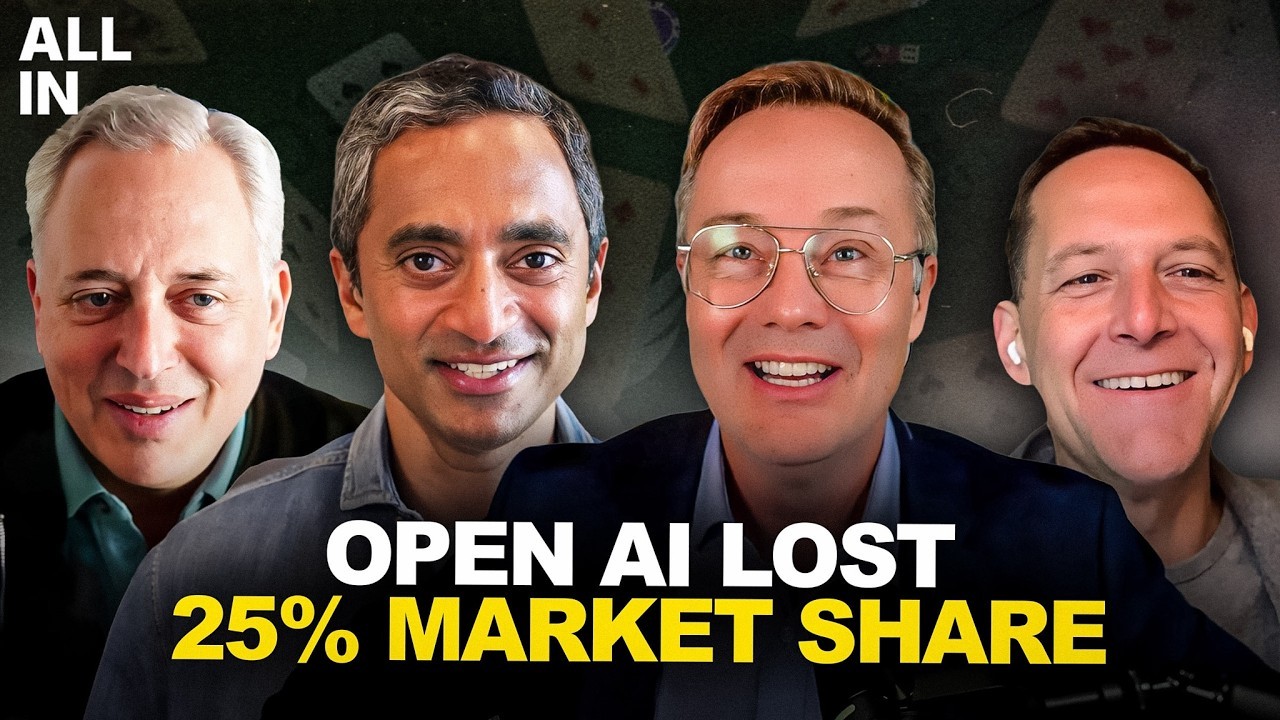
The strongest counter-thesis is that the current AI frontier lab boom mirrors the late-1990s telecom buildout: massive capital expenditure funds infrastructure that ultimately commoditizes, destroying the economics of the builders while enriching the users. Historically, the companies that spent the most building transformative infrastructure (railroads, fiber optic networks, early internet portals) were not the ones that captured the most durable value. The winners were those who built on top of the commoditized layer (Standard Oil used railroads; Google used cheap bandwidth; Amazon used cheap cloud). Today, OpenAI and Anthropic are spending tens of billions on compute, talent, and training runs, while simultaneously facing open-source model parity narrowing (DeepSeek R1 demonstrated frontier-competitive performance at a fraction of the cost), platform incumbents who can bundle AI for free (Google, Apple, Meta), and an enterprise market where the real value accrues to the change-management layer, not the model provider (as Chamath himself noted with the 95% enterprise pilot failure rate). The PE guaranteed-return deal OpenAI offered — guaranteeing 17.5% minimum returns to investors — is a classic late-cycle financing structure that signals the company cannot raise capital on pure equity conviction alone. Meanwhile, the revenue figures being cited are pre-normalization, the consumer moat is eroding quarter over quarter (from 100% to 75% market share in two years), and the enterprise moat depends on switching costs that have not yet been proven durable. The most likely outcome is not that these companies fail, but that they become high-revenue, low-margin utility providers — the AWS of intelligence — generating substantial revenue but never justifying their current $100B-$300B+ private valuations. The value instead accrues to the application layer (vertical AI companies, PE rollups integrating AI into acquired businesses) and to the incumbents who already own distribution and customer relationships. This is not a contrarian view; it is the base-rate outcome for every prior infrastructure buildout cycle in technology history.

//

RISK 01

RISK 01

Consumer AI monetization collapses under free-tier competition from platform incumbents

Consumer AI monetization collapses under free-tier competition from platform incumbents

THESIS

The bull thesis on OpenAI and Anthropic as generational companies assumes sustained willingness-to-pay by consumers and enterprises at current or increasing price points. However, Apple, Google, Meta, and Microsoft all have the incentive, distribution, and financial capacity to offer AI capabilities for free or near-free, subsidized by advertising, hardware margins, or cloud upsell. Google already embeds Gemini into Search at no incremental cost. Apple is shipping AI features natively in iOS. Meta offers Llama as open-source. If consumer AI queries become a commodity layer — free and embedded everywhere — then ChatGPT's consumer subscription model (which represents ~75% of OpenAI's revenue) faces severe margin compression. The 5% paid conversion rate J-Cal cited could decline, not grow, as free alternatives improve. This directly breaks the thesis that consumer AI subscriptions will rival Netflix or Spotify in scale, because those services have exclusive content moats that a commoditized AI inference layer does not.

The bull thesis on OpenAI and Anthropic as generational companies assumes sustained willingness-to-pay by consumers and enterprises at current or increasing price points. However, Apple, Google, Meta, and Microsoft all have the incentive, distribution, and financial capacity to offer AI capabilities for free or near-free, subsidized by advertising, hardware margins, or cloud upsell. Google already embeds Gemini into Search at no incremental cost. Apple is shipping AI features natively in iOS. Meta offers Llama as open-source. If consumer AI queries become a commodity layer — free and embedded everywhere — then ChatGPT's consumer subscription model (which represents ~75% of OpenAI's revenue) faces severe margin compression. The 5% paid conversion rate J-Cal cited could decline, not grow, as free alternatives improve. This directly breaks the thesis that consumer AI subscriptions will rival Netflix or Spotify in scale, because those services have exclusive content moats that a commoditized AI inference layer does not.

DEFENSE

J-Cal explicitly raised this risk, noting Apple, Google, Meta, and Microsoft are underrepresented today but will intercept consumer share and push ChatGPT well under 50%. Chamath partially defended by arguing consumer mind share and switching costs (kids default to ChatGPT) provide durability. Freeberg defended by arguing consumer AI will be so valuable it commands subscription pricing akin to cell phone bills. However, none of them resolved the fundamental tension that platform owners with existing distribution can bundle AI for free, which historically destroys standalone subscription businesses.

J-Cal explicitly raised this risk, noting Apple, Google, Meta, and Microsoft are underrepresented today but will intercept consumer share and push ChatGPT well under 50%. Chamath partially defended by arguing consumer mind share and switching costs (kids default to ChatGPT) provide durability. Freeberg defended by arguing consumer AI will be so valuable it commands subscription pricing akin to cell phone bills. However, none of them resolved the fundamental tension that platform owners with existing distribution can bundle AI for free, which historically destroys standalone subscription businesses.

//

RISK 02

RISK 02

Revenue recognition opacity masks true competitive positioning and inflates perceived momentum

Revenue recognition opacity masks true competitive positioning and inflates perceived momentum

THESIS

Chamath flagged that Anthropic and OpenAI use fundamentally different revenue recognition methodologies — OpenAI counts conservative consumer subscription revenue while Anthropic reports gross API tonnage. The market and press are comparing incomparable numbers to manufacture narratives about who is winning. This creates a scenario where investors allocate capital based on misleading growth metrics. If Anthropic's $6 billion ARR figure includes substantial pre-committed API credits, usage-based revenue with high churn, or gross billings that overstate net revenue, then the company's true economic trajectory could be materially worse than headlines suggest. Similarly, if OpenAI's consumer revenue faces the free-tier compression described above, its more conservative accounting may actually be hiding a faster decline in unit economics. Neither company is public, so there is no standardized audit forcing apples-to-apples disclosure. This is a classic pre-IPO information asymmetry risk that could result in massive valuation corrections at the point of public listing.

Chamath flagged that Anthropic and OpenAI use fundamentally different revenue recognition methodologies — OpenAI counts conservative consumer subscription revenue while Anthropic reports gross API tonnage. The market and press are comparing incomparable numbers to manufacture narratives about who is winning. This creates a scenario where investors allocate capital based on misleading growth metrics. If Anthropic's $6 billion ARR figure includes substantial pre-committed API credits, usage-based revenue with high churn, or gross billings that overstate net revenue, then the company's true economic trajectory could be materially worse than headlines suggest. Similarly, if OpenAI's consumer revenue faces the free-tier compression described above, its more conservative accounting may actually be hiding a faster decline in unit economics. Neither company is public, so there is no standardized audit forcing apples-to-apples disclosure. This is a classic pre-IPO information asymmetry risk that could result in massive valuation corrections at the point of public listing.

DEFENSE

Chamath directly identified and explained this risk in detail, noting the revenue recognition differences and warning that press narratives of one overtaking the other are misleading. He predicted that by the time these companies go public, revenue recognition will be normalized. However, this defense is forward-looking and speculative — the risk remains live for all current private market investors and for any strategic decisions being made based on current reported ARR figures.

Chamath directly identified and explained this risk in detail, noting the revenue recognition differences and warning that press narratives of one overtaking the other are misleading. He predicted that by the time these companies go public, revenue recognition will be normalized. However, this defense is forward-looking and speculative — the risk remains live for all current private market investors and for any strategic decisions being made based on current reported ARR figures.

//

RISK 03

RISK 03

SaaS and software valuation rerating signals that AI-era businesses may never achieve durable cash flow multiples

SaaS and software valuation rerating signals that AI-era businesses may never achieve durable cash flow multiples

THESIS

Chamath presented data showing SaaS company valuations collapsing from ~100x free cash flow payback periods to ~50x or lower, while Mag-6 companies are simultaneously rerated upward. He framed this as the market pricing in the possibility of superintelligence making every business fragile and disruptable on 5-6 year cycles. If this thesis is correct, it has devastating implications for the AI frontier labs themselves. OpenAI and Anthropic are currently valued at $300B+ and $100B+ respectively in private markets — valuations that assume they will become the next Mag-7 incumbents with durable monopolistic cash flows. But if AI itself accelerates disruption cycles, then the frontier labs are equally vulnerable. Open-source models (DeepSeek, Llama) could commoditize inference. New architectural paradigms could leapfrog transformers. The very 'super intelligence on the horizon' narrative that justifies high AI company valuations simultaneously undermines the durability of any specific AI company's competitive position. This is a logical contradiction at the heart of the investment thesis: you cannot simultaneously believe AI disrupts everything AND that specific AI companies will sustain monopoly-like margins for decades.

Chamath presented data showing SaaS company valuations collapsing from ~100x free cash flow payback periods to ~50x or lower, while Mag-6 companies are simultaneously rerated upward. He framed this as the market pricing in the possibility of superintelligence making every business fragile and disruptable on 5-6 year cycles. If this thesis is correct, it has devastating implications for the AI frontier labs themselves. OpenAI and Anthropic are currently valued at $300B+ and $100B+ respectively in private markets — valuations that assume they will become the next Mag-7 incumbents with durable monopolistic cash flows. But if AI itself accelerates disruption cycles, then the frontier labs are equally vulnerable. Open-source models (DeepSeek, Llama) could commoditize inference. New architectural paradigms could leapfrog transformers. The very 'super intelligence on the horizon' narrative that justifies high AI company valuations simultaneously undermines the durability of any specific AI company's competitive position. This is a logical contradiction at the heart of the investment thesis: you cannot simultaneously believe AI disrupts everything AND that specific AI companies will sustain monopoly-like margins for decades.

DEFENSE

Chamath raised the SaaS rerating and the philosophical question of 'what is anything worth if superintelligence arrives,' but neither he nor any other speaker applied this logic reflexively to OpenAI or Anthropic themselves. The entire discussion treated the frontier AI labs as the disruptors rather than the disrupted. No one addressed the possibility that the same forces compressing SaaS multiples — rapid technological obsolescence, open-source commoditization, shifting architectural paradigms — could apply to the frontier labs within the same timeframe. The speakers assumed a stable oligopoly of 2-3 frontier labs, but provided no structural argument for why this oligopoly would persist in an era defined by accelerating disruption.

Chamath raised the SaaS rerating and the philosophical question of 'what is anything worth if superintelligence arrives,' but neither he nor any other speaker applied this logic reflexively to OpenAI or Anthropic themselves. The entire discussion treated the frontier AI labs as the disruptors rather than the disrupted. No one addressed the possibility that the same forces compressing SaaS multiples — rapid technological obsolescence, open-source commoditization, shifting architectural paradigms — could apply to the frontier labs within the same timeframe. The speakers assumed a stable oligopoly of 2-3 frontier labs, but provided no structural argument for why this oligopoly would persist in an era defined by accelerating disruption.

//

ASYMMETRIC SKEW

Downside is structurally underappreciated relative to upside. The upside case requires frontier AI labs to simultaneously maintain technological leadership against open-source commoditization, win enterprise adoption against incumbents with existing customer relationships, sustain consumer willingness-to-pay against free alternatives from Apple/Google/Meta, and avoid the valuation compression their own disruption narrative implies for every other software company. The downside case only requires one of these assumptions to break: model commoditization alone could compress margins to utility-like levels, wiping 60-80% of current private market valuations. The speakers themselves acknowledged consumer market share declining from 100% to 75% in two years, SaaS valuations collapsing, and 95% of enterprise AI pilots failing — yet none applied these observations to the frontier labs' own trajectory. The skew is approximately 2:1 downside-to-upside on a risk-adjusted basis at current private market valuations.

ALPHA

NOISE

The Consensus

The market broadly believes we are in an AI-driven transformation where frontier model companies (OpenAI, Anthropic, Google) will all grow massively, that consumer AI will be the dominant revenue driver with ChatGPT as the clear leader, that SaaS companies retain durable value through their installed bases, and that the Mag 7 tech giants face potential disruption from AI startups. The consensus also holds that AI model providers will converge on similar product offerings and compete head-to-head across consumer and enterprise, and that current valuations of high-growth software companies are broadly justified by long-term cash flow expectations.

The market's logic is linear: frontier AI labs build better models → models get adopted by consumers and enterprises → revenue grows → valuations rise proportionally. SaaS companies with existing customer bases will adapt by integrating AI features. Consumer AI is a winner-take-most market where ChatGPT's brand and first-mover advantage creates durable market share. The Mag 7 face disruption risk from AI-native startups.

SIGNAL

The Variant

The speakers collectively argue several contrarian positions: (1) Chamath contends that OpenAI and Anthropic are NOT in direct competition yet — they are fundamentally different businesses with different go-to-market motions, different revenue recognition approaches, and the media narrative pitting them against each other is manufactured drama, not reality. (2) The group believes SaaS valuations are undergoing a structural permanent re-rating downward — not a cyclical correction — because the prospect of superintelligence fundamentally undermines the assumption of durable long-term cash flows for ANY software business. (3) Chamath argues brands as a moat are going to zero, replaced by value abundance as the dominant competitive advantage. (4) Sacks argues Google is actually in the BEST position for consumer AI agents because of pre-existing trust and data access, which is contrarian to the view that Google is a legacy search company being disrupted. (5) The group believes the Mag 6 are being irrationally bid UP (market treating their cash flows as monopolistically durable forever) while Nvidia is being irrationally treated DOWN despite being the most accretive business of the group — a valuation anomaly the market hasn't recognized.

The speakers' causal logic is fundamentally different: (1) Chamath argues the real question is not 'who wins the AI model race' but 'what is ANYTHING worth if superintelligence actually arrives?' — because if superintelligence creates constant disruption cycles every 5-6 years, then terminal value assumptions collapse for all companies, PE ratios should compress universally, and the entire equity valuation framework breaks down. This is visible first in SaaS (the canary in the coal mine) but will spread. (2) The knock-on effect is that startup equity compensation becomes irrational — employees will demand cash over equity because long-term equity upside becomes uncertain, which then further compresses startup valuations in a reflexive loop. (3) Sacks argues consumer AI market share numbers are misleading because the total market is expanding so rapidly that declining percentage share can coexist with massive absolute growth — the pie-expansion dynamic matters more than share. (4) Freeberg argues that individual responsibility and parental agency, not product liability litigation, is the correct causal frame for social media harms — and that the tort litigation industry ($900B/year, 3% of GDP) is a parasitic tax that reduces R&D investment and innovation, creating second-order economic harm that exceeds the harm it purports to remedy. (5) On the geopolitical dimension, Freeberg argues China's scientific output has gone from 50% of US levels to 150% in a decade, making this an industrial race where builder-practitioners on PCAST matter more than pure academics.

SOURCE OF THE EDGE

The speakers' edge is genuine and multi-layered but not uniform in credibility. Chamath has a real operational edge from running 8090, an enterprise software factory that is a direct customer of Anthropic's API — he has firsthand visibility into enterprise AI adoption patterns, token consumption economics, and the actual difficulty of deploying AI in large organizations. His observation that 95% of enterprise AI pilots fail and that enterprises want 'strangulation as a service' (abstracting away UI complexity) comes from direct customer conversations, not theory. This is a high-credibility structural informational advantage. Sacks has genuine policy-insider edge from his roles as former AI/crypto czar and now PCAST co-chair — he has direct visibility into how the administration thinks about AI regulation, age verification, and the Anthropic-Pentagon dispute dynamics. His claim that Anthropic employs 'brass knuckle political operatives' is presented as insider knowledge but is harder to verify and carries the risk of being colored by his documented adversarial relationship with the company. Freeberg has operational edge from building Ohalo (biotech) and deep science background, giving him credibility on PCAST composition and the China research competition data. His tort litigation analysis ($900B figure) is publicly available data being applied with an ideological frame — it's a narrative construction rather than proprietary insight. On the consumer AI market share analysis and the SaaS valuation re-rating thesis, the edge is more analytical than informational — these are smart people synthesizing public data through experienced lenses, but a sophisticated investor could arrive at similar conclusions independently. The weakest claimed edge is the prediction that brands go to zero — Chamath presents this as conviction but supports it with a narrow set of examples (Tesla vs. BMW, LVMH stock decline) that could easily be explained by cyclical factors rather than structural brand erosion. Overall, the genuine structural edges are: Chamath's enterprise AI deployment visibility, Sacks' policy-insider position, and the group's collective pattern recognition from decades of company-building. The weaker edges are the macro valuation framework (which is speculative) and the brand-erosion thesis (which cherry-picks supporting evidence).

//

CONVICTION DETECTED

• "It's head and shoulders above anything else" (Chamath on Anthropic's technical team) • "I wake up every day and my head spins" (Chamath on the pace of AI change) • "Every day feels like a new era right now" (Chamath) • "I think brands go to zero" (Chamath) • "Nobody's going to pay a premium for these products" (Chamath on branded goods vs. value) • "No good comes out of kids under 16 using social media" (Jamath/J-Cal) • "It's existential to them" (Sacks on Google competing for consumer AI) • "This wave feels like a hundred times bigger than that" (Chamath comparing AI to mobile/social) • "I don't think it's going to be free" (Freeberg on consumer AI pricing) • "We never talk about responsibility" (Freeberg on personal agency) • "China could end up engulfing the entire pharmaceutical industry" (Freeberg) • "If you can make an enterprise business work, it's always been a model I've liked" (Sacks) • "These are two totally different conversations" (Chamath on OpenAI vs. Anthropic revenue comparisons) • "I think we've opened the floodgates" (Chamath on tort litigation precedent)

//

HEDGE DETECTED

• "I'm not sure" (Sacks on whether Anthropic's coding bet was for business or ideological reasons) • "Their motives for doing that may be pure. It may not be regulatory capture. It may be ideologically motivated" (Sacks hedging on Anthropic's regulatory strategy) • "I think it's possible that you could get a few hundred million subscribers" (Sacks on consumer AI) • "Hard to say" (Sacks on whether phone OS gets disrupted by agents) • "I'm not saying this is going to happen, but I'll just throw out a counterfactual" (Sacks on Apple disruption) • "I can't explain this" (Chamath on the Mag 7 vs. SaaS valuation divergence) • "I don't know what to tell you" (Chamath on his kids' behavior after social media use) • "It's very hard to know which of these companies going to be disrupted" (Sacks) • "I think it's more on the side of unclear, that's just me" (Sacks on social media harms) • "I think it's much more unclear what the harms are and what the benefits are" (Sacks on social media vs. smoking) • "I don't know" (Sacks on whether Apple will succeed with AI Siri) • "We just don't know" (Freeberg on discount rates and AI disruption) The ratio of conviction to hedging reveals a distinctive and credible pattern: the speakers deploy high conviction on topics where they have direct operational experience (enterprise AI deployment, policy dynamics, company-building) and hedge meaningfully on areas requiring prediction about uncertain futures (consumer market structure, which companies get disrupted, valuation endpoints). This is the signature of practitioners who distinguish between what they know from doing versus what they're speculating about. The hedging is concentrated on macro predictions and the conviction is concentrated on micro-operational observations, which is the correct epistemic posture for operators. This suggests the operational claims deserve significant weight while the macro framework (superintelligence disrupting everything, brands going to zero) should be treated as directionally interesting but speculative hypothesis rather than high-confidence prediction.